Quant Market Brief — August 28, 2026
Research cutoff: August 28, 2026, 6:32 a.m. CT (11:32 UTC). Premarket readings are indicative and may be delayed. Prior-close data are identified below.
1. Anthropic previews a hardware standard for AI agents
Credit: original Market State Lab AI graphic.
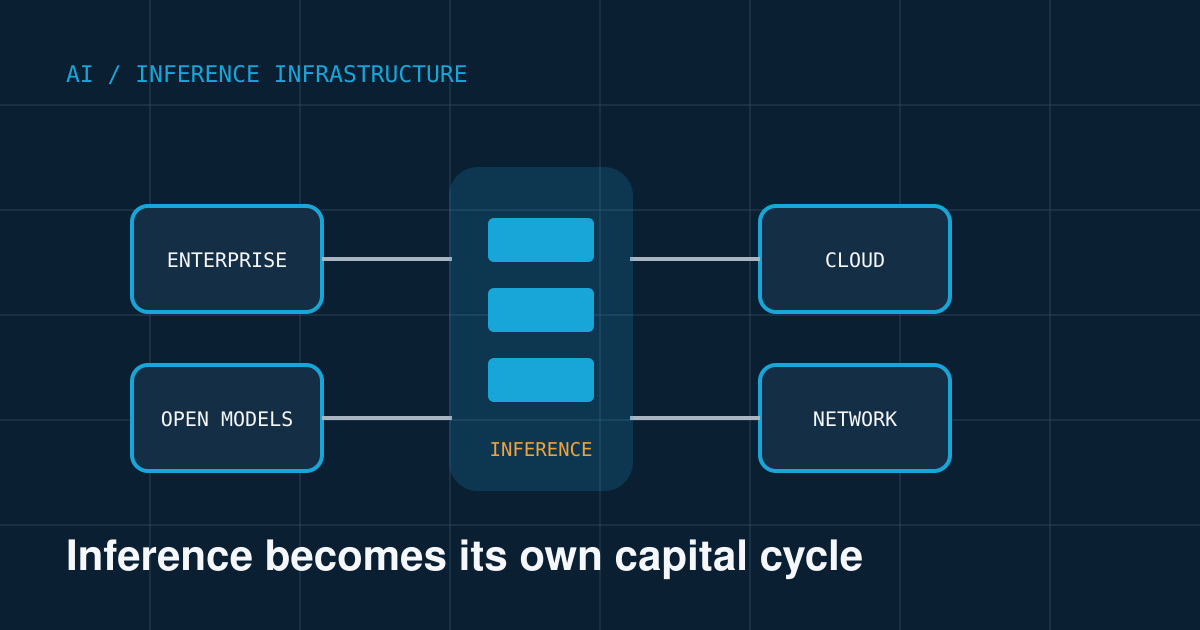
Fact: Anthropic opened a research preview of the Model Hardware Standard on August 27. The model-agnostic specification uses standardized drivers and simple read/write primitives so AI agents can discover and operate programmable laboratory and manufacturing devices. Anthropic said it is working with early partners on safety evaluations before an open-source release. Anthropic announcement
Inference: MHS extends the tool-interface idea behind MCP from software services to physical systems, potentially reducing custom integration work while increasing the consequences of unsafe agent actions.
Uncertainty: MHS is an early preview. Anthropic’s integration-time claims are company-reported, and independent evidence on reliability, interoperability, failure recovery, and cyber-physical safety is not yet available.
Why it matters: The same design principle applies to MATLAB trading agents: expose typed, narrow commands; separate observation from actuation; validate every action against hard risk rules; and require logs, simulation tests, permission boundaries, and emergency stops before live execution.
2. Cboe’s extended equity-option hours create a separate liquidity regime
Credit: original Market State Lab quantitative-finance graphic.
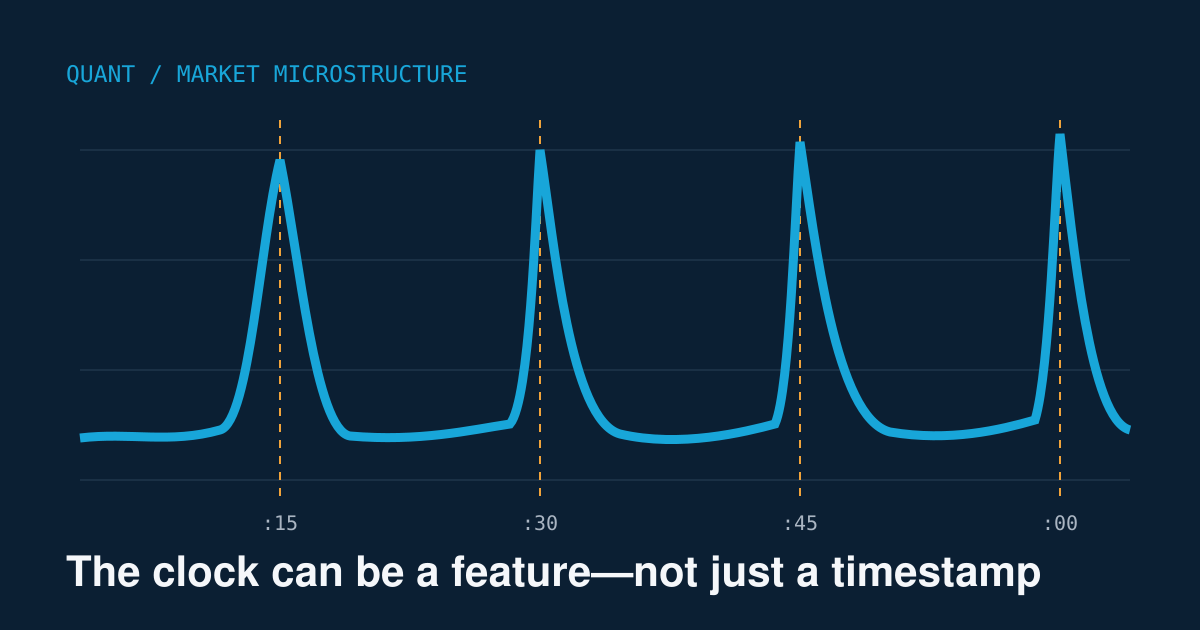
Fact: Cboe Options Exchange began morning Global Trading Hours for selected single-stock options on August 17. The session runs from 7:30 to 9:25 a.m. ET, followed by regular hours and a 4:00–4:15 p.m. curb session. The anticipated list includes NVDA, AMD, AVGO, MU, MSFT, META, AMZN, and other actively traded names. Market and stop orders are not allowed in the extended sessions. Cboe schedule notice
Inference: Premarket options can improve event hedging, but their price discovery, spreads, depth, and queue behavior may differ materially from regular-hours markets—especially after earnings.
Uncertainty: Reliable consolidated volume, spread, and depth evidence for the new sessions was not available at the cutoff. Symbol eligibility can change, and an exchange session is not proof of executable liquidity.
Why it matters: Treat Global Trading Hours, the regular opening rotation, and the curb as separate execution regimes. In MATLAB, tag every quote by session, reject stale or one-sided markets, and fit transaction-cost and fill models independently before using extended-hours options in backtests or live hedges.
3. S&P 500 and Nasdaq futures soften before Warsh’s speech
Credit: original Market State Lab U.S. markets graphic.
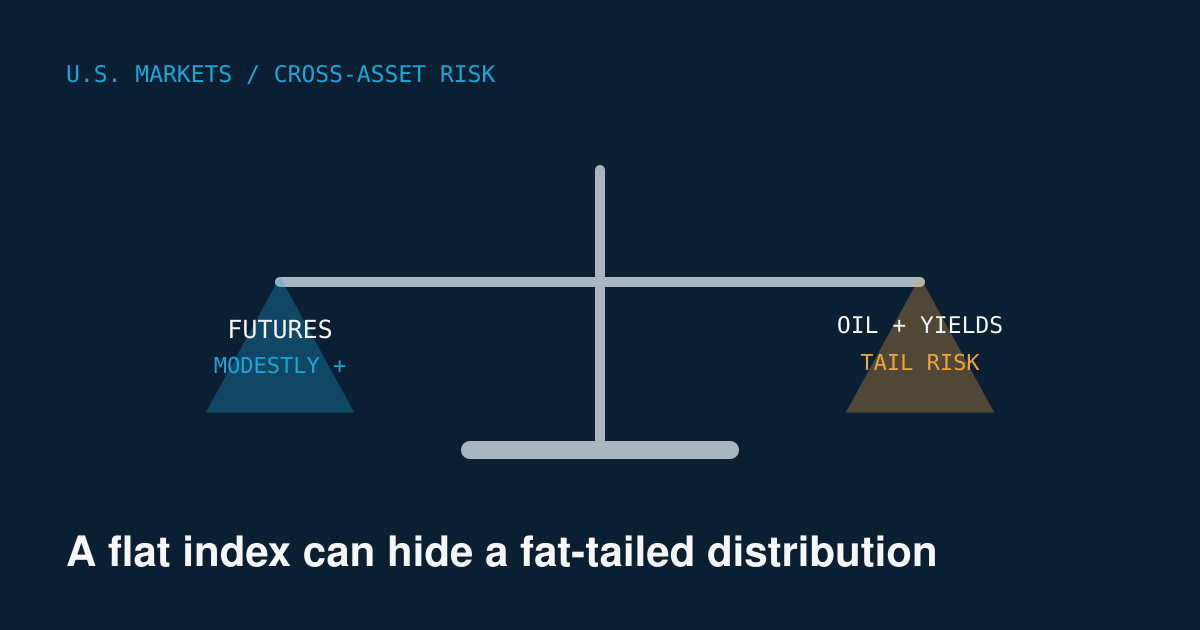
Fact: At 4:46 a.m. CT, Dow E-minis were up 0.11%, S&P 500 E-minis down 0.06%, and Nasdaq-100 E-minis down 0.32%. Nvidia was down 1% premarket, while Micron and Intel were each down 2.2% following Thursday’s technology-led rally. Reuters, August 28
Inference: The pullback looks more like event-risk compression and semiconductor profit-taking than a confirmed broad risk-off regime.
Uncertainty: Futures readings were indicative and may be delayed. Consolidated ETF spreads, futures depth and volume, opening imbalances, and dealer gamma were not independently verified.
Why it matters: Avoid extrapolating Thursday’s QQQ momentum into Friday’s open. Gate participation on NQ–ES relative strength, breadth, Treasury yields, auction imbalance, and observed slippage; reassess after the speech rather than forcing one full-day execution model.
4. Warsh’s Jackson Hole debut becomes a reaction-function test
Credit: original Market State Lab Federal Reserve graphic.
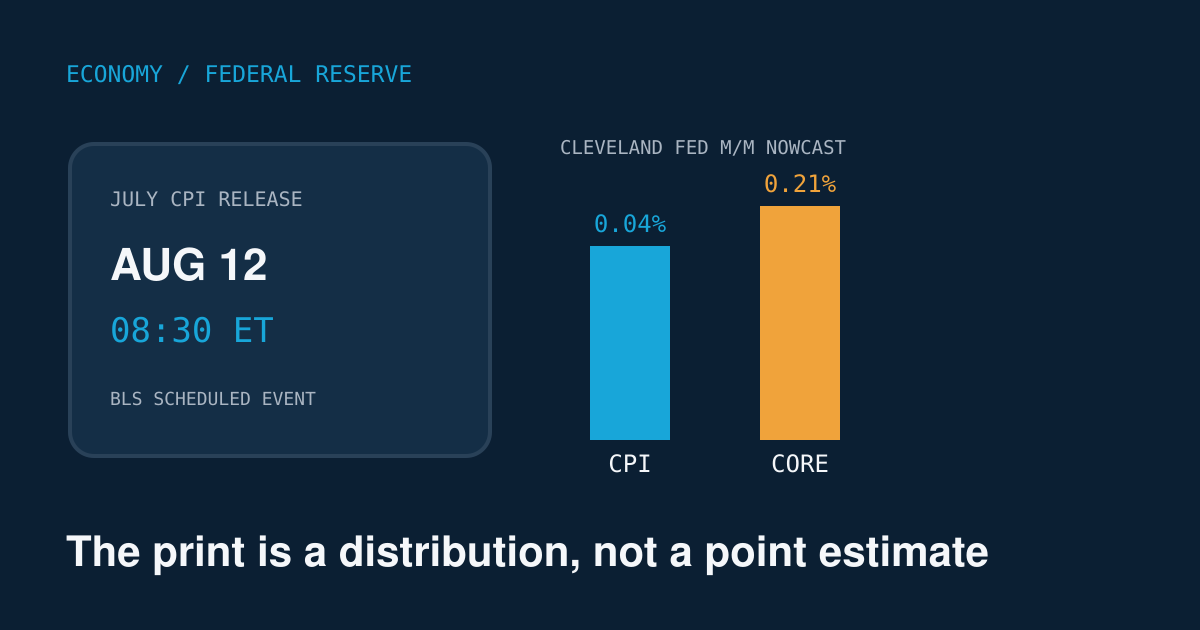
Fact: Federal Reserve Chair Kevin Warsh is scheduled to speak at 9:00 a.m. CT on August 28. The policy rate has remained at 3.50%–3.75% since December, July PCE inflation was 3.7% year over year, and several Fed officials have argued that rates may need to rise. Markets assigned a 33% probability to a September increase before the speech. Reuters, August 28
Inference: The market may respond less to a specific September signal than to Warsh’s description of which data would trigger tightening and how he separates monetary policy from Treasury-market support.
Uncertainty: Warsh had not spoken at the cutoff. Market-implied probabilities can change rapidly and are not forecasts or FOMC commitments.
Why it matters: Maintain separate hold, conditional-hike, and communication-shock states. Model expected policy rates, term premium, Treasury supply, and market-functioning interventions independently; do not collapse them into a single yield feature.
5. Marvell’s forecast rises, but Google-chip revenue timing disappoints
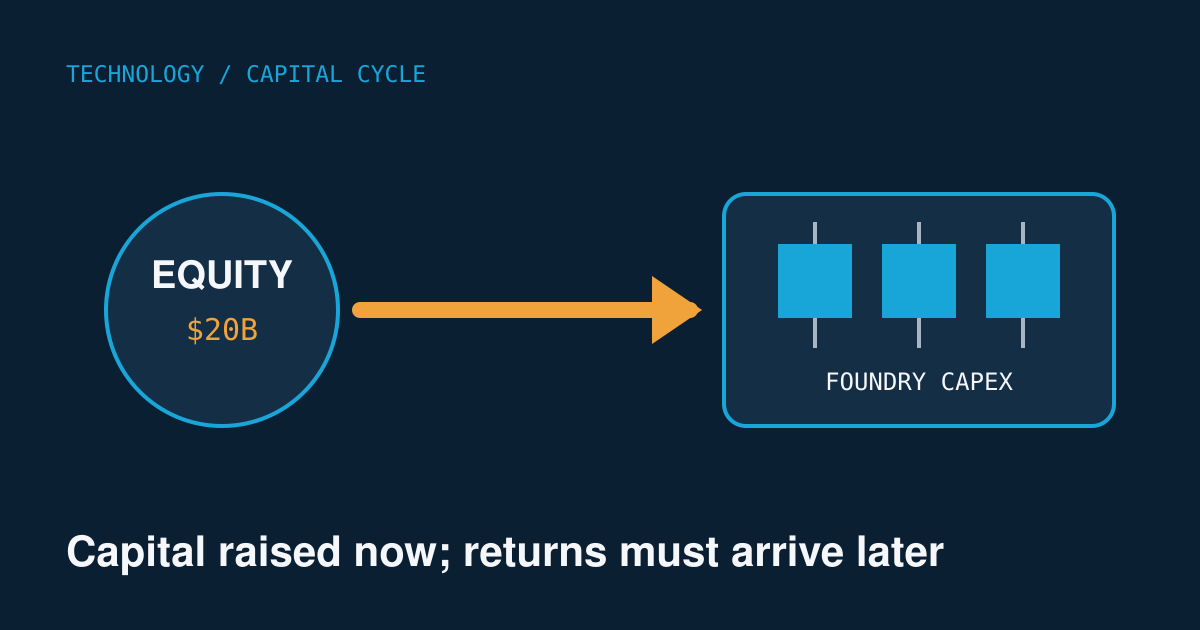
Credit: original Market State Lab technology/business graphic.
Fact: Marvell raised its fiscal-2027 revenue forecast to about $12 billion and its fiscal-2028 forecast to about $18 billion. Its shares nevertheless fell 8% premarket after management said revenue from its Google custom-chip agreement would become much more significant in fiscal 2029; analysts said much of the near-term contribution was already embedded in guidance. Reuters, August 28
Inference: AI-infrastructure valuations are increasingly sensitive to the timing and incremental economics of contracted demand, not merely the headline size of a partnership.
Uncertainty: Premarket prices can reverse, long-range guidance is uncertain, and the Google agreement’s realized revenue, margins, customer concentration, and execution costs remain unknown.
Why it matters: Separate backlog or framework-agreement value from recognized revenue. Track forecast revisions, timing, gross margin, customer concentration, capital needs, and free-cash-flow conversion when comparing custom-silicon beneficiaries.
Quant & Market Dashboard
Overnight liquidity and funding
- Futures and ETFs: At 4:46 a.m. CT, Dow E-minis were +0.11%, S&P 500 E-minis −0.06%, and Nasdaq-100 E-minis −0.32%. QQQ was indicated −0.16% at 6:30 a.m. CT on a reported 258,967 premarket shares. These readings were indicative and may be delayed. Consolidated ETF spreads, futures volume, order-book depth, and auction imbalances were unavailable. Reuters, QQQ market data
- Prior-session liquidity: August 27 volume was approximately 34.0 million SPY shares and 28.6 million QQQ shares. Both indexes rose, but the new information set—weekly expiry and the Warsh speech—makes prior-close depth a weak proxy for today’s executable liquidity. SPY history, QQQ history
- Treasuries: The August 27 indicative Treasury par curve showed 2-year 4.20%, 10-year 4.67%, and 30-year 5.19%, each 1 basis point above August 26. These are bid-side curve estimates near 3:30 p.m. ET, not transaction prices. U.S. Treasury
- Volatility: VIX closed August 27 at 14.51. September, October, and November VX settled at 16.6614, 18.5279, and 19.3117, respectively—clear contango and no stress signal in the prior close. VIX history, Cboe settlements
- Funding: At the cutoff, the latest published observations were August 26 SOFR at 3.64% and EFFR at 3.63%; August 27 overnight rates were not yet released. SOFR, EFFR
Volatility regime
Moderate, medium confidence. Prior-close VIX was low and the VX curve was in contango, but today combines weekly expiry, a major Fed speech, semiconductor dispersion, and elevated long yields. Low index volatility therefore coexists with meaningful opening, cross-sectional, and event-gap risk.
Factor performance proxies
| Factor | ETF proxy | Aug. 27 | Four calendar weeks* |
|---|---|---|---|
| Momentum | MTUM | +0.08% | +1.83% |
| Value | VLUE | −0.27% | +4.12% |
| Quality | QUAL | +0.35% | +2.59% |
| Size | IWM | +0.29% | +2.47% |
| Growth | IWF | +1.76% | +5.50% |
| Low volatility | SPLV | −1.00% | −1.65% |
*August 27 close versus July 30 close. Split-adjusted ETF price proxies excluding dividends; they are not pure-factor total returns. Sources: MTUM, VLUE, QUAL, IWM, IWF, SPLV.
Interpretation: Growth dominated Thursday and leads the four-week window; value, quality, and size are also positive over four weeks, while low volatility lags. This is broad medium-horizon risk appetite with a strong latest-session growth tilt—not a clean single-factor market.
Execution-risk notes and microstructure implications
- Treat the opening auction and the 9:00 a.m. CT speech as separate price-discovery events. Reduce carryover assumptions between the two.
- Use auction-aware limits, participation caps, fresh depth checks, and realized-slippage kill switches; delay aggressive size when breadth and the NQ–ES spread disagree.
- Rebuild SPY, QQQ, NVDA, and semiconductor implied-volatility, skew, open-interest, and strike-liquidity maps after the open and again after the speech.
- Friday weekly expiry can amplify hedging flows near concentrated strikes, but dealer gamma direction was not verified. Treat any pinning or acceleration thesis as conditional.
- Cboe’s morning single-stock option session is a separate liquidity pool. Do not blend its quotes, spreads, or fill rates with regular-hours observations.
- Reject stale, crossed, zero-bid, one-sided, or thin options quotes and flag underlying prices that are outside the relevant session.
Watchlist: SPY, QQQ, IWM, TLT, VIX, MTUM, VLUE, QUAL, IWF, SPLV, NVDA, SMH, SOXX, MRVL, MU, INTC, AVGO, GOOGL, ES, NQ, VX.
DRL Improvements for the MATLAB System
- Add session identifier, event countdown, NQ–ES spread, VX slope, yield-curve change, breadth, quote age, and auction-state inputs; mask features that are unavailable in deployment.
- Enforce drawdown, concentration, liquidity, turnover, and daily-loss constraints outside the reward. Penalize downside risk, unstable switching, and implementation shortfall inside the reward.
- Randomize extended-hours spreads, partial fills, quote staleness, opening rotations, speech-time jumps, expiry pinning, latency, and nonlinear impact across calm and stressed regimes.
- Use purged, embargoed walk-forward testing with frozen baselines, multiple random seeds, regime-specific scorecards, and untouched earnings/Fed event blocks.
Model hygiene
Control target and feature leakage, survivorship bias, look-ahead bias, timestamp and session alignment, corporate actions, stale options quotes, crossed markets, and multiple testing. Calibrate probabilities out of sample, retain rejected trials, and monitor feature, calibration, policy, transaction-cost, and regime drift.
MATLAB optimization patterns
- Use
timetable,retime, andsynchronizeto align sessions, releases, and quote-availability timestamps without forward-filling unavailable information. - Vectorize rolling features, preallocate replay buffers, and profile memory copies and environment steps before parallelizing.
- Run parallel
bayesoptonly across independent purged folds; reserve a final untouched evaluation and use reproducible random streams. - Use GPUs for sufficiently large neural-network batches, not small branching execution logic; keep the environment, cost model, constraints, and agent modular.
High-value quant research question
Does the interaction of the pre-speech NQ–ES spread, VX slope, and 30-year-yield change predict QQQ post-speech continuation versus reversal after auction, weekly-expiry, and realistic option-hedging costs?
It is worth testing because it targets a specific event-window execution decision and forces the model to distinguish overnight information, policy communication, and expiry-related liquidity effects.
Disclosure
Market State Lab is research and education, not individualized financial advice. Premarket data may be delayed or indicative. ETF factor proxies are simplified price measures. Futures, options, and leveraged strategies can lose more than expected, and historical or simulated results do not ensure future performance.