Quant Market Brief — October 12, 2026: Options Exits & Inflation-Week Execution
Research cutoff: October 12, 2026, 6:30 a.m. CT. Futures are indicative; ETF, volatility and Treasury observations below are prior-close or lagged, not live executable quotes.
Get Quant Market Brief by email.
1. HCLTech and Anthropic target enterprise agent deployment
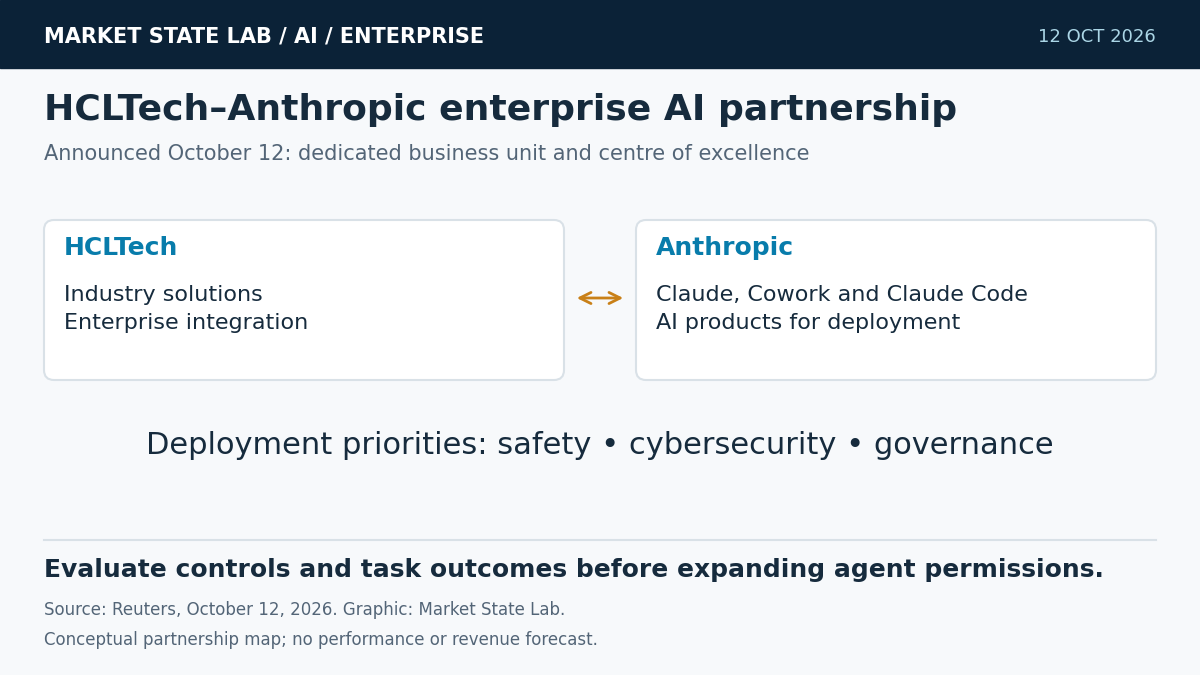
Graphic: Market State Lab. Conceptual map based on Reuters, October 12; no performance forecast.
Fact: HCLTech announced an Anthropic partnership and a dedicated business unit and centre of excellence for agentic AI, emphasizing safety, cybersecurity and governance. Reuters, October 12
Inference: Enterprise adoption depends on integration and controls as well as model capability.
Uncertainty: Deployment outcomes and commercial returns are unproven.
Why it matters: Benchmark MATLAB-connected agents on task completion, permissions, audit trails and recovery before expanding access.
2. Options-exit research puts supervised learning before RL
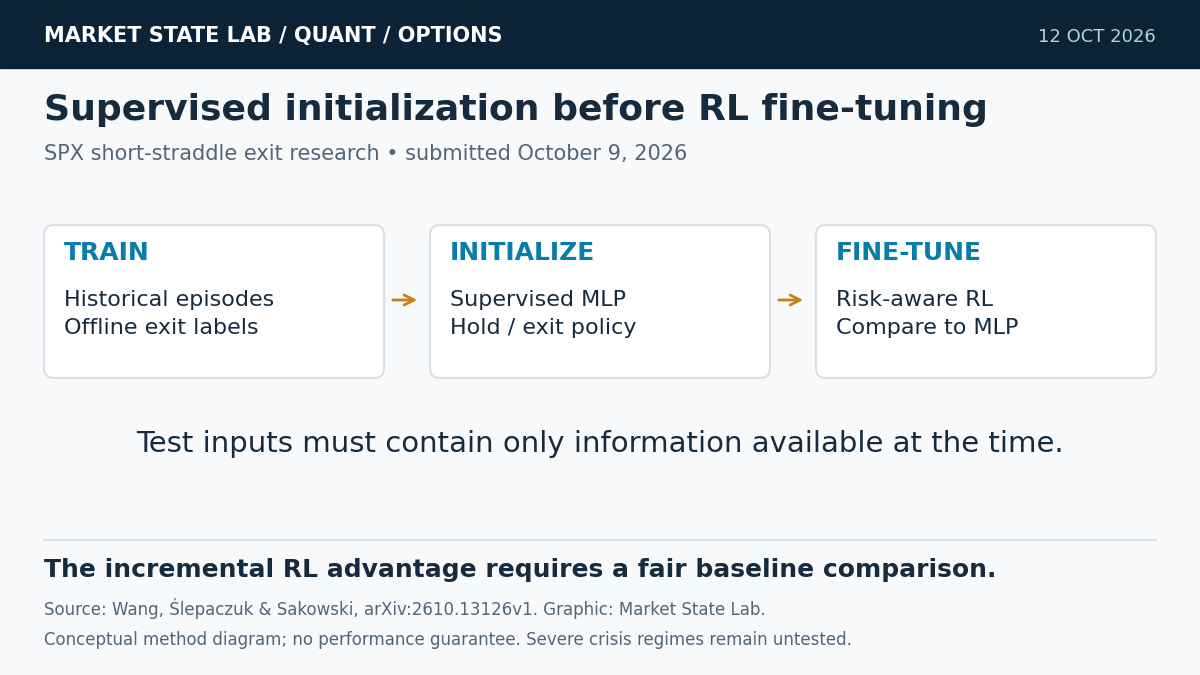
Graphic: Market State Lab. Conceptual method diagram based on Wang, Ślepaczuk and Sakowski, October 9.
Fact: An October 9 paper initializes SPX short-straddle exit policies with a supervised MLP, then fine-tunes using Actor–Critic. Authors report modest average improvement over the MLP; the equal-notional episode-level increment is not statistically significant. Paper and limitations
Inference: A strong supervised baseline may contribute more than additional RL complexity.
Uncertainty: Results are not independently replicated; licensed data, synthetic continuation states and missing severe-crisis regimes limit generalization.
Why it matters: Compare MLP-only, initialized RL and fixed exits on identical purged episodes. Keep future-derived training labels entirely outside test inputs. This does not establish safety for uncovered options selling.
3. Futures are mixed before earnings and inflation tests
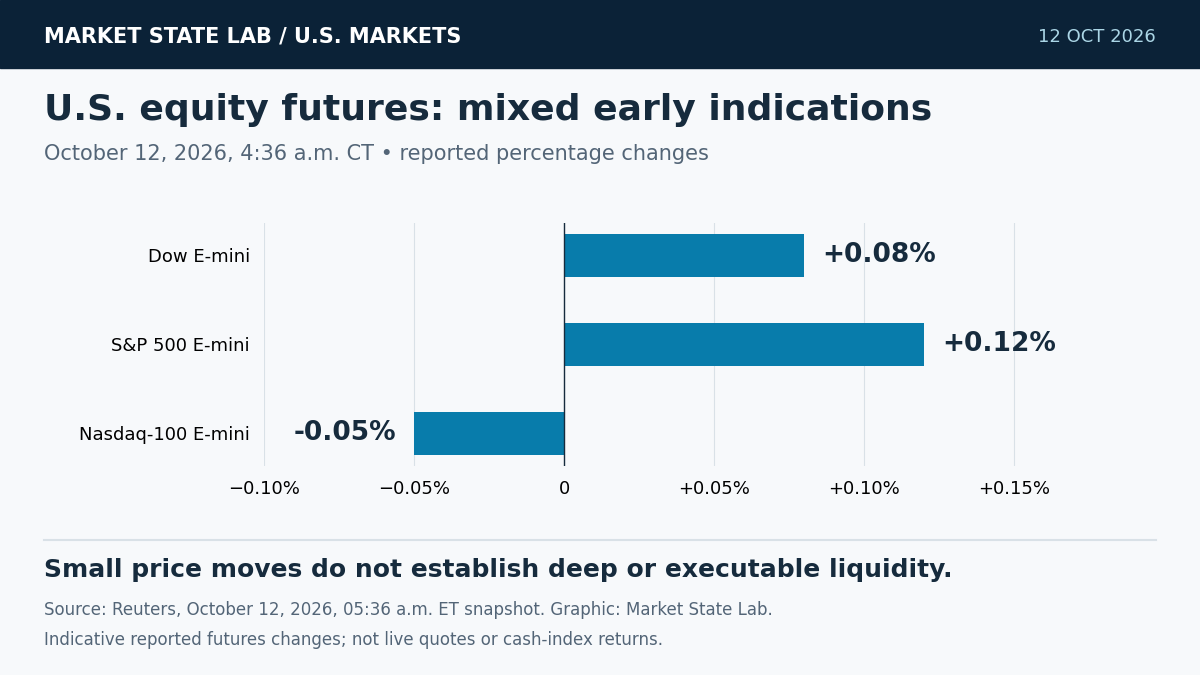
Graphic: Market State Lab. Reuters 05:36 a.m. ET snapshot; indicative changes, not cash-index returns.
Fact: At 4:36 a.m. CT, Dow E-minis were +0.08%, S&P 500 E-minis +0.12% and Nasdaq-100 E-minis −0.05%. Brent remained above $100 ahead of bank earnings and inflation data. Reuters, October 12
Inference: Mixed index direction offers little evidence of broad risk appetite.
Uncertainty: Executable spreads, depth and consolidated overnight volume were not verified.
Why it matters: Gate opening participation on current liquidity, breadth and NQ–ES relative strength.
4. Inflation-release sequence starts Wednesday
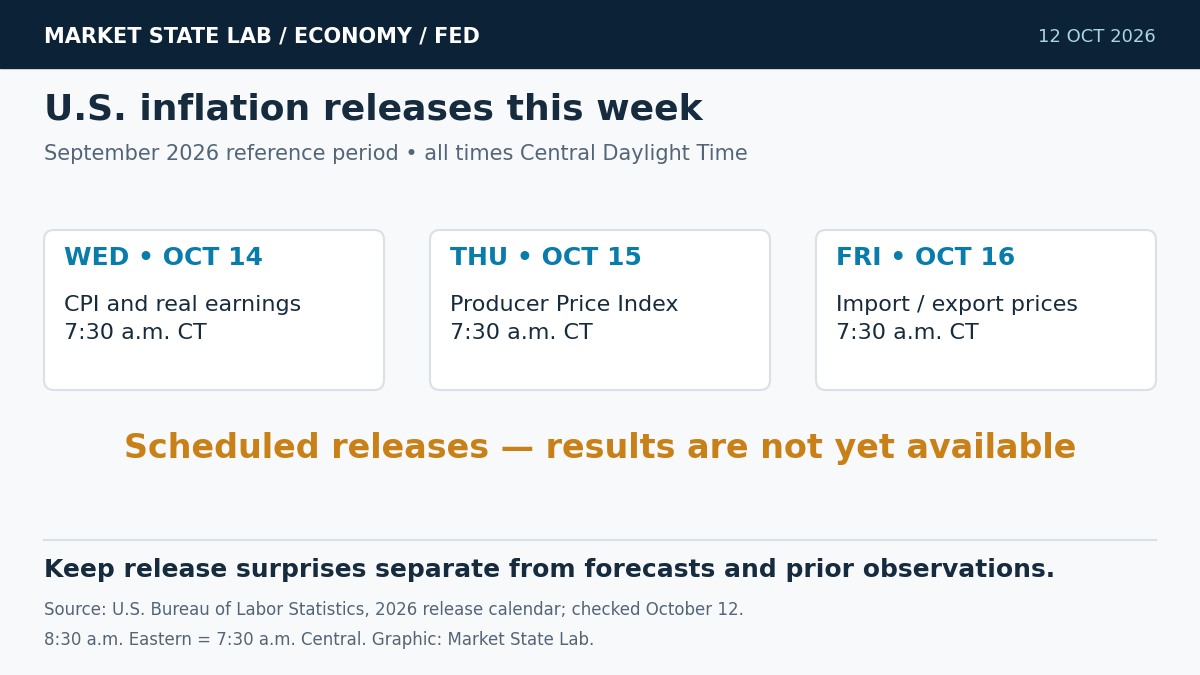
Graphic: Market State Lab. Source: BLS 2026 calendar, checked October 12. Scheduled releases; outcomes unknown.
Fact: BLS schedules September CPI and real earnings for October 14, PPI for October 15, and import/export prices for October 16, all at 7:30 a.m. CT. BLS calendar
Inference: Sequential releases can change rate expectations and invalidate an earlier volatility surface.
Uncertainty: These are scheduled events, not released results; no inflation surprise or Fed response is known.
Why it matters: Freeze pre-release forecasts, timestamp surprises, and separate headline, core and component responses in event studies.
5. Tencent prepares a large bond offering
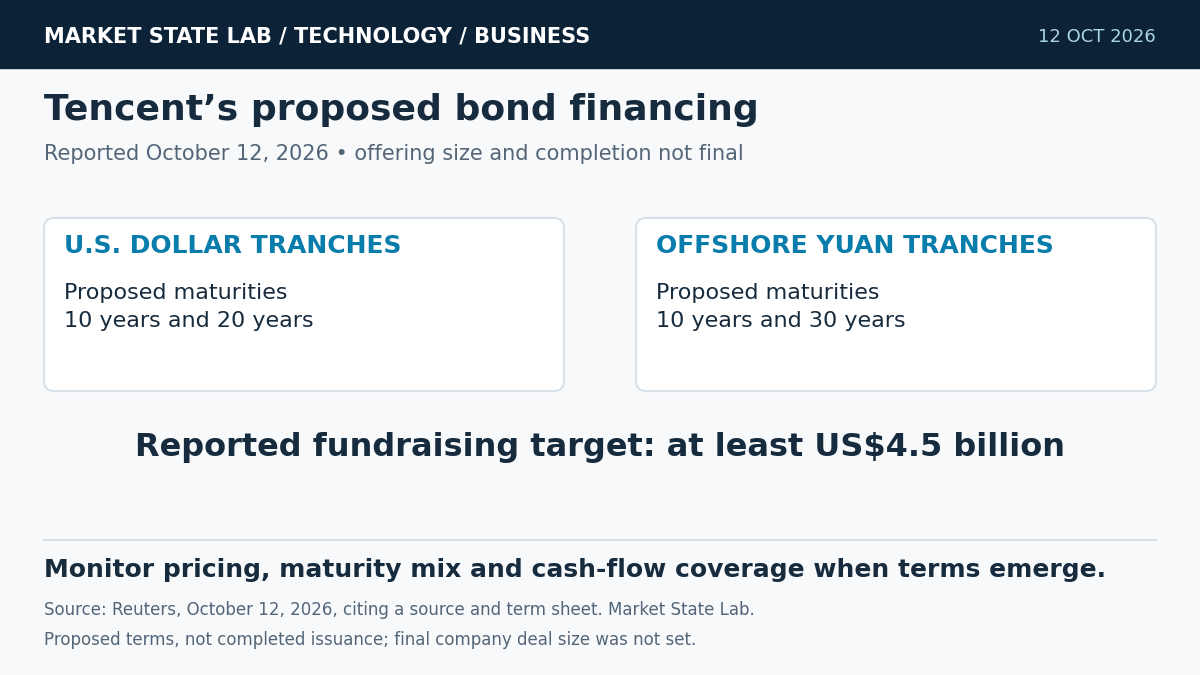
Graphic: Market State Lab. Reuters, October 12, citing a source and term sheet. Proposed terms, not completed issuance.
Fact: Tencent reportedly seeks at least $4.5 billion through U.S. dollar and offshore yuan bonds amid AI investment. Proposed maturities extend to 30 years; the company had not fixed the offering size. Reuters, October 12
Inference: Financing costs and cash-flow timing increasingly shape AI investment economics.
Uncertainty: Final pricing, size and completion remain conditional.
Why it matters: Track debt service, currency exposure and returns on deployed capital alongside spending announcements.
Quant & Market Dashboard
Liquidity and funding
- Calendar: U.S. equities are open today; SIFMA recommends a full close for U.S.-dollar fixed-income trading. A cash-bond holiday does not imply every futures contract is closed. SIFMA
- Overnight: The futures snapshot above is a directional proxy only. Current SPY/QQQ NBBO, depth, auction imbalances, futures volume and funding-market transaction volumes were unavailable. Do not infer normal liquidity from small price changes.
- October 9 close, 3:00 p.m. CT: SPY 778.57 and QQQ 751.27. Yahoo historical reported volume: SPY 22.60 million; QQQ 21.12 million. These are vendor-reported prior-session activity proxies, not today's depth. SPY history, QQQ history
- Treasury reference: October 9 official indicative par yields: two-year 4.80%, ten-year 5.24%, thirty-year 5.60%. These are curve estimates, not today's executable prices. Treasury
- Funding: Latest verified observations: October 8 SOFR 3.87% and EFFR 3.88%; FRED lists October 13 as the next release. No current funding-stress conclusion follows from these lagged fixings. SOFR, EFFR
Volatility regime
Low implied-volatility regime; medium confidence. October 9 VIX close was 14.84, below the prior 15.41. This describes the prior-close equity-options signal, not a live risk assessment. Current VX term structure, option skew and realized volatility were not independently verified. Holiday hedge liquidity and approaching inflation releases warrant tighter execution controls despite low implied volatility. VIX history
Factor proxies
| Factor | ETF | October 9 | Four weeks |
|---|---|---|---|
| Momentum | MTUM | +0.84% | +4.22% |
| Value | VLUE | −0.30% | −1.81% |
| Quality | QUAL | +0.44% | +3.14% |
| Size | IWM | +0.49% | −3.44% |
| Growth | IWF | +0.63% | +4.61% |
| Low volatility | SPLV | +0.24% | −2.24% |
Four weeks = October 9 versus September 11 closes. Split-adjusted price returns excluding dividends; these ETFs are overlapping exposure proxies, not isolated factor portfolios. Momentum led Friday; growth led the four-week comparison and size lagged. No overnight factor ranking is claimed.
Execution implications
- Separate premarket, the 8:30 a.m. CT opening auction, first half-hour, and closing auction. Use limits and participation caps tied to fresh depth; monitor realized slippage and cancellation rates.
- Treat the equity-open/bond-holiday session as a distinct state. Check actual hedge-venue hours and basis; stale cash Treasury marks can mislead cross-asset models.
- Rebuild SPY/QQQ option surfaces from synchronized, executable two-sided quotes. Reject stale, crossed, zero-bid and mismatched-leg observations. Avoid treating last trades as achievable combo fills.
- Dealer gamma direction and strike-level positioning are unverified. Tag each option's actual expiry/settlement; do not infer hedging flows from open interest alone. Isolate 0DTE tests from longer-dated exits.
- Map Wednesday–Friday inflation windows explicitly; stop using pre-release spread and impact estimates when observed conditions change.
Watchlist: SPY, QQQ, RSP, IWM, TLT, VIX, MTUM, VLUE, QUAL, IWF, SPLV, XLE, SMH, ES, NQ, ZN, VX.
DRL Improvements for the MATLAB System
- Keep a frozen supervised exit baseline; test initialized RL only as an incremental improvement under identical actions, episodes, fills and seeds.
- Enforce drawdown, exposure, turnover, liquidity and loss constraints outside the reward. Include implementation shortfall and downside penalties without rewarding infeasible fills.
- Stress gaps, missing quotes, partial fills, spread widening and hedge unavailability; distinguish observed data from synthetic continuation states.
- Use purged, embargoed walk-forward evaluation, multiple seeds and untouched crisis/event blocks. Separate fixed exposure from dynamic sizing and report uncertainty around incremental gains.
Model hygiene
Prevent leakage and look-ahead through first-known timestamps and label-horizon purging. Use point-in-time constituents to control survivorship bias; reconcile splits, dividends and corporate actions. Audit stale options quotes and multiple testing, retain failed trials, calibrate out of sample, and monitor feature, probability, policy, cost and regime drift.
MATLAB optimization
- Align sessions and releases using
timetable,retimeandsynchronize; preserve timezone and holiday metadata. - Preallocate episode buffers and vectorize rolling features; profile environment steps before parallelizing.
- Run parallel
bayesoptacross independent purged folds with reproducible worker random streams; prevent nested oversubscription. - Use GPUs only when batch size justifies transfer overhead; keep data, environment, execution and risk-constraint modules separate.
High-value quant research question
Does supervised initialization improve out-of-sample SPY/QQQ options-exit decisions beyond a frozen MLP baseline after identical exposure, quote-freshness filters and realistic costs, especially on equity-open/bond-holiday sessions and inflation-release days?
This tests whether the incremental learning benefit survives execution friction and regime changes, rather than merely different position sizing.
Subscribe to Quant Market Brief by email.
Research and education only—not individualized financial advice.
If this was useful, forward it to one colleague who tests systematic strategies.