Quant Market Brief — October 11, 2026: Market Impact & AI Concentration
Research cutoff: October 11, 2026, 6:25 a.m. CT (11:25 UTC). Weekend edition: market observations below are Friday's close or the latest published fixing, not live executable quotes.
Visual correction — October 11, 2026: five reused category graphics were replaced with story-specific diagrams and sourced charts; captions and alt text were corrected.
1. China couples AI expansion with investment and safety oversight
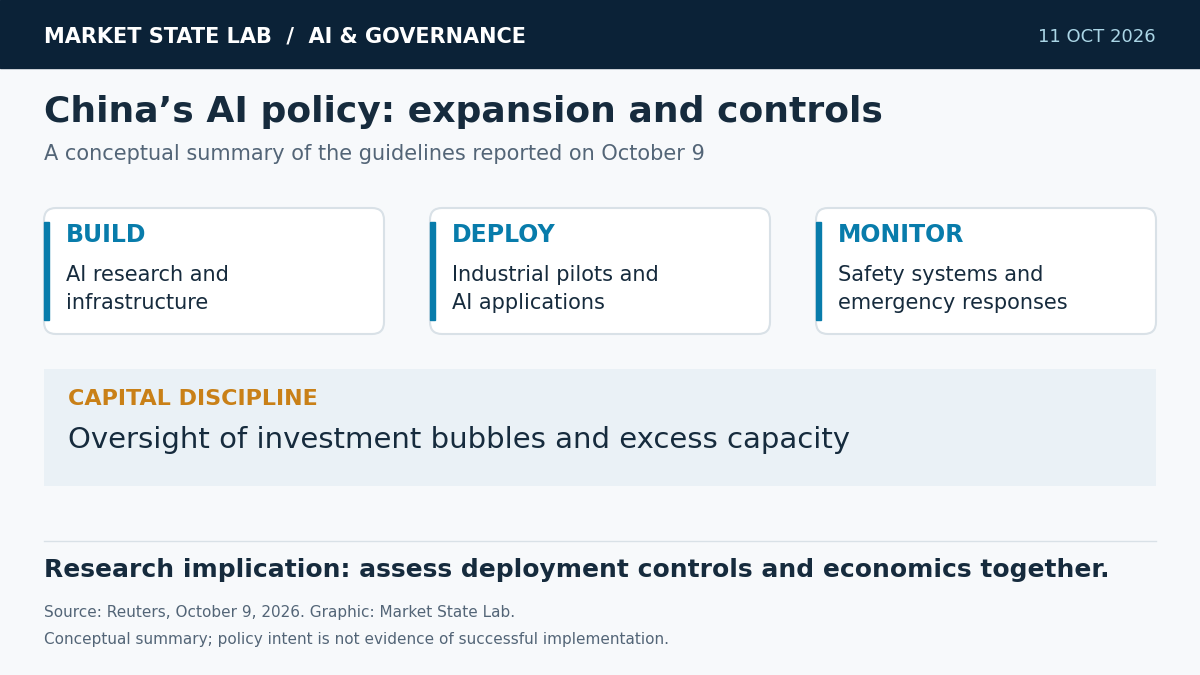
Graphic: Market State Lab conceptual policy summary, based on Reuters, October 9, 2026; implementation outcomes are unverified.
Fact: China issued guidelines promoting AI infrastructure and industrial pilot bases while calling for risk monitoring, emergency responses, and restraint against blind investment and excess capacity. Reuters, October 9
Inference: Deployment controls and capital discipline increasingly belong in the same AI investment assessment.
Uncertainty: Guidelines do not establish implementation results, project returns, or consistent enforcement.
Why it matters: Benchmark MATLAB-connected AI on latency, cost, reliability, data boundaries, and failover. Policy support alone does not validate a deployment's economics.
2. Market-impact preprint challenges simplistic execution costs
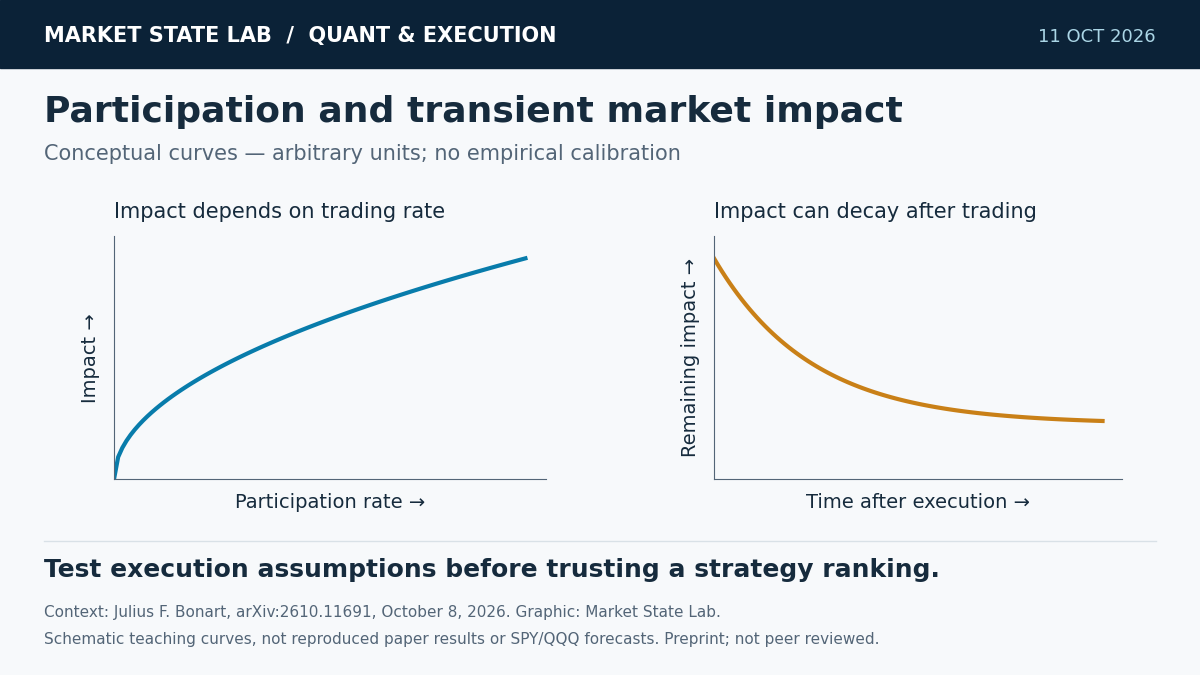
Graphic: Market State Lab schematic, informed by Bonart’s October 8 preprint. Curves are illustrative, not reproduced research results or calibrated SPY/QQQ estimates.
Fact: Julius F. Bonart's October 8 preprint models how arbitrageurs remove predictable returns, producing participation-dependent impact and impact decay under specified information and stationarity assumptions. “Diffusive Market Impact: A Consistent Microfoundation,” arXiv
Inference: Fixed-basis-point costs may misrank strategies that trade at different rates or repeatedly consume liquidity.
Uncertainty: This is theoretical, unreviewed research—not a calibrated SPY/QQQ execution model or an empirical performance guarantee.
Why it matters: Compare linear, square-root, and transient-impact models against actual fills; stress-test decay and participation assumptions before using them in DRL rewards.
3. Four-year U.S. bull market highlights index concentration
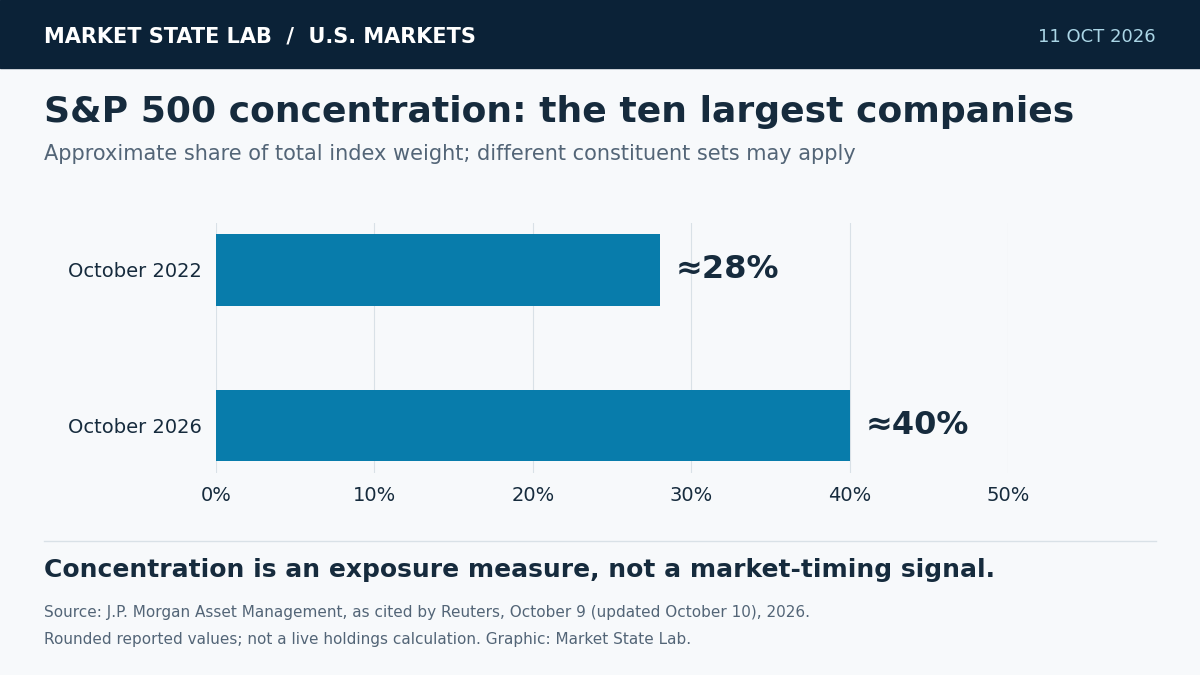
Graphic: Market State Lab. Rounded index weights from J.P. Morgan Asset Management, as cited by Reuters, October 9, updated October 10, 2026.
Fact: Near the October 12 anniversary of its 2022 low, the S&P 500 had gained 117%. Its ten largest companies represented about 40% of index weight, versus 28% at the start, according to data cited by Reuters. Reuters, October 9; updated October 10
Inference: Shared megacap exposure can limit diversification between broad-market and growth portfolios.
Uncertainty: Historical gains and concentration do not forecast the next move.
Why it matters: Track RSP/SPY, breadth, constituent contributions, and overlapping SPY/QQQ exposures; do not trade the rally's age alone.
4. Fed survey shows a heavier household debt-service burden
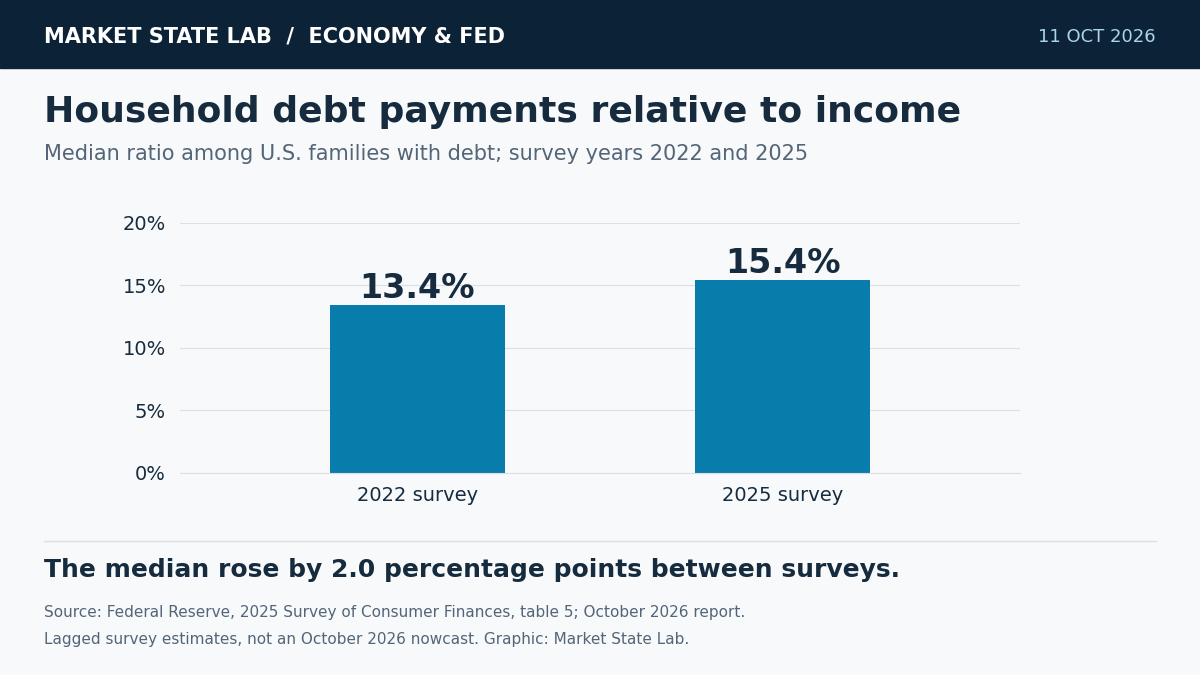
Graphic: Market State Lab. Source: Federal Reserve, 2025 Survey of Consumer Finances, table 5. Lagged survey estimates, not a current distress nowcast.
Fact: The Fed's 2025 Survey of Consumer Finances, released October 9, shows median debt payments relative to income among debtors rising from 13.4% in 2022 to 15.4% in 2025. The share with payment-to-income ratios above 40% rose from 6.5% to 8.6%. Federal Reserve report, table 5
Inference: Aggregate balance-sheet strength can coexist with cash-flow pressure.
Uncertainty: These are lagged survey estimates, not an October 2026 distress nowcast.
Why it matters: Segment consumer-credit research by debt burden. Respect survey weights, multiple imputation, and the October 9 availability date in backtests.
5. Nvidia reportedly considers a deeper Reflection AI deal
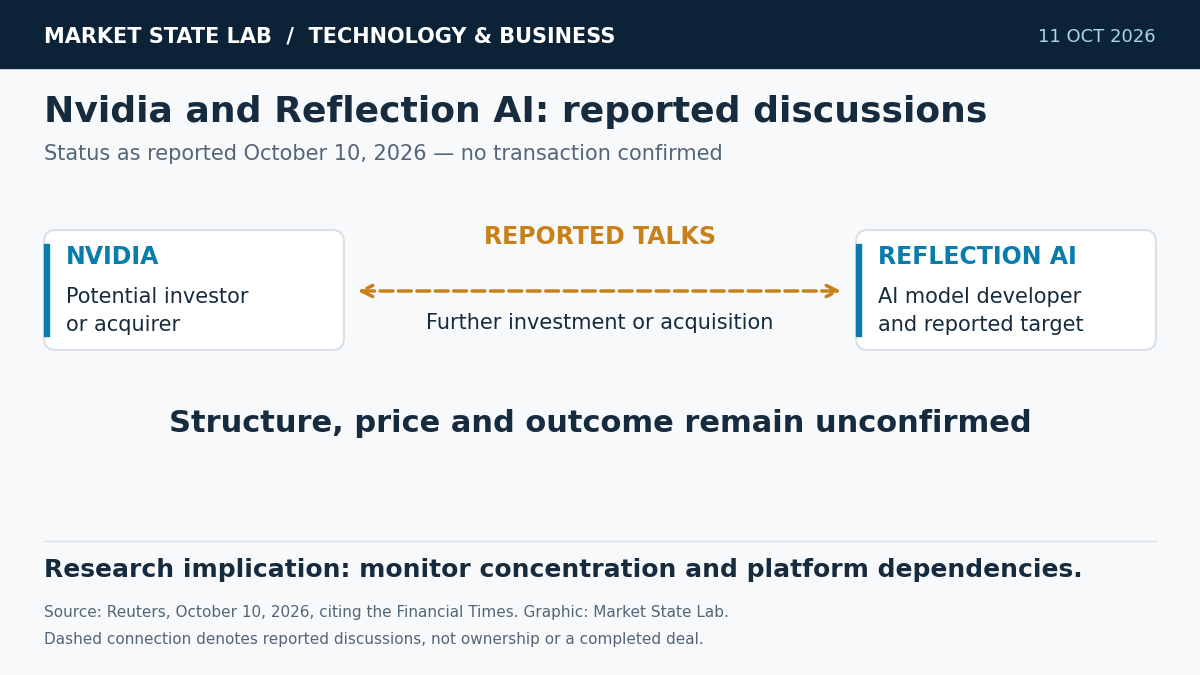
Graphic: Market State Lab. Reuters, October 10, 2026, citing the Financial Times. Dashed connection represents reported talks, not a completed transaction.
Fact: Nvidia is discussing further investment in Reflection AI or a possible acquisition, Reuters reported October 10, citing the Financial Times and people familiar with the matter. Reuters
Inference: Hardware, model, and developer-tool economics may become more tightly connected.
Uncertainty: Talks are preliminary and could fail; no transaction structure or price is confirmed.
Why it matters: Track NVDA concentration and platform dependencies. Keep model-provider portability and independent performance tests in the technical roadmap.
Quant & Market Dashboard
Liquidity and funding
- Weekend conditions: No live executable SPY/QQQ or equity-options market at the cutoff. Fresh futures spreads, depth, volume, auction imbalances, and options dealer positioning were not verified. Friday volume is an activity proxy, not evidence of current liquidity.
- Friday, October 9, 3:00 p.m. CT closes: SPY 778.57, +0.60%, volume 22.76 million; QQQ 751.27, +0.49%, volume 22.53 million. Historical prices, not executable quotes.
- Treasury par yields, October 9: two-year 4.80%, ten-year 5.24%, twenty-year 5.65%, thirty-year 5.60%. Indicative curve estimates, not trade prices. U.S. Treasury
- Latest published funding observations: October 8 SOFR 3.87% and EFFR 3.88%, published October 9. These lag current conditions.
- Calendar: U.S. equities have a regular session Monday, October 12; SIFMA recommends a U.S. bond-market holiday. Infer potentially less reliable cash-bond price discovery; verify product-specific futures hours and settlement. NYSE, SIFMA
Volatility regime
Low implied-volatility regime; medium confidence. VIX finished October 9 at 14.84. October, November, and December monthly VX settlements were 17.1186, 17.8517, and 18.4448, an upward curve. Cboe settlements
This classification describes prior-close implied volatility. It does not establish low execution risk: weekend gaps, index concentration, and Monday's equity/bond calendar mismatch can still produce adverse selection.
Factor proxies
| Factor | ETF | October 9 | Four weeks |
|---|---|---|---|
| Momentum | MTUM | +0.84% | +4.22% |
| Value | VLUE | −0.30% | −1.81% |
| Quality | QUAL | +0.44% | +3.14% |
| Size | IWM | +0.49% | −3.44% |
| Growth | IWF | +0.63% | +4.61% |
| Low volatility | SPLV | +0.24% | −2.24% |
Calculated from October 9 versus October 8 and September 11 closing prices. Split-adjusted price proxies excluding dividends, not pure-factor total returns. Growth and momentum lead over four weeks; size lags.
Execution implications
- Separate Sunday futures reopening, Monday premarket, the 8:30 a.m. CT cash opening auction, and the first hour. Recheck the event calendar before enabling execution.
- Require fresh spread, displayed depth, quote-age, and auction-imbalance checks. Start with capped participation; compare expected and realized slippage.
- Do not carry Friday's option surfaces into Monday. Refresh strike liquidity, skew, open interest, expiry/settlement conventions, and executable multi-leg prices.
- Dealer gamma direction is unverified. Reject stale, crossed, zero-bid, one-sided, and thin quotes; distinguish reported volume from accessible depth.
- Test transient impact and nonlinear participation costs; use cancellation controls and slippage kill switches. Treat holiday cross-asset hedges as a separate regime.
Watchlist: SPY, QQQ, RSP, IWM, TLT, VIX, MTUM, VLUE, QUAL, IWF, SPLV, NVDA, SMH, ES, NQ, ZN, VX.
DRL Improvements for the MATLAB System
- Add participation rate, spread, depth, quote age, concentration, session, and holiday states; allow a valid no-trade action.
- Enforce drawdown, exposure, turnover, and liquidity constraints outside the reward; penalize implementation shortfall and non-executable fills inside it.
- Randomize impact curvature, decay, latency, partial fills, opening gaps, and depth withdrawal to reduce dependence on a single simulator.
- Use purged, embargoed walk-forward evaluation, nested tuning, frozen baselines, multiple seeds, and untouched event/holiday blocks.
Model hygiene
Control leakage, survivorship and look-ahead bias, first-known timestamps, corporate actions, stale options quotes, and multiple testing. Keep survey release dates separate from reference periods; handle SCF imputation and weights correctly. Calibrate out of sample and monitor feature, probability, policy, regime, and transaction-cost drift.
MATLAB optimization
- Align market sessions and release timestamps with
timetable,retime, andsynchronize; avoid filling closed sessions with synthetic tradable quotes. - Vectorize rolling features, preallocate episode buffers, and profile environment steps before parallelizing.
- Use parallel
bayesoptacross independent purged folds with reproducible random streams. - Use GPUs only for sufficiently large neural-network batches; separate environment, execution-cost, constraint, and agent modules.
High-value research question
Does replacing fixed transaction costs with participation-dependent transient impact change the out-of-sample ranking of SPY/QQQ momentum and mean-reversion policies, especially at opens and equity-open/bond-holiday sessions?
Worth testing because it separates forecast skill from optimistic execution assumptions.
If this edition helps your research, forward it to one colleague who works on markets, quantitative trading, or MATLAB.
Research and education only—not individualized financial advice.