Quant Market Brief — October 14, 2026: CPI Execution Risk & ASML Capacity
Research cutoff: October 14, 2026, 6:36 a.m. CT (11:36 UTC). Market observations below are indicative or prior-session, not a live consolidated feed.
1. NVIDIA pledges compute access for UK agentic safety research
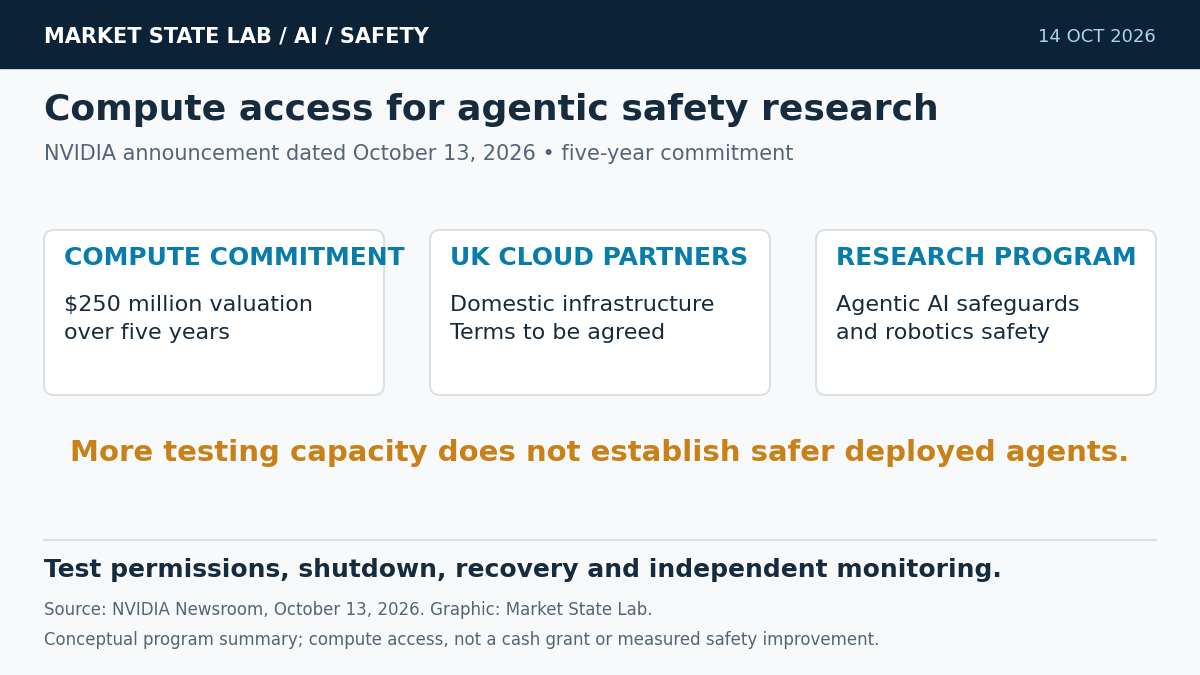
Graphic: Market State Lab. Source: NVIDIA, October 13, 2026. Conceptual panels are illustrative; quantitative charts use reported values.
Fact: NVIDIA announced a five-year compute donation valued at $250 million for UK agentic safety and security research. Access will come through UK-based cloud partners; supported work includes BOLD, SOFAIR and Imperial College London. Source.
Inference: More evaluation capacity could improve the evidence supporting agent safeguards.
Uncertainty: Provider selection, architecture and commercial terms remain to be agreed; no measured safety improvement was announced.
Why it matters: For MATLAB-connected agents, test tool permissions, independent monitoring, shutdown and recovery before expanding autonomy.
2. CME advances cloud migration and targets Aurora client testing
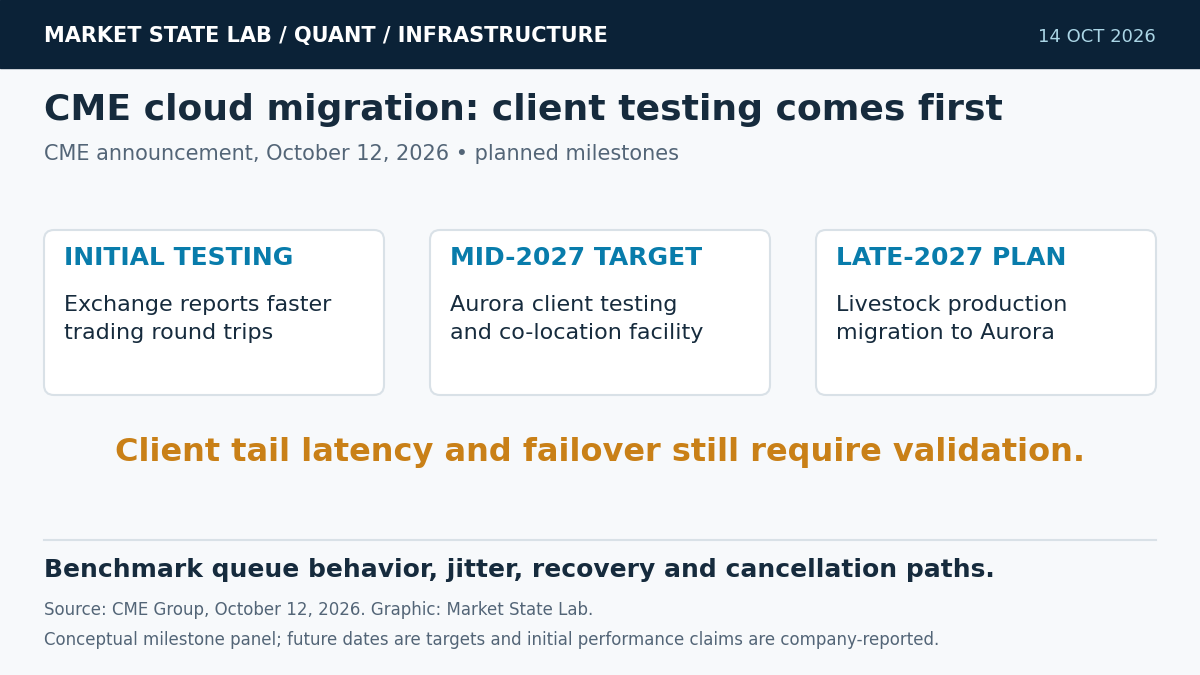
Graphic: Market State Lab. Source: CME Group, October 12, 2026. Conceptual panels are illustrative; quantitative charts use reported values.
Fact: CME says initial cloud-based Globex testing delivered faster round trips. Aurora client testing is targeted for mid-2027 and livestock-market migration for late 2027. An interim production move to Dallas is no longer planned. Source.
Inference: Infrastructure changes could alter latency, queue competition and operational dependencies.
Uncertainty: These are company-reported tests and future targets; client tail latency, load behavior and failover performance were not independently verified.
Why it matters: Benchmark jitter, queue position, cancel acknowledgments and disaster recovery before changing execution assumptions.
3. Dow and S&P futures edge higher ahead of CPI; Nasdaq lags
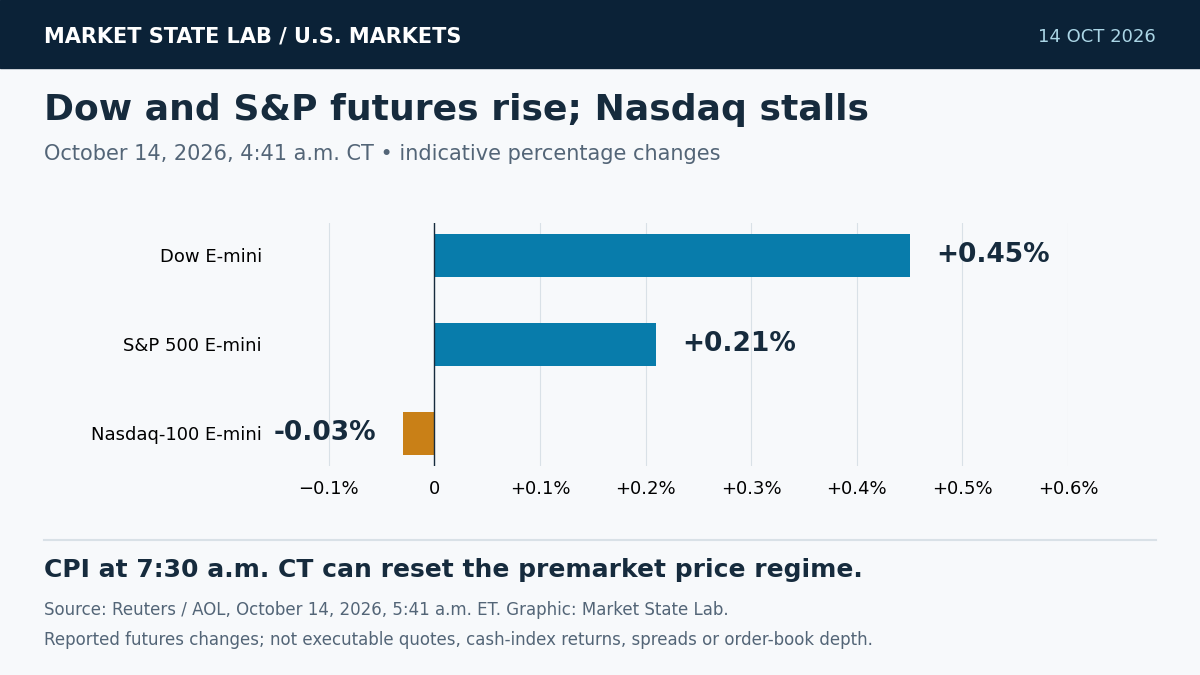
Graphic: Market State Lab. Source: Reuters via AOL, October 14, 2026; 4:41 a.m. CT snapshot. Conceptual panels are illustrative; quantitative charts use reported values.
Fact: At 4:41 a.m. CT, Dow E-minis were +0.45%, S&P 500 E-minis +0.21% and Nasdaq-100 E-minis −0.03%. Traders awaited inflation data and bank earnings; chip shares were mixed. Source.
Inference: The index divergence warrants checking sector breadth before treating the move as broad risk appetite.
Uncertainty: Reported premarket indications are not executable prices. Consolidated spreads, depth and auction imbalances were unavailable.
Why it matters: Reassess SPY/QQQ after the 7:30 a.m. CT CPI release and again at the cash opening auction.
4. Williams leaves room for another 2026 hike, with a conditional 2027 view
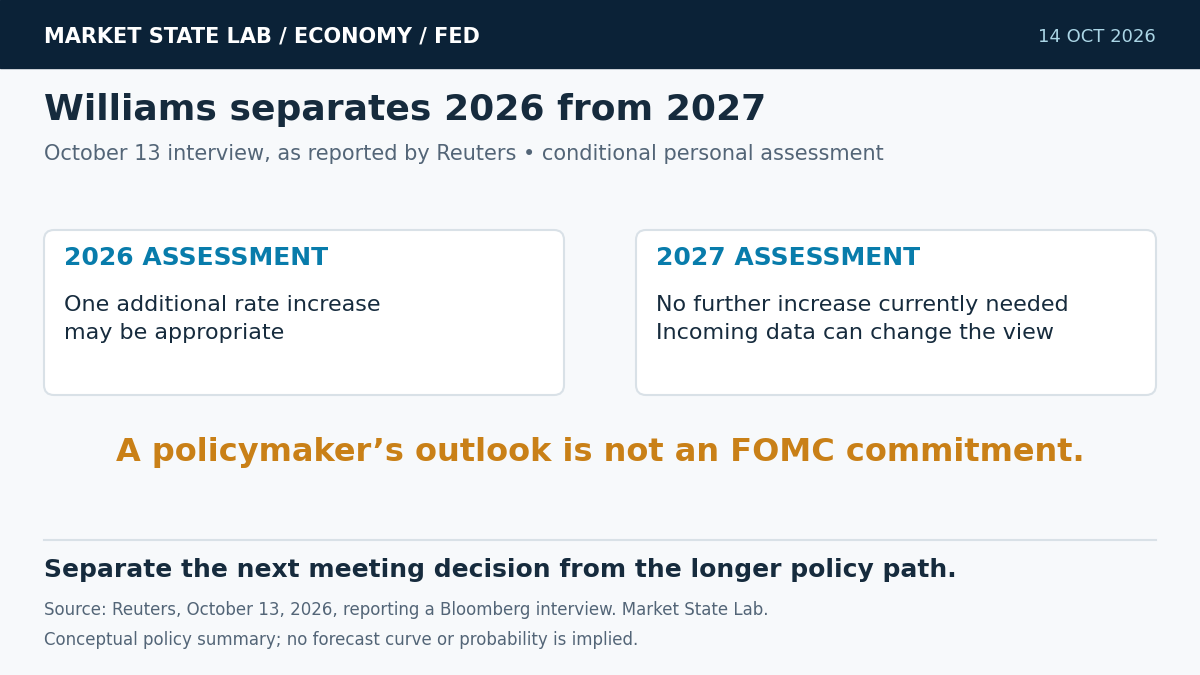
Graphic: Market State Lab. Source: Reuters, October 13, 2026; Bloomberg interview. Conceptual panels are illustrative; quantitative charts use reported values.
Fact: In an October 13 Bloomberg interview reported by Reuters, New York Fed President John Williams said another increase may be appropriate in 2026. He currently sees no need for more in 2027, while leaving that assessment open to incoming data. Source.
Inference: The next meeting decision and the longer policy path are separate sources of rate sensitivity.
Uncertainty: This is one policymaker’s conditional outlook, not an FOMC commitment.
Why it matters: Keep pause, delayed-hike and persistent-inflation scenarios separate; update each with inflation breadth and curve reactions.
5. ASML reports record quarterly sales and considers more capacity
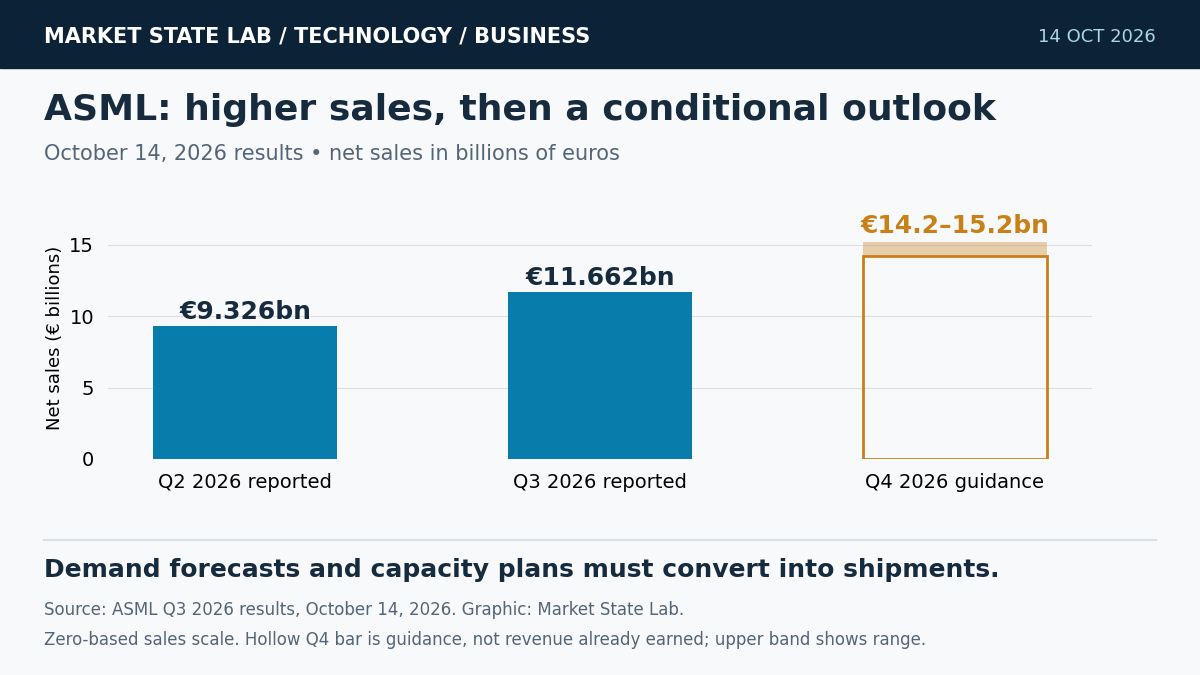
Graphic: Market State Lab. Source: ASML, October 14, 2026. Conceptual panels are illustrative; quantitative charts use reported values.
Fact: ASML reported Q3 sales of €11.662 billion and a 57.5% gross margin. Q4 sales guidance is €14.2–15.2 billion. The company is examining capacity expansion beyond its previously discussed 2028 increase as customer demand forecasts rise. Source.
Inference: Equipment capacity may remain a constraint on the AI investment cycle.
Uncertainty: Customer forecasts and interest in future orders are not completed shipments; guidance and capacity plans can change.
Why it matters: Track order conversion, shipments, upgrades, supplier capacity and cash generation alongside semiconductor valuations.
Quant & Market Dashboard
Liquidity, funding and volatility
- Overnight futures: Use the 4:41 a.m. CT indications above as directional context only. Overnight volume, consolidated spreads and depth were not verified.
- ETFs, prior close October 13: SPY 778.01, −0.01%, volume 25.85 million shares; QQQ 743.57, −0.33%, volume 28.74 million. Alpha Vantage daily data, retrieved October 14. These are completed-session vendor observations, not current premarket quotes; prior volume cannot establish current liquidity.
- Treasuries, October 13 official daily par yields: 2-year 4.79%, 10-year 5.21%, 20-year 5.60%, 30-year 5.56%. The 2s10s slope was +42 basis points. These are prior-session curve observations, not overnight Treasury bid/ask depth. U.S. Treasury.
- Funding: Latest verified FRED observations were October 9 SOFR 3.87% and EFFR 3.88%. October 13 fixings were not verified at cutoff; holiday-related lag limits their use. SOFR, EFFR.
- Regime: Moderate; medium confidence. October 13 VIX close was 15.27, indicating modest benchmark implied volatility. CPI, elevated Treasury yields and index divergence raise event risk despite that reading. VX term structure, live implied volatility and liquidity degradation were not verified; this is a qualitative assessment. VIX history.
Factor proxies
| Factor | ETF | October 12→13 | September 15→October 13 |
|---|---|---|---|
| Momentum | MTUM | -0.63% | +4.54% |
| Value | VLUE | -0.68% | -1.46% |
| Quality | QUAL | -0.28% | +3.85% |
| Size | IWM | -0.43% | -2.96% |
| Growth | IWF | -0.01% | +5.54% |
| Low volatility | SPLV | +0.26% | -0.60% |
Four-week window is exactly 28 calendar days. Calculated from common-date Alpha Vantage raw closing prices, excluding dividends. Split adjustment was not independently reconciled, so these are indicative price proxies rather than the archive’s standard split-adjusted panel or pure-factor returns. No proxy substitutions were made. The snapshot shows defensive relative strength in SPLV Tuesday, while growth, momentum and quality retain positive four-week price changes; confirm corporate actions before relying on rankings.
Execution and microstructure
- Timing: September CPI is scheduled October 14 at 7:30 a.m. CT; cash equities open 8:30 a.m. CT; Beige Book is due 1:00 p.m. CT. CPI and Beige Book results were unavailable at the research cutoff. BLS calendar, Fed calendar.
- For SPY/QQQ, recheck quote age, spread, displayed depth, auction imbalance and realized slippage after CPI and at the open. Use auction-aware limits, participation caps and cancellation controls; a narrow displayed spread can conceal small size or rapidly disappearing quotes.
- October 16 monthly expiry adds positioning uncertainty. Rebuild options volatility/skew and strike-liquidity maps with fresh open interest; distinguish 0DTE from monthly contracts. Dealer gamma direction was not verified. Check each contract’s settlement and last-trade terms. Cboe 2026 expiration calendar.
- Reject stale, crossed, zero-bid, one-sided and thin option quotes. Stress partial fills, event gaps and nonlinear impact; do not assume fillability at the midpoint.
Watchlist: SPY, QQQ, IWM, TLT, VIX, MTUM, VLUE, QUAL, IWF, SPLV, ASML, NVDA, MU, SMH, SOXX, CME, ES, NQ, ZT, ZN, VX.
DRL Improvements for the MATLAB System
- Enforce drawdown, concentration, turnover, liquidity and daily-loss constraints outside the learned reward; include implementation shortfall and downside-risk penalties inside it.
- Add CPI phase, overnight/cash session, NQ–ES divergence, curve shift, quote age, auction state and expiry state; evaluate feature availability at decision time.
- Randomize spread widening, depth withdrawal, latency jitter, rejected cancels, partial fills and nonlinear impact; require robust behavior across event and quiet regimes.
- Use purged, embargoed walk-forward folds, frozen baselines and multiple seeds. Hold out entire inflation-release and expiry blocks and include realistic fees, spread and impact costs.
Model hygiene
Preserve first-known timestamps; control leakage, survivorship and look-ahead bias. Reconcile splits, dividends and symbol changes before factor comparisons. Filter stale options quotes, retain unsuccessful trials, correct for multiple testing, calibrate out of sample and monitor feature, policy, probability and execution-cost drift.
MATLAB optimization
- Align event, quote and session data with
timetable,retimeandsynchronize; retain availability timestamps separately from event timestamps. - Vectorize rolling features, preallocate replay buffers and profile environment steps before adding parallelism.
- Parallelize
bayesoptonly over independent purged folds; use reproducible random streams and multiple policy seeds. - Use GPUs for sufficiently large neural-network batches. Keep market-session, execution-cost, risk-constraint and agent modules separate.
High-value quant research question
Does pre-CPI NQ–ES divergence, combined with the post-release 2s10s change, predict QQQ opening-gap continuation versus reversal after realistic auction and expiry-week costs?
Worth testing because it separates overnight sector positioning from inflation information and cash-market execution. Measure incremental out-of-sample value against simple gap and volatility baselines.
Technical companion (available after the GitHub commit).
If this helped your process, forward it to one colleague who works on systematic trading or market data.
Research and education only—not individualized financial advice.