Quant Market Brief — August 25, 2026
Research cutoff: August 25, 2026, 6:29 a.m. CT. Premarket readings are indicative and may be delayed. Prior-close values are identified below.
1. MathWorks moves embedded AI toward library-independent deployment
Credit: original Market State Lab AI graphic.
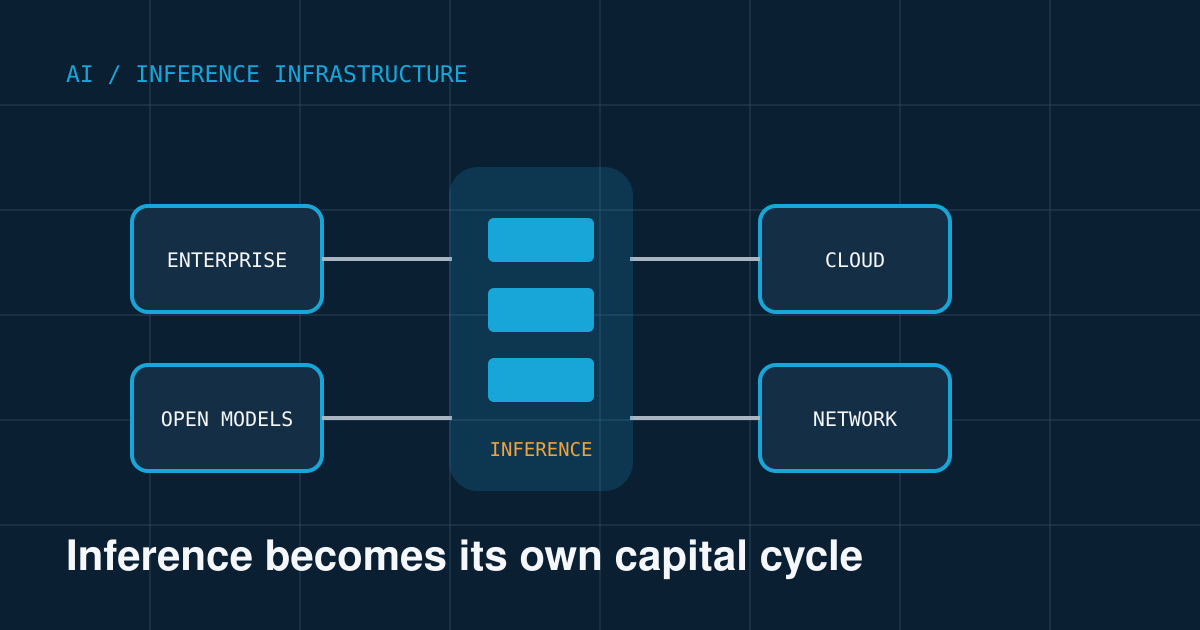
Fact: MathWorks scheduled August 25 sessions on target-independent code generation for embedded AI. The workflow covers C, C++, and CUDA generation from deep-learning networks, host and software-in-the-loop validation, profiling, benchmarking, and comparison with vendor-specific deployment paths; the first session begins at 8:00 a.m. CT. MathWorks event listing
Inference: Separating a trained network from a vendor runtime can improve deployment portability and auditability, but only if numerical equivalence, latency, memory use, and generated-code behavior are tested on the target.
Uncertainty: The sessions had not occurred at the research cutoff. No independent performance results were available, and target-independent code may still underperform hardware-specific libraries on some devices.
Why it matters: For a MATLAB trading system, treat deployment as a controlled model-conversion step: freeze weights and preprocessing, compare host and target outputs, profile latency and memory, and require regression tests before generated code reaches production.
2. CME launches E-nano futures for four U.S. equity benchmarks
Credit: original Market State Lab quantitative-finance graphic.
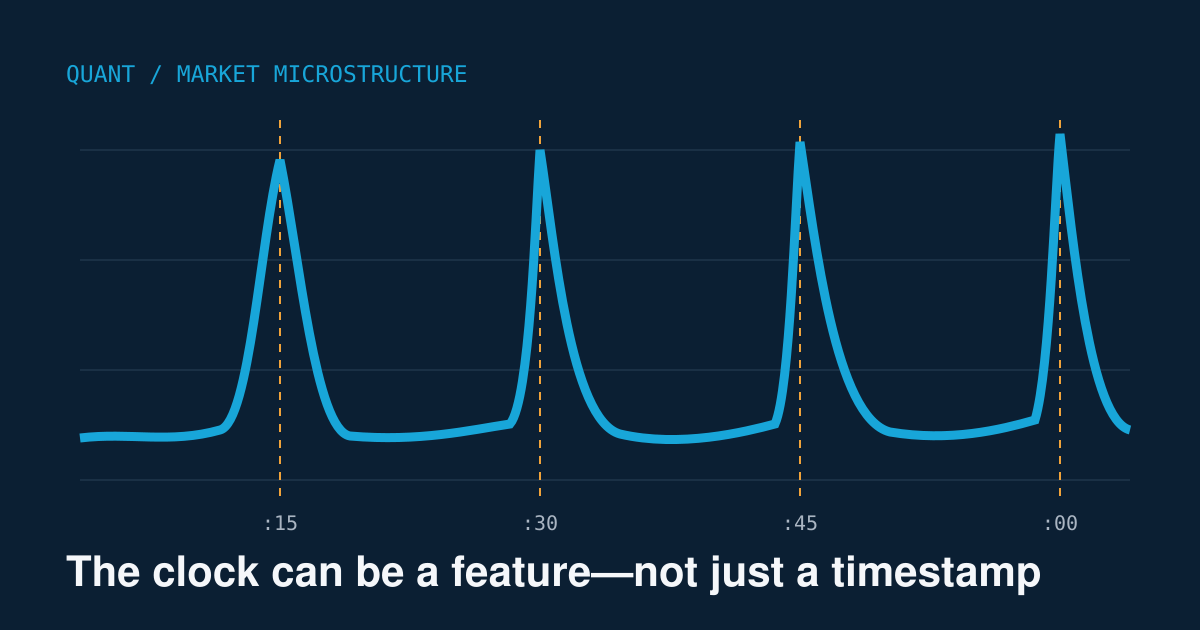
Fact: CME officially launched E-nano futures on August 24 for the S&P 500, Nasdaq-100, Russell 2000, and Dow. The contracts are one-tenth the size of Micro E-minis and one-hundredth the size of E-minis. The S&P 500 contract uses a $0.50 multiplier and $0.25 minimum tick value; the Nasdaq-100 contract uses a $0.20 multiplier and $0.10 tick value. CME FAQ
Inference: Smaller contracts improve hedge granularity and make controlled execution experiments easier, but they may fragment order flow and exhibit different spreads, depth, and queue behavior from ES, NQ, MES, and MNQ.
Uncertainty: One trading day is insufficient to establish stable liquidity, volume, basis quality, or transaction-cost behavior. CME's daily settlement uses the corresponding E-mini contract's closing VWAP rather than a standalone E-nano liquidity sample.
Why it matters: Build separate symbol, multiplier, tick, margin, and cost specifications for NES, NNQ, N2K, and NDOW. Do not inherit Micro E-mini slippage assumptions until venue-level depth and realized fills support them.
3. Nvidia options price a large—but below-average—earnings move
Credit: original Market State Lab U.S. markets graphic.
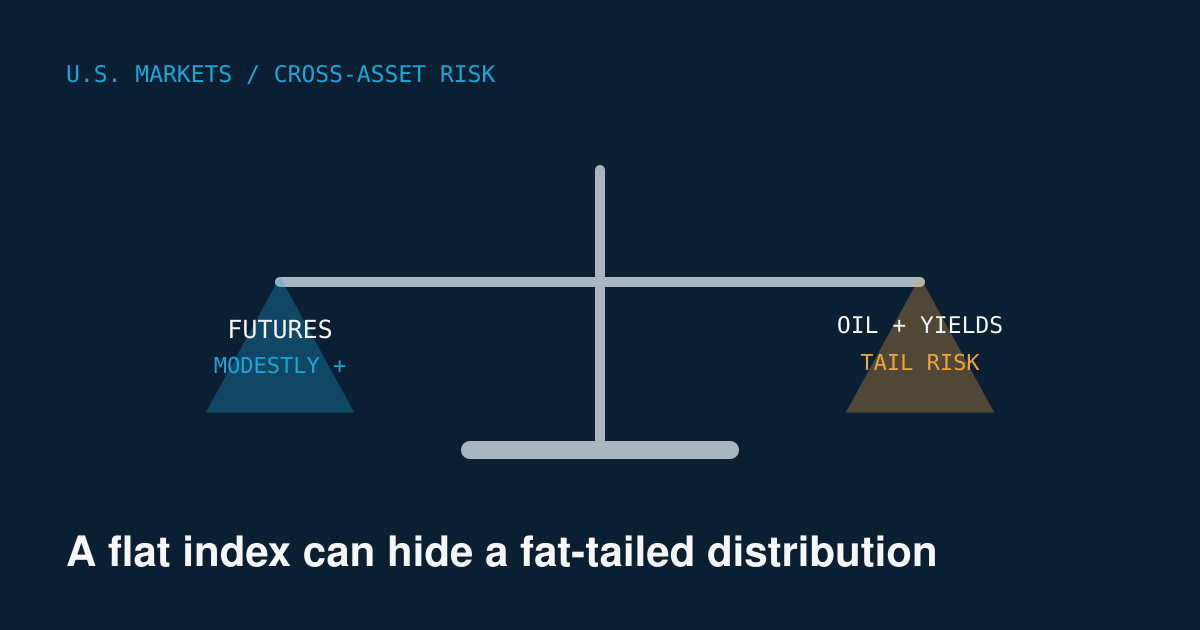
Fact: Nvidia options implied a 5.4% move in either direction for Thursday after Wednesday's results, equivalent to about $280 billion of market value. Reuters reported that this was below the 6.5% implied move before May's report and Nvidia's 7.4% average post-earnings move over the last 12 quarters. Reuters, August 25
Inference: The smaller implied move may reflect improved earnings predictability or relative complacency. Because Nvidia is a large QQQ and semiconductor driver, single-name volatility can transmit into index dispersion even if SPY's broad volatility signal remains moderate.
Uncertainty: Implied moves are option-market estimates, not forecasts. Dealer gamma, strike-level open interest, skew, term structure, and executable spreads were not independently verified.
Why it matters: Reprice QQQ, SMH, and correlated-name execution scenarios around the report. Avoid using Monday's realized volatility as the sole cost input, and separate pre-event premium, post-report gap, and Thursday opening-liquidity regimes.
4. AI investment is colliding with the U.S. fiscal constraint
Credit: original Market State Lab Federal Reserve graphic.
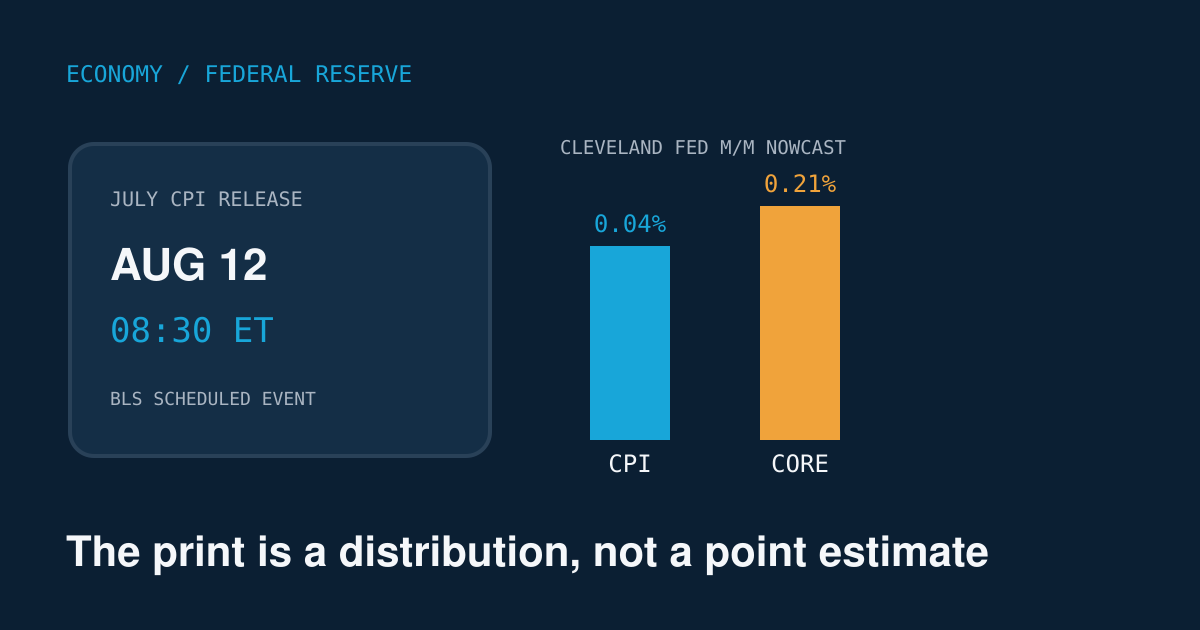
Fact: Reuters' Open Interest column reported annual U.S. deficits near 6% of GDP, total federal debt around $40 trillion, and annual interest expense above $1 trillion. It cited a CBO projection that debt held by the public could reach $56 trillion by 2036 and noted that fiscal-2026 corporate-tax receipts were down 23%, partly because immediate expensing and bonus depreciation were used against large AI and other capital investments. Reuters, August 25
Inference: The AI buildout can pressure Treasury markets through both lower near-term corporate-tax receipts and competing long-dated corporate issuance. That makes long-end yields and the Fed's inflation reaction function more important than the headline policy rate alone.
Uncertainty: The article is analysis, not an official forecast. Fiscal outcomes depend on growth, legislation, tariffs, spending, rates, and whether AI investment eventually lifts productivity and the tax base.
Why it matters: Model fiscal supply, hyperscaler issuance, term premium, and expected policy rates as separate state variables. A positive AI productivity scenario should not automatically be mapped to lower near-term inflation or lower long yields.
5. A physics-focused AI startup challenges the transformer default
Credit: original Market State Lab technology/business graphic.
Fact: Accelerated Understanding, founded by Anima Anandkumar and Benedikt Jenik, launched an enterprise-focused AI system based on neural operators rather than transformers. The company said a test handled 5 trillion data elements in one prompt and identified chip design, robotics, extreme weather, and energy exploration as potential applications. Reuters, August 25
Inference: Commercial AI may fragment into architecture-specific systems for language, physics, control, and scientific data rather than converge on one general transformer stack.
Uncertainty: The 5-trillion-element result is company-reported, funding was undisclosed, enterprise deployments were not named, and no independent accuracy, latency, energy, or economics benchmark was available.
Why it matters: Evaluate scientific-AI vendors on domain error, conservation constraints, data movement, compute cost, reproducibility, and integration—not context size alone. Neural-operator methods may be worth testing for high-dimensional market-state surfaces, but transfer to finance is unproven.
Quant & Market Dashboard
Liquidity and funding
- Overnight direction: At 5:44 a.m. CT, Dow and S&P 500 E-minis were up about 0.4% and Nasdaq-100 E-minis 0.85%. These were indicative futures readings, not executable ETF quotes. Reuters
- Prior session: SPY closed down 0.29% on approximately 32.4 million shares and QQQ down 1.00% on approximately 36.5 million. Premarket indications around 6:00 a.m. CT showed SPY roughly 0.4% and QQQ roughly 0.8% above Monday's close, but consolidated spreads, depth, futures volume, and auction imbalances were unavailable. SPY history, QQQ history
- Treasuries: The August 24 indicative bid-side par curve showed 2-year 4.24%, 10-year 4.70%, 20-year 5.21%, and 30-year 5.23%; the 2s30s slope was approximately +99 basis points. U.S. Treasury
- Volatility curve: Cboe's August 24 VIX close was 15.85. September, October, and November VX settled at 17.589, 19.1282, and 19.8492, an upward and non-stressed curve. Cboe VIX, Cboe futures settlements
- Funding: Same-day SOFR and EFFR had not been published at the cutoff; their normal release times are approximately 8:00 and 9:00 a.m. ET. Do not substitute Monday's fixing for a live Tuesday funding reading. New York Fed SOFR, New York Fed EFFR
Volatility regime
Moderate, medium confidence. Spot VIX remained in the mid-teens and the futures curve was in contango, but Monday's QQQ underperformance, elevated long yields, Nvidia earnings, Wednesday's PCE release, and Friday's Jackson Hole speech increase event and opening dispersion. Dealer gamma and current consolidated depth were unavailable.
Factor performance proxy
August 24 one-session and July 24–August 24 four-week price returns, based on split-adjusted closes and excluding dividends:
| Factor | ETF | 1 session | 4 weeks |
|---|---|---|---|
| Momentum | MTUM | -1.50% | -1.89% |
| Value | VLUE | -1.19% | +2.81% |
| Quality | QUAL | +0.26% | +3.22% |
| Size | IWM | -0.66% | +2.34% |
| Growth | IWF | -1.10% | +2.88% |
| Low volatility | SPLV | +0.93% | -1.53% |
The one-session proxy showed a defensive rotation toward low volatility and quality; the four-week proxy favored quality, growth, and value while momentum lagged. These are ETF price proxies, not pure-factor or total-return portfolios. Synchronize corporate-action-adjusted closes before model use. Historical price data
SPY, QQQ, and options execution
- Treat the positive premarket gap as new price discovery after Monday's semiconductor-led decline; do not assume continuation from headline futures alone.
- Nvidia's report can concentrate short-dated gamma and widen QQQ, SMH, and correlated single-name option spreads before and after the event.
- Tuesday's auction, the Wednesday earnings/PCE window, and Thursday's post-event open require separate cost and participation models.
- Use limit orders, participation caps, fresh spread/depth checks, venue-aware slippage models, and realized-cost kill switches.
- Reject stale, crossed, zero-bid, or thin option quotes. Do not infer liquidity from displayed size in newly launched E-nano contracts until fills validate it.
- Rebuild open-interest, skew, and strike maps each session; distinguish dealer-gamma estimates from verified exchange data.
Microstructure implication: Gate QQQ participation on contemporaneous breadth, the Nasdaq/S&P futures spread, Treasury-yield changes, and executable depth. If the futures rebound narrows before the auction while spreads widen, reduce aggression rather than forcing a gap-continuation trade.
Watchlist: SPY, QQQ, IWM, TLT, VIX, MTUM, VLUE, QUAL, IWF, SPLV, ES, NQ, NES, NNQ, NVDA, SMH, META, MU, WDC, SNDK.
DRL Improvements for the MATLAB System
- Add futures-breadth disagreement, yield-curve, VIX-curve, event-countdown, E-nano-liquidity, and data-freshness states.
- Enforce drawdown, concentration, daily-loss, and liquidity limits outside the reward; penalize downside semivariance, turnover, unstable switching, and fills beyond executable depth inside it.
- Randomize earnings gaps, spread widening, partial fills, latency, stale quotes, auction uncertainty, and nonlinear impact during training.
- Use purged, embargoed walk-forward evaluation with frozen benchmarks, multiple seeds, and separate ordinary, pre-event, post-event, and high-yield scorecards.
Model hygiene
Prevent leakage and look-ahead across webinar times, futures timestamps, ETF prints, Treasury data, earnings, and option surfaces. Use survivorship-safe universes; process splits, dividends, and symbol changes; reject stale option quotes; correct for multiple testing; calibrate out of sample; and monitor feature, probability, policy, and transaction-cost drift.
MATLAB optimization
- Align cross-asset data with
timetableandsynchronize, preserving timestamp, venue, session, and freshness flags. - Vectorize rolling features and preallocate episode buffers before parallelizing.
- Run parallel
bayesoptonly across independent purged folds; keep the final holdout untouched. - Use reproducible random streams and evaluate final policies across multiple seeds.
- Profile CPU, memory transfer, and generated-code latency before moving workloads to a GPU or embedded target.
High-value research question
Does the premarket Nasdaq-versus-S&P futures spread, conditioned on the VX curve and the change in the 30-year Treasury yield, predict QQQ opening continuation versus reversal during mega-cap AI earnings weeks?
This could improve auction participation and dynamic slippage assumptions without requiring a full-session directional forecast.
Disclosure
Market State Lab is research and education, not individualized financial advice. Premarket and delayed readings can change, proxy ETFs contain implementation noise, and every strategy should be independently validated against realistic costs and risk limits.wn