Quant Market Brief — August 23, 2026
Research cutoff: August 23, 2026, 6:30 a.m. CT. U.S. cash equities, listed equity options, and regular equity-index futures were closed at the cutoff; market readings below are Friday, August 21 prior-close, delayed, or indicative values unless stated otherwise. Market State Lab — signals, regimes, and execution for systematic market decisions.
1. AI productivity does not guarantee lower inflation
Credit: original Market State Lab AI graphic.
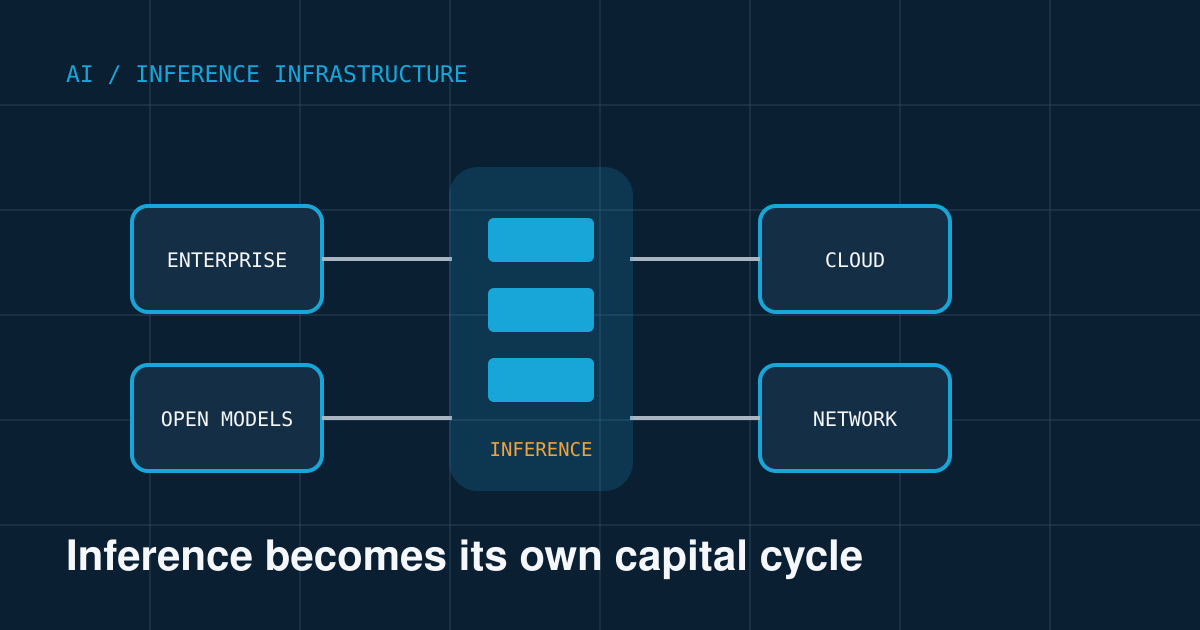
Fact: A Bank of England working paper published August 21 finds that productivity gains affect both supply and demand; the inflation result depends on the shock's timing, persistence, sector, and monetary-policy response. Anticipation of future AI-driven gains can raise investment and consumption before supply expands, potentially increasing the natural rate of interest. Bank of England working paper
Inference: An AI-capex boom can be inflationary during deployment even if realized productivity becomes disinflationary later. Treat “AI productivity” as a sequence of states, not a permanently lower-inflation variable.
Uncertainty: The result is model-based, and the size and timing of broad AI productivity gains remain unobserved. The authors' analysis does not establish the path of U.S. inflation or policy rates.
Why it matters: In MATLAB regime models, separate anticipated AI investment, realized productivity, sector concentration, wages, and real-rate responses. Do not hard-code an automatic negative relationship between AI adoption and inflation.
2. Cboe extends trading hours for selected single-stock options
Credit: original Market State Lab quantitative-finance graphic.
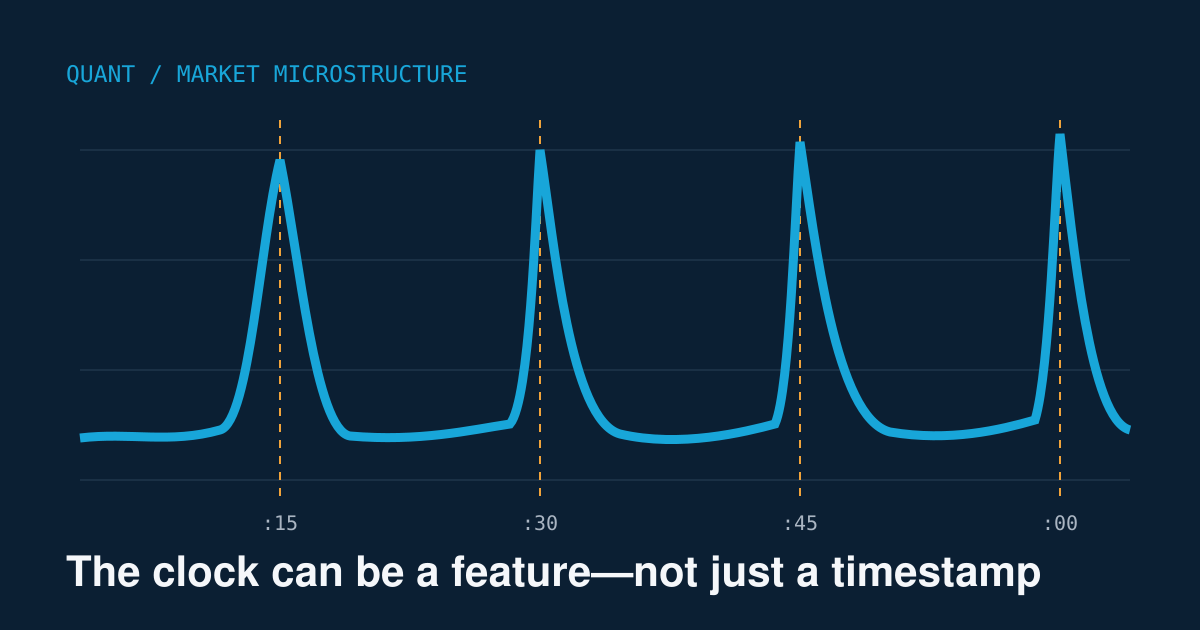
Fact: Effective August 17, Cboe Options Exchange expanded trading for selected equity options to a 7:30–9:25 a.m. ET Global Trading Hours session and a 4:00–4:15 p.m. ET Curb session. The initial symbol set includes AAPL, AMD, AMZN, AVGO, GOOGL, META, MSFT, MU, NVDA, PLTR, TSLA, and others. Market and stop orders are not allowed in the morning session; NBBO protection applies. Cboe technical notice
Inference: Price discovery for heavily traded technology options can begin before the equity opening auction, but thinner cross-venue participation may produce wider spreads, lower depth, and less reliable Greeks.
Uncertainty: Venue-level spreads, volume, depth, and quote quality for the first week were not reliably available. Cboe may change eligible classes, and liquidity need not resemble regular hours.
Why it matters: Build separate extended-hours cost and fill models; require fresh underlying prints and two-sided options markets; prohibit market orders; and do not transfer regular-session slippage assumptions into the new sessions.
3. Friday rebound fails to repair a weaker week for U.S. equities
Credit: original Market State Lab U.S. markets graphic.
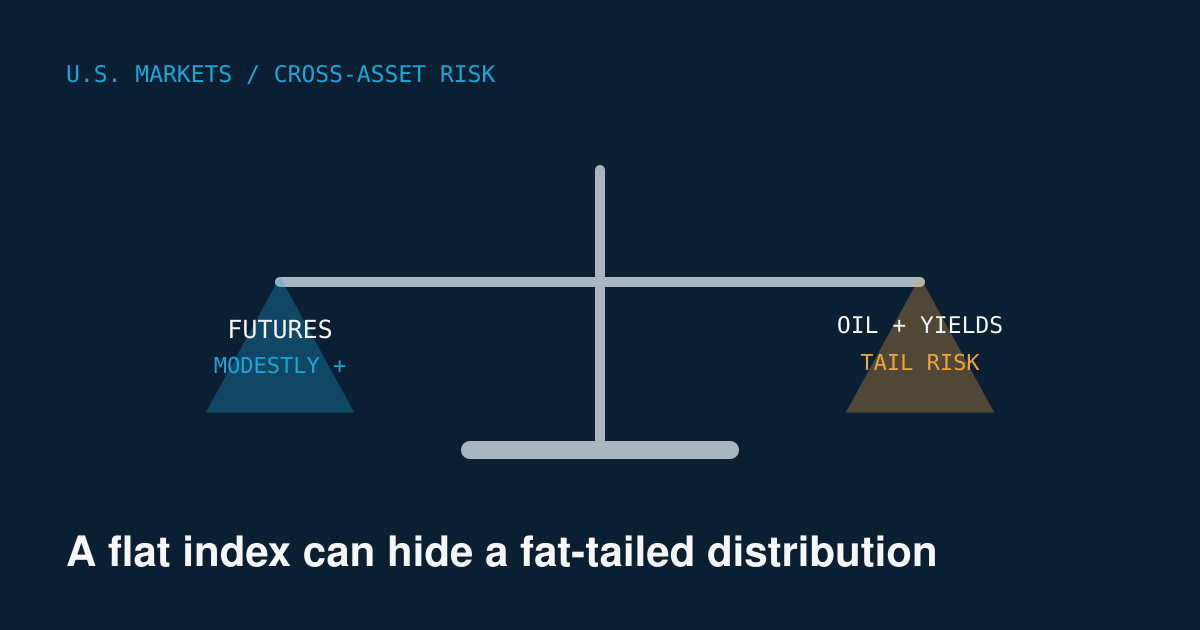
Fact: On August 21, the S&P 500 rose 0.43%, the Nasdaq Composite 0.44%, and the Dow 0.98%; for the week they fell 1.43%, 2.05%, and 0.85%, respectively. SPY closed at 765.72 on about 39.19 million shares, QQQ at 713.44 on about 33.40 million, and IWM gained about 0.76%. Reuters market close
Inference: The stronger Dow and small-cap session relative to the Nasdaq looks more like rotation and short-covering than a confirmed return to broad growth leadership.
Uncertainty: Weekend developments can invalidate Friday's close before futures reopen. Consolidated auction imbalances, effective spreads, depth, and dealer-gamma estimates were unavailable.
Why it matters: Use Friday's data as a regime input, not a Monday trade trigger. Re-estimate breadth, rates sensitivity, volatility structure, and executable liquidity after futures reopen and during Monday's auction.
4. Economists still expect a Fed hold despite inflation risk
Credit: original Market State Lab Federal Reserve graphic.
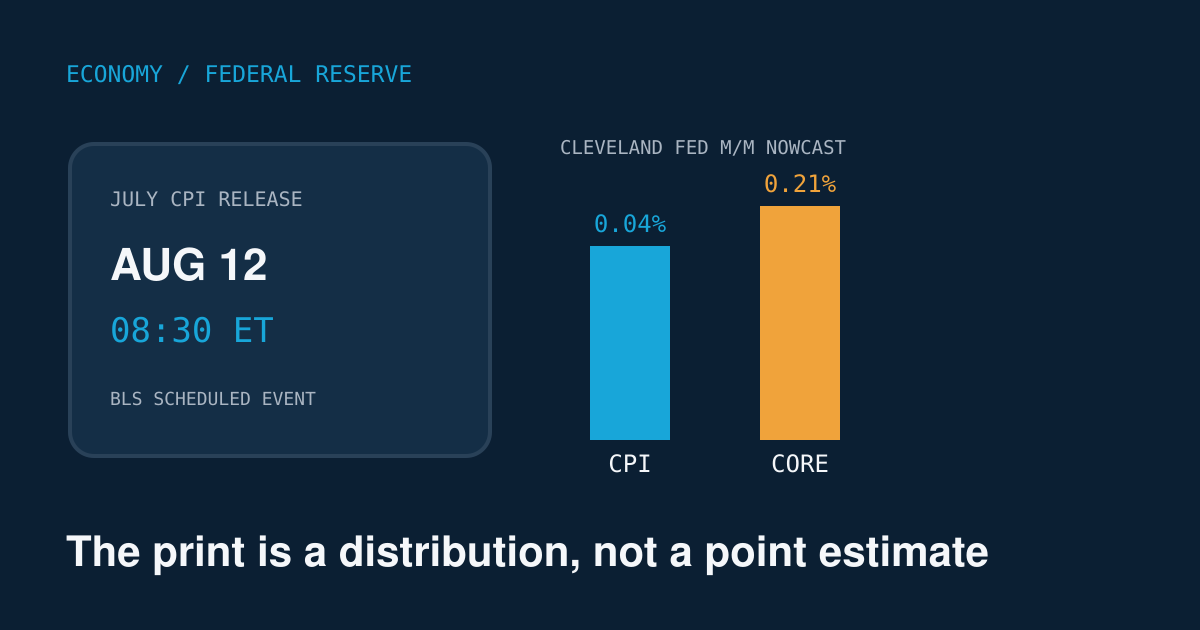
Fact: In a Reuters poll conducted August 12–17, 94 of 104 economists expected the Fed to keep its 3.50%–3.75% target range unchanged at the September meeting; 80 expected no change through year-end. Market pricing still implied one increase by December, while economists' median PCE-inflation forecast remained above target. Reuters poll
Inference: The central case is “hold,” but the distribution is asymmetric: persistent inflation can revive tightening faster than weak activity can justify easing.
Uncertainty: This is a dated survey of forecasts, not an FOMC commitment. July PCE data, the employment report, energy prices, and financial conditions can change the September balance.
Why it matters: Maintain separate hold and renewed-tightening scenarios. Stress equity duration, option skew, funding costs, and position sizing against both rather than using the poll median as certainty.
5. Uber faces a major penalty over automated driver suspensions
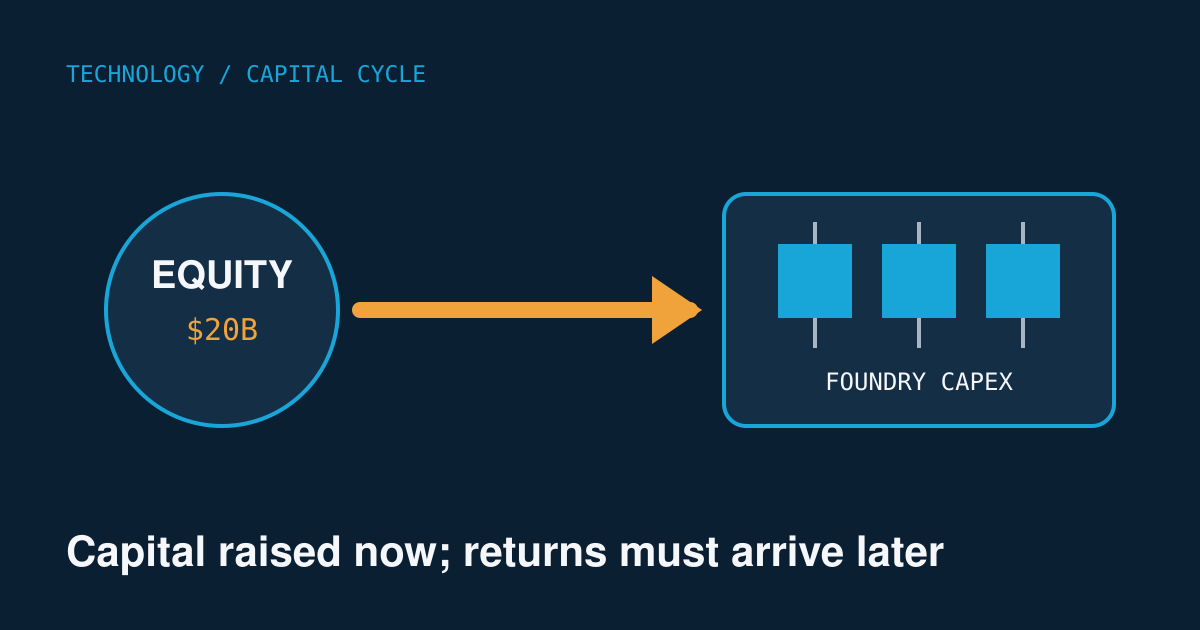
Credit: original Market State Lab technology/business graphic.
Fact: Reuters reported August 21 that the Dutch Data Protection Authority fined Uber €825 million for deactivating driver accounts through automated systems without adequate disclosure or meaningful human review. Uber disputes the findings and size of the penalty and plans to appeal. Reuters
Inference: Automated decision systems that affect income or access create material governance, litigation, and model-risk exposure even when the underlying classifier performs well.
Uncertainty: The decision is subject to appeal; Uber disputes that permanent deactivations were automated. The ultimate penalty and precedent could change.
Why it matters: Businesses deploying AI should log decision provenance, provide human review and appeal routes, test disparate errors, and maintain controls that can stop automated actions independently of model output.
Quant & Market Dashboard
Liquidity and funding
- Weekend state: U.S. cash equities, listed equity options, and regular equity-index futures were closed at 6:30 a.m. CT. No executable overnight-liquidity reading was available; the next meaningful checkpoint is the Sunday futures reopen.
- Friday ETF proxy: SPY volume was about 39.19 million shares, QQQ 33.40 million, and IWM 22.95 million. These are prior-close totals, not forecasts of Monday depth. Consolidated effective spreads, auction imbalances, and order-book depth were unavailable.
- Treasury signal: Treasury's August 21 indicative curve showed 2-year 4.24%, 10-year 4.74%, 20-year 5.25%, and 30-year 5.27%; the 2s30s slope was about +103 basis points. TLT finished down about 0.35%. U.S. Treasury
- Volatility curve: Cboe showed a September standard-maturity implied-volatility point of 15.18 during Friday's session and the September VX future settled at 17.5022. The timestamps and instruments differ, so this is only a cautious contango proxy. Cboe term structure, Cboe settlements
Volatility regime
Moderate, medium confidence. Mid-teens implied volatility and an upward forward curve are non-stressed. A weak index week, long yields above 5%, geopolitical and energy sensitivity, post-expiry repositioning, and the information gap before futures reopen limit confidence.
Factor performance proxy
Friday prior-close one-session ETF returns:
- Momentum (MTUM): approximately +0.01%
- Value (VLUE): approximately +0.46%
- Quality (QUAL): approximately +0.40%
- Size (IWM): approximately +0.76%
- Growth (IWF): approximately +0.46%
- Low volatility (SPLV): approximately −0.45%
These are unadjusted, one-session proxies with differing timestamps. Reliable synchronized one- and three-month total returns were unavailable; recompute them from corporate-action-adjusted closes before using a medium-horizon factor signal.
SPY, QQQ, and options execution
- The August monthly expiration has passed; rebuild gamma, open-interest, and strike maps instead of carrying Friday's positioning forward.
- Monday's auction must absorb weekend rate, energy, geopolitical, and corporate developments. Treat early indicative quotes as price discovery.
- Extended-hours single-stock options require a separate liquidity regime; verify the underlying print, two-sided quotes, spread, depth, and order-type eligibility.
- Use limit orders, participation caps, venue-aware slippage models, and realized-cost kill switches. Reject stale, crossed, zero-bid, and thin quotes.
- Model the opening auction, first 30 minutes, midday, and closing auction separately.
Watchlist: SPY, QQQ, IWM, TLT, VIX, MTUM, VLUE, QUAL, IWF, SPLV, HYG, LQD, AAPL, AMD, AMZN, GOOGL, META, MSFT, MU, NVDA, PLTR, TSLA, UBER.
DRL Improvements for the MATLAB System
- Add weekend-gap, post-expiry, extended-hours, volatility-curve, yield-curve, and data-freshness states; mask actions when executable-liquidity inputs are missing.
- Enforce drawdown, concentration, liquidity, and daily-loss constraints outside the reward; penalize downside risk, turnover, unstable switching, and fills beyond observable depth inside it.
- Randomize gaps, thin books, partial fills, latency, stale quotes, spread widening, auctions, and nonlinear impact during training.
- Use purged, embargoed walk-forward evaluation with frozen benchmarks and separate regular-hours, extended-hours, high-yield, and post-expiry scorecards.
Model hygiene
Prevent leakage and look-ahead across publication times, Friday closes, Sunday futures, extended-hours options, and Monday auctions. Use survivorship-safe universes; process splits, dividends, and symbol changes; preserve exchange timestamps; reject stale options quotes; correct for multiple testing; calibrate out of sample; and monitor feature, probability, policy, and transaction-cost drift.
MATLAB optimization
- Align cross-asset data with
timetableandsynchronize, retaining source timestamps, session labels, venue, and freshness flags. - Vectorize rolling features and preallocate episode buffers before considering GPU acceleration.
- Run parallel
bayesoptonly across independent, purged folds; keep the final holdout untouched. - Use reproducible random streams and evaluate final policies over multiple seeds and randomized execution paths.
- Profile first; keep data, feature, environment, reward, risk, and execution modules independently testable.
High-value quant research question
Do Cboe's new extended-hours single-stock option quotes improve the prediction of regular-session opening gaps and first-30-minute realized volatility after controlling for overnight underlying returns and rates?
This is worth testing because the new session may add information before the equity auction, but thin liquidity could make its apparent signal mostly microstructure noise.
Disclosure
This publication is research and education, not individualized financial advice or a recommendation to trade. Market and derivatives data may be prior-close, delayed, indicative, venue-specific, or stale. Facts are sourced; inference and material uncertainty are labeled explicitly.