Quant Market Brief — August 22, 2026
Research cutoff: August 22, 2026, 6:31 a.m. CT. U.S. cash markets and listed equity-index futures were closed at the cutoff; market values below are Friday, August 21 prior-close or delayed readings unless stated otherwise. Market State Lab — signals, regimes, and execution for systematic market decisions.
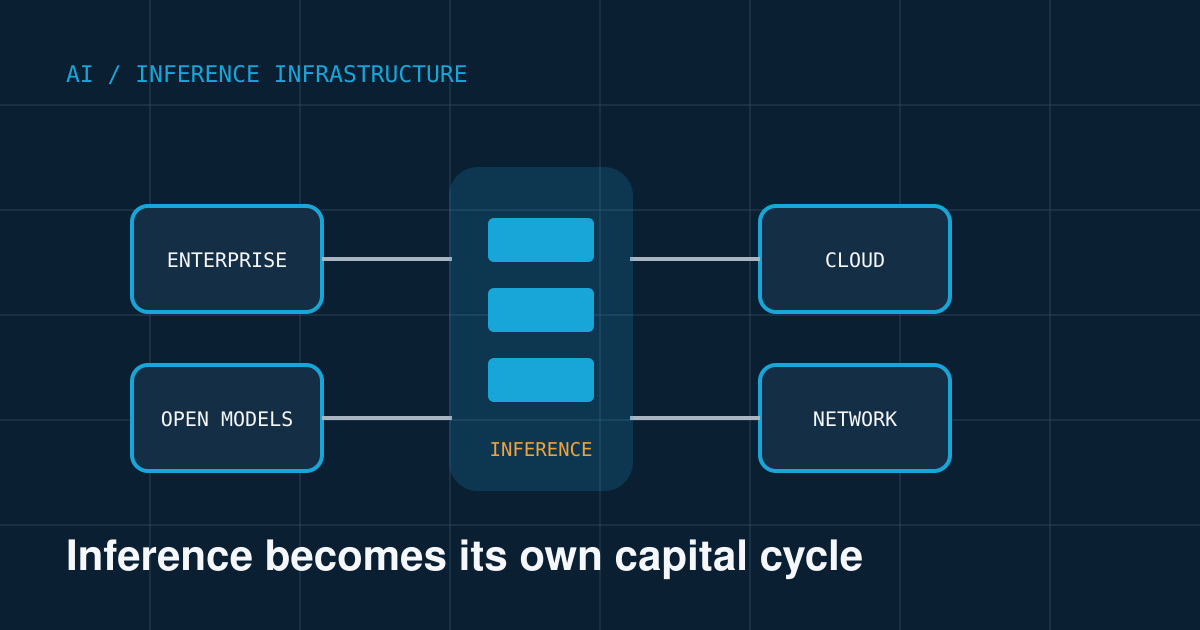
1. Google’s Gemma open-model family passes one billion downloads
Credit: original Market State Lab AI graphic.
Fact: On August 20, Google DeepMind said the Gemma model family had surpassed one billion downloads and that developers had published more than 100,000 model variants over two years. Google highlighted deployments spanning local and edge devices, including onboard analysis and communications work in orbit. Google DeepMind
Inference: The milestone supports the view that smaller open-weight models are becoming a durable deployment layer for constrained, private, and domain-specific inference rather than merely a substitute for frontier APIs.
Uncertainty: Downloads are not unique active users, production deployments, or evidence of model quality. Google supplied the adoption counts; an independently audited usage series was not available.
Why it matters: For MATLAB-centered systems, test compact local models for bounded tasks such as feature documentation, experiment triage, anomaly explanation, and log summarization. Benchmark latency, memory, calibration, and failure modes against a simple deterministic baseline before adding an LLM to the trading loop.
2. CFTC proposes broader CPO and CTA registration exemptions
Credit: original Market State Lab quantitative-finance graphic.
Fact: On August 18, the CFTC proposed amendments to Part 4 that would create a commodity-pool-operator exemption for certain SEC-registered investment advisers serving pools limited to specified sophisticated investors, add a related commodity-trading-adviser exemption, and inflation-adjust the capital threshold for the small-pool exemption. Comments are due 45 days after Federal Register publication. CFTC Release 9284-26
Inference: If adopted, the changes could lower duplicative registration costs for some multi-asset and derivatives strategies, potentially improving entry economics for smaller quantitative managers.
Uncertainty: This is a proposal, not a final rule. Eligibility conditions, compliance interpretation, the final threshold, and the effect on investor protection remain unresolved.
Why it matters: Quant managers should model compliance cost as a strategy-capacity constraint and map every fund, adviser, investor class, and derivatives activity to the proposed conditions before treating an exemption as usable.
3. Wall Street rebounds Friday but SPY and QQQ finish a weaker week
Credit: original Market State Lab U.S. markets graphic.
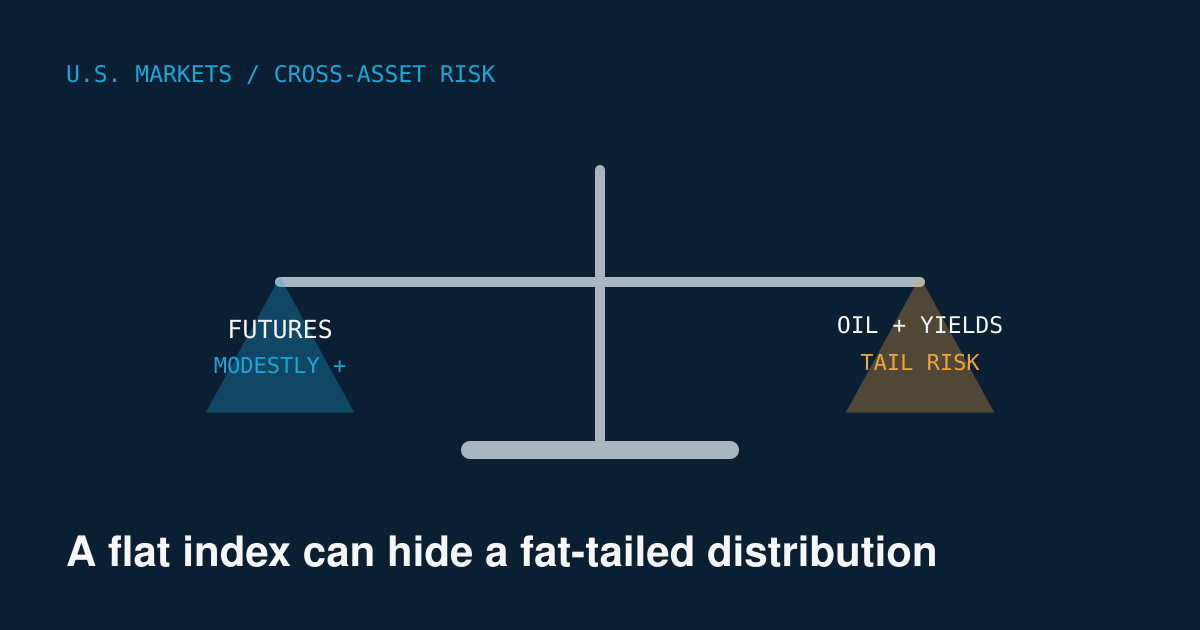
Fact: On August 21, the S&P 500 gained 0.43%, the Nasdaq Composite 0.44%, and the Dow 0.98%. For the week, however, the S&P 500 fell 1.43%, the Nasdaq 2.05%, and the Dow 0.85%. SPY closed at 765.72 on about 39.2 million shares and QQQ at 713.44 on about 33.4 million shares; both ETF readings are prior-close data. Reuters market close
Inference: Friday’s rebound reduced immediate selling pressure without repairing the week’s duration-sensitive damage. The stronger Dow and small-cap session relative to the Nasdaq suggests rotation and dispersion mattered more than a clean broad-risk signal.
Uncertainty: Weekend headlines can invalidate Friday’s close before Sunday futures reopen. Consolidated closing-auction imbalances, displayed depth, effective spreads, and dealer-gamma estimates were not reliably available.
Why it matters: Use Friday’s close as a regime input, not a Monday execution signal. Re-estimate breadth, Treasury sensitivity, spread, and depth after futures reopen and again during Monday’s opening auction.
4. August services PMI points to faster U.S. growth—and persistent price risk
Credit: original Market State Lab Federal Reserve graphic.
Fact: S&P Global’s August flash services PMI rose to 56.8 from 54.6, its highest since December 2024, while the composite output index rose to 56.0, its highest since April 2022. Manufacturing PMI eased to 53.2. S&P Global said the survey was consistent with annualized third-quarter growth approaching 3%, while price pressures remained elevated. Reuters report on S&P Global data
Inference: Strong services demand strengthens the soft-landing case but also reduces urgency for monetary easing, especially while energy and long-term yields remain elevated.
Uncertainty: PMIs are diffusion surveys, not GDP or inflation accounts. The 3% estimate is a model-based nowcast and can change materially with official spending, labor, and price data.
Why it matters: Keep separate growth and inflation states in the regime model. A stronger activity signal can support earnings breadth while simultaneously raising discount-rate pressure on long-duration growth assets.
5. AI infrastructure debt supply begins demanding a larger premium
Credit: original Market State Lab technology/business graphic.
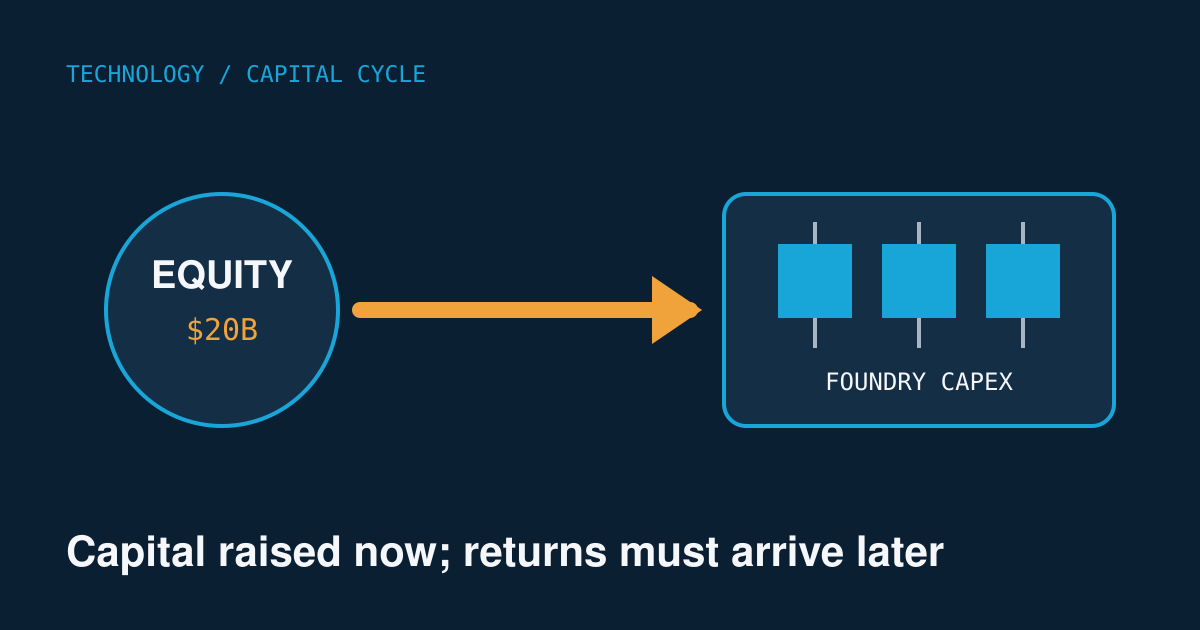
Fact: Reuters reported on August 21 that AI-hyperscaler debt issuance had reached $220 billion in 2026 through August 10, versus $12.5 billion in the comparable 2025 period, citing BNP Paribas. Investors said technology-company bond spreads had widened to 89 basis points—nine basis points wider than the broader investment-grade market—and recent deals required larger concessions despite strong issuer credit quality. Reuters
Inference: Financing conditions are becoming a measurable constraint on the AI capital-expenditure cycle. Credit spreads and new-issue concessions may provide an earlier warning than equity prices when investors question the marginal return on infrastructure spending.
Uncertainty: Aggregate issuance does not reveal project-level returns, and wider spreads can reflect duration, Treasury volatility, supply composition, or portfolio limits rather than deteriorating fundamentals.
Why it matters: Add hyperscaler credit spreads, issuance calendars, maturities, and concession estimates to the AI-equity factor model. Separate cash-funded and debt-funded capital expenditure, then test whether credit repricing leads semiconductor and infrastructure-equity revisions.
Quant & Market Dashboard
Liquidity and funding
- Weekend state: U.S. cash equities, SPY/QQQ options, and regular equity-index futures were closed at the 6:31 a.m. CT cutoff. There is no reliable “overnight” executable liquidity reading; the next meaningful checkpoint is the Sunday futures reopen.
- Friday ETF proxy: SPY volume was about 39.2 million shares, QQQ 33.4 million, and IWM 22.9 million. These are prior-close totals, not forecasts of Monday depth. Consolidated effective spreads, closing-auction imbalances, and order-book depth were unavailable.
- Treasury signal: Treasury’s August 21 indicative 3:30 p.m. ET curve showed 2-year 4.24%, 10-year 4.74%, 20-year 5.25%, and 30-year 5.27%; the 2s30s slope was about +103 basis points. TLT finished down about 0.35%. U.S. Treasury
- Volatility curve: Cboe’s August 21 page showed a September standard-maturity implied-volatility point of 15.19 at 11:19 a.m. ET, while the September VX futures settlement was 17.5022. The timestamps and instruments differ, so use the upward relationship only as a cautious contango proxy. Cboe term structure, Cboe settlements
Volatility regime
Moderate, medium confidence. Mid-teens SPX implied-volatility readings and an upward-sloping forward curve argue against stress. Counterweights are a weak index week, a 30-year yield above 5%, oil/geopolitical headline sensitivity, and an information gap until futures reopen.
Factor performance proxy
Friday prior-close one-session returns favored value, quality, growth, and size over low volatility:
- Momentum (MTUM): approximately +0.01%
- Value (VLUE): approximately +0.46%
- Quality (QUAL): approximately +0.40%
- Size (IWM): approximately +0.76%
- Growth (IWF): approximately +0.46%
- Low volatility (SPLV): approximately -0.45%
These are unadjusted one-session ETF proxies with differing close timestamps. Reliable synchronized one- and three-month total returns were unavailable at the cutoff; recompute them from corporate-action-adjusted closes before using a medium-horizon factor signal.
SPY, QQQ, and options execution
- The August monthly expiration has passed; expect post-expiry position rebuilding and strike migration rather than assuming Friday’s gamma map persists.
- Monday’s opening auction will absorb weekend rate, energy, geopolitical, and corporate headlines. Treat early indicative quotes as price discovery.
- Recheck spread, displayed depth, auction imbalance, short-dated skew, and open interest after Sunday futures reopen and immediately before routing.
- Use limit orders, participation caps, venue-aware slippage models, and realized-cost kill switches. Reject stale, crossed, zero-bid, and thin options quotes.
- Separate opening-auction, first-30-minute, midday, and closing-auction execution models; do not transfer Friday volume curves mechanically to Monday.
Watchlist: SPY, QQQ, IWM, TLT, VIX, MTUM, VLUE, QUAL, IWF, SPLV, HYG, LQD, AMZN, GOOGL, MSFT, NVDA.
DRL Improvements for the MATLAB System
- Add weekend-gap, post-expiry, yield-curve, credit-spread, volatility-curve, and data-freshness states; mask actions when executable liquidity inputs are unavailable.
- Enforce drawdown, concentration, liquidity, and daily-loss limits outside the reward; penalize downside semivariance, turnover, unstable switching, and fills beyond observable depth inside it.
- Randomize weekend gaps, partial fills, latency, stale quotes, spread widening, auction uncertainty, and nonlinear market impact during training.
- Use purged, embargoed walk-forward evaluation with frozen benchmarks and separate calm, high-yield, post-expiry, and geopolitical-shock scorecards.
Model hygiene
Prevent leakage and look-ahead across publication times, Friday closes, Sunday futures, and Monday auctions. Use survivorship-safe universes; adjust for splits, dividends, and symbol changes; preserve exchange timestamps; reject stale options quotes; and correct for multiple testing. Calibrate out of sample and monitor feature, probability, policy, and transaction-cost drift.
MATLAB optimization
- Align cross-asset series with
timetableandsynchronize, retaining source timestamps, session labels, and freshness flags. - Vectorize rolling features and preallocate episode buffers before considering GPU acceleration.
- Run parallel
bayesoptonly across independent, purged folds; keep the final holdout untouched. - Use reproducible random streams and evaluate final policies over multiple seeds and randomized execution paths.
- Profile first; keep data, feature, environment, reward, risk, and execution modules independently testable.
High-value quant research question
Does widening hyperscaler credit versus broad investment-grade credit predict subsequent underperformance or higher implied volatility in AI infrastructure equities after controlling for Treasury-duration shocks?
This is worth testing because it separates financing-supply pressure from the common rate factor and may reveal whether credit markets lead revisions to the AI capital-expenditure cycle.
Disclosure
This publication is research and education, not individualized financial advice or a recommendation to trade. Market and derivatives data may be prior-close, delayed, indicative, venue-specific, or stale. Facts are sourced; inference and material uncertainty are labeled explicitly.