Quant Market Brief — August 20, 2026
Market State Lab
Signals, regimes, and execution for systematic market decisions
Research cutoff: August 20, 2026, 6:30 a.m. CT (11:30 UTC). Premarket prices are indicative; ETF quotes may be delayed or stale. This edition contains exactly five news stories.
Story 1 — AI / Machine Learning / MATLAB
MathWorks brings generative and agentic AI workflows into focus today
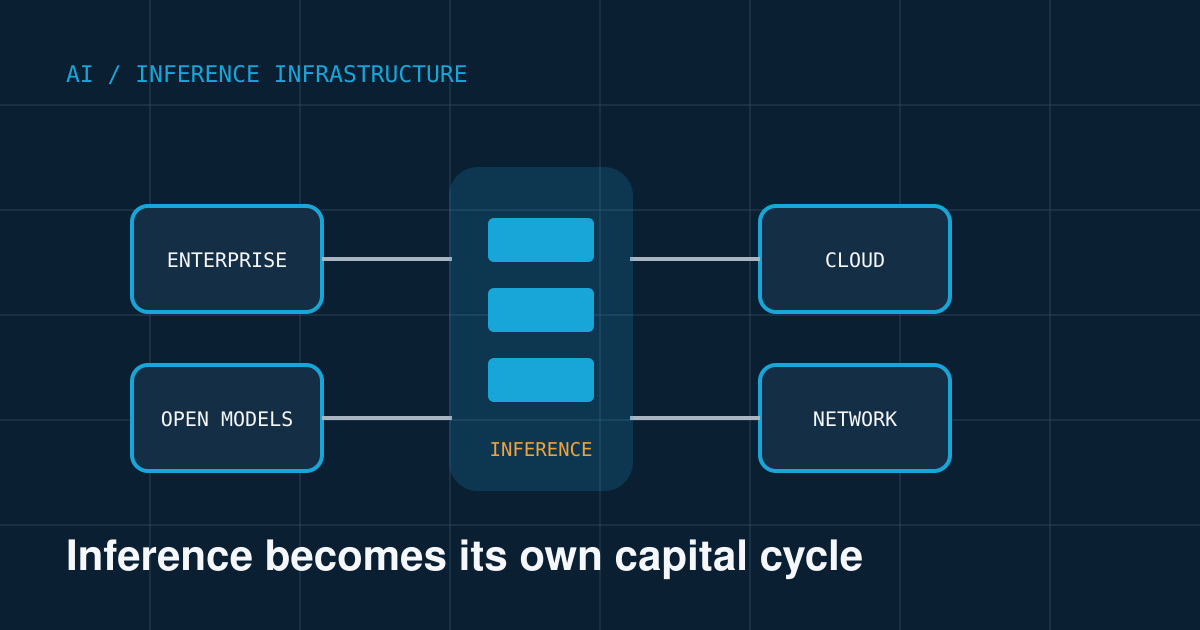
Image: original Market State Lab AI category graphic.
Fact. MathWorks scheduled two August 20 sessions of its “Generative and Agentic AI with MATLAB and Simulink for Engineering” webinar. The program covers code and model creation, algorithm exploration, simulation, repetitive-work automation, and validation of AI-generated results in engineering workflows. The first session begins at 8:00 a.m. CT, after this edition's research cutoff.
Inference. The practical opportunity for a MATLAB-centered trading stack is not autonomous strategy deployment; it is tool-assisted research orchestration—generating candidate code, running controlled experiments, documenting results, and routing outputs through deterministic validation gates.
Uncertainty. The session had not occurred at the cutoff. No comparative productivity, correctness, or trading-performance evidence was available, and webinar examples should not be treated as production validation.
Why it matters. Use agentic workflows for bounded tasks with explicit tests, versioned prompts, fixed datasets, and human approval before any live-trading change. The value is faster experimentation with stronger traceability, not permission to relax model governance.
Source: MathWorks webinar, August 20, 2026
Story 2 — Algorithmic Trading / Quantitative Finance
CFTC asks how compute derivatives should be designed and supervised
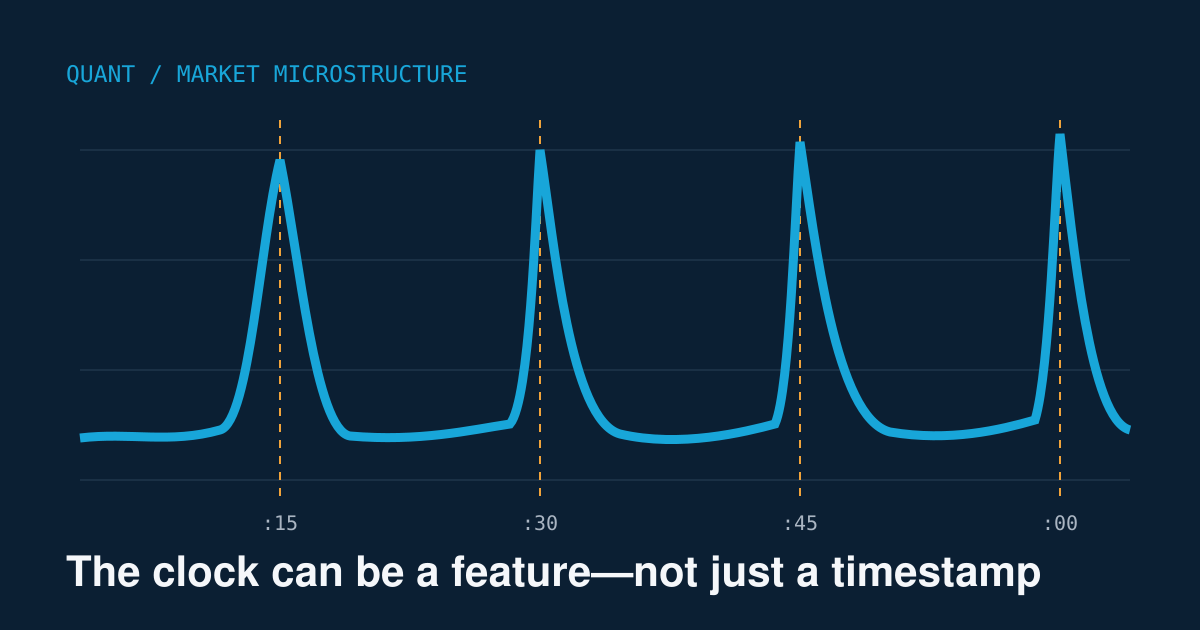
Image: original Market State Lab quantitative-finance category graphic.
Fact. On August 19, the CFTC issued a request for comment on derivatives markets tied to computing power. It is seeking input on cash-market size and liquidity, oversight and manipulation risks, customer protection, and perpetual compute futures. Comments will be accepted for 60 days after publication in the Federal Register.
Inference. Standardized compute futures could eventually create observable forward curves for a major AI input cost, giving data-center operators and model developers a hedging instrument and quants a new cross-commodity signal linking chips, power, cloud demand, and capital expenditure.
Uncertainty. This is an information-gathering step, not approval of a contract or endorsement of any exchange. Deliverability, benchmark quality, market depth, basis risk, and anti-manipulation controls are unresolved.
Why it matters. Before modeling the asset class, define the underlying unit precisely—hardware time, accelerator type, location, power efficiency, service quality, and delivery window. A contract without a robust reference market could be dominated by basis and manipulation risk.
Source: CFTC Release 9286-26, August 19, 2026
Story 3 — U.S. Markets / SPY / QQQ / Options
Long yields rebound while index futures hold near flat
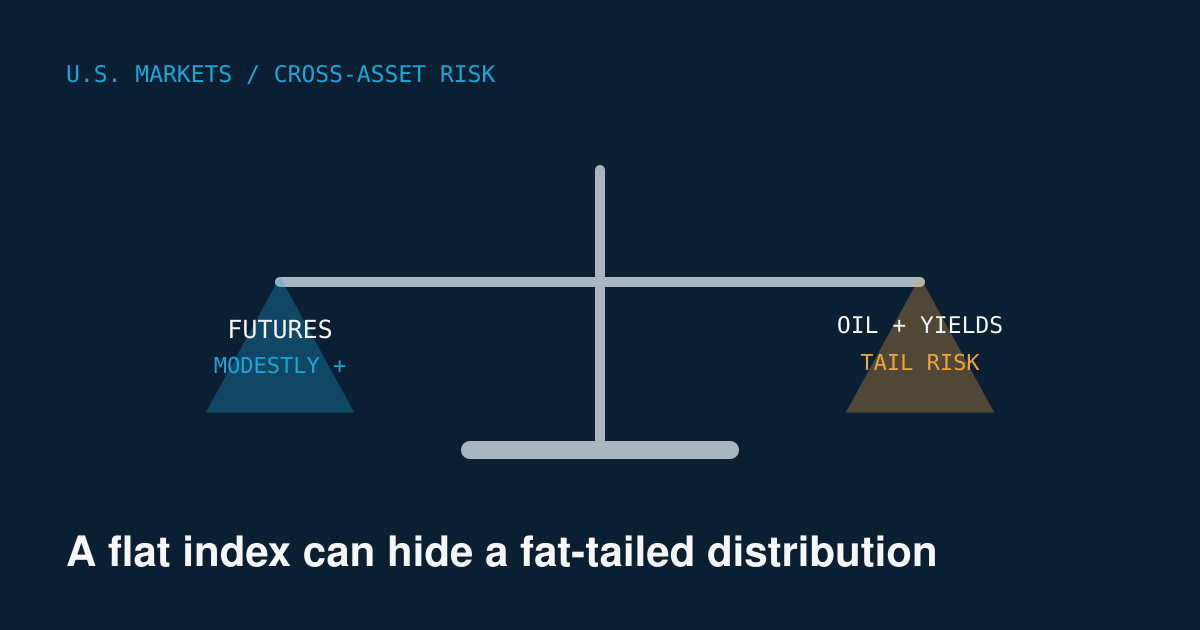
Image: original Market State Lab U.S. markets category graphic.
Fact. At 4:52 a.m. CT, Reuters showed Dow futures down 0.17%, S&P 500 futures down 0.07%, and Nasdaq-100 futures up 0.04%. The 30-year Treasury yield was 5.217% and the 10-year yield 4.67%, while oil was up 2.4%. The figures were premarket indications, not closing prices.
Inference. Near-flat index futures are masking a more fragile cross-asset setup: higher long yields and oil pressure duration-sensitive equities while supporting energy. The more useful signal may be opening dispersion among sectors and factors rather than the broad-index direction.
Uncertainty. Reliable consolidated premarket bid-ask spreads, order-book depth, futures volume, and options positioning were unavailable. Thin ETF prints and last-sale quotes may not represent executable liquidity.
Why it matters. Do not infer calm execution from flat futures. Require post-open breadth and rate confirmation before increasing QQQ exposure; use limits, participation caps, and a separate opening-auction model for gap-sensitive trades.
Source: Reuters market preview, August 20, 2026
Story 4 — U.S. Economy / Federal Reserve
FOMC minutes show a broader willingness to tighten if inflation persists
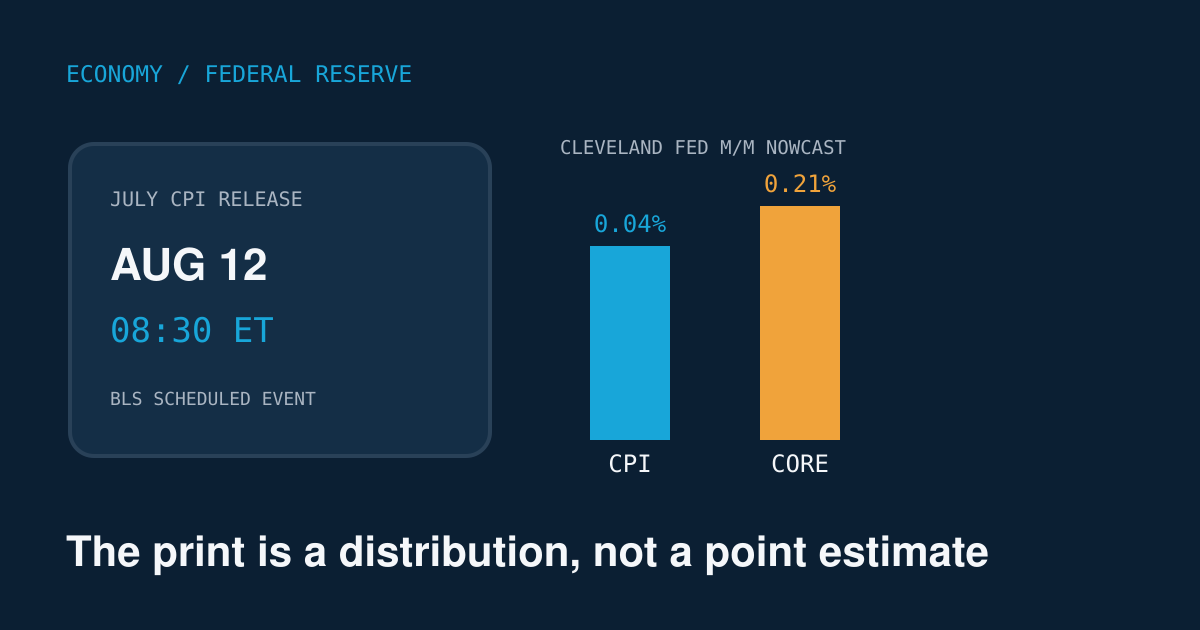
Image: original Market State Lab Federal Reserve category graphic.
Fact. Minutes released August 19 show the Fed held the target range at 3.50%–3.75% by a 9–3 vote at its July 28–29 meeting; three members preferred a quarter-point increase. Several participants favored an increase at that meeting, and many assessed that tightening would likely be necessary if inflation did not decline. The minutes also described money markets as generally stable and reserves as ample during the intermeeting period.
Inference. The policy reaction function is more hawkish than a simple “hold” headline suggests. Persistent inflation, rising long yields, and resilient demand can reprice the expected rate path even without an immediate policy move.
Uncertainty. Minutes describe views at the July meeting, not a commitment for September. Incoming inflation, employment, energy, and financial-conditions data can change the balance.
Why it matters. Rate-sensitive models should carry both hold and renewed-tightening scenarios. Re-estimate equity-duration exposure, financing assumptions, and option-volatility responses rather than treating the policy rate as a static feature.
Source: Federal Reserve, July 28–29 FOMC minutes released August 19, 2026
Story 5 — Technology / Business
Walmart's digital engine grows, but comparable sales miss expectations
Image: original Market State Lab technology/business category graphic.
Fact. Walmart reported Q2 FY27 total revenue growth of 5.9%, global e-commerce growth of 23%, global advertising growth of 38%, and Walmart U.S. comparable-sales growth of 2.6% excluding fuel. Reuters reported that the comparable-sales figure missed the 3.8% consensus as consumers pared spending; Walmart nevertheless raised its full-year sales and earnings outlook.
Inference. Walmart is becoming a mixed retail, marketplace, logistics, and advertising platform, but the sales miss is a cautionary consumer signal. For equity models, digital and advertising growth may support margins while softer transactions constrain the cyclical read-through.
Uncertainty. Company-reported adjusted and constant-currency measures require reconciliation to GAAP. Pharmacy-policy effects and tariff refunds complicate year-over-year comparisons, and the early share reaction may change after management's conference call.
Why it matters. Separate consumer-demand features from business-mix features. Track transactions, basket size, e-commerce contribution, advertising growth, margin quality, and guidance revisions instead of using headline revenue alone.
Sources: Walmart Q2 FY27 release, August 20, 2026 and Reuters analysis, August 20, 2026
Quant & Market Dashboard
Overnight liquidity and funding
- Futures/ETF proxy: Reuters' 4:52 a.m. CT snapshot showed Dow futures -0.17%, S&P 500 futures -0.07%, and Nasdaq-100 futures +0.04%. Around 6:15 a.m. CT, indicative prints showed SPY near 769.06 (+0.19%) and QQQ near 716.08 (-0.21%). The ETF/futures divergence is small but argues against treating one feed as definitive.
- Rates/oil: The 30-year Treasury yield was 5.217%, the 10-year 4.67%, and oil was up 2.4%. Long-end yield pressure and oil-driven inflation risk remain the principal cross-asset liquidity signals.
- Depth/spreads/volume: Reliable consolidated premarket spreads, order-book depth, and futures/ETF volume were unavailable. Do not infer normal liquidity from last-sale prints.
- Funding: Same-day SOFR and EFFR fixings were not yet published at the cutoff. The July FOMC minutes described money markets as generally stable, repo softness as brief, and reserves as ample, but that is historical context—not a live funding reading.
Volatility regime
Classification: Moderate, with low headline implied volatility and elevated macro gap risk. Confidence: medium. Cboe showed spot VIX around 15.31 on August 20, while the August 19 close was about 14.89. Those levels are not stressed, but rising oil and long yields increase the chance that realized opening dispersion exceeds the broad-index volatility signal.
Factor performance proxy
Premarket indications favored size and value over growth: IWM was about +0.45%, VLUE +0.22%, IWF -0.33%, and SPLV near flat. QUAL's latest available print was approximately +0.08% but timestamp-stale; MTUM's roughly -1.99% indication was earlier and potentially non-representative. Treat this as a short-horizon directional proxy only. Reliable adjusted-close medium-horizon returns were unavailable at cutoff; recompute one- and three-month factor returns before using them in a model.
Execution risk — SPY, QQQ, and options
- Flat index futures can conceal sector dispersion. Expect opening-auction imbalance in WMT and related consumer names and duration sensitivity in QQQ.
- Weekly options expire tomorrow; short-dated gamma can amplify strike-level pinning or reversals. Verify current open interest and dealer-gamma estimates before acting.
- Jobless claims are due at 7:30 a.m. CT, Walmart's call at 7:00 a.m. CT, and Fed commentary later in the session. Avoid scheduling unbounded market orders through those windows.
- Use limits, participation caps, spread/depth checks, and slippage kill switches. Reject stale options quotes and premarket prints with insufficient size.
Actionable microstructure watchlist
Core: SPY, QQQ, IWM, TLT, VIX. Factors: MTUM, VLUE, QUAL, IWF, SPLV. Cross-asset/event: XLE, USO, WMT, XLY, XLP. Look for confirmation from QQQ/TLT weakness plus XLE strength before labeling a persistent inflation-duration shock.
DRL Improvements for the MATLAB System
- Add long-yield, oil-shock, VIX-term-structure, and opening-dispersion states; require a regime transition to persist before changing policy mode.
- Enforce drawdown, concentration, and daily-loss limits outside the reward while penalizing downside semivariance, turnover, and unstable action switching inside it.
- Randomize gaps, spreads, partial fills, latency, and nonlinear market impact during training; evaluate on unseen cost and liquidity regimes.
- Use purged, embargoed walk-forward tests with frozen benchmarks, identical seeds, and separate calm, inflation, and event-shock scorecards.
Model hygiene
Guard against target leakage, survivorship and look-ahead bias, unadjusted corporate actions, stale options quotes, and timestamp mismatches across futures, ETFs, rates, earnings, and news. Correct for multiple testing; calibrate probabilities out of sample; monitor feature, policy, and transaction-cost drift.
MATLAB optimization patterns
- Align cross-asset inputs with
timetableandsynchronize; vectorize rolling features before training. - Use parallel
bayesoptonly for independent, purged folds and retain the full trial history. - Fix reproducible random streams per fold and environment, then test final policies across multiple seeds.
- Profile first; reserve GPU execution for sufficiently large networks and batches, and keep data, environment, reward, and execution modules independently testable.
High-value quant research question
Does the combination of VIX spot-to-front-future slope and the change in the 30-year Treasury yield predict when near-flat index futures will produce unusually large SPY/QQQ opening dispersion? If so, it could improve auction participation, strategy selection, and dynamic slippage assumptions without relying on index direction alone.
Disclosure
This is research and educational analysis, not individualized financial advice. Market data were gathered from public sources at the stated cutoff and may be delayed, indicative, revised, or incomplete. Validate prices, liquidity, and suitability before acting.
Market State Lab
Signals, regimes, and execution for systematic market decisions
Research cutoff: August 20, 2026, 6:30 a.m. CT (11:30 UTC). Premarket prices are indicative; ETF quotes may be delayed or stale. This edition contains exactly five news stories.
Story 1 — AI / Machine Learning / MATLAB
MathWorks brings generative and agentic AI workflows into focus today
Image: original Market State Lab AI category graphic.
Fact. MathWorks scheduled two August 20 sessions of its “Generative and Agentic AI with MATLAB and Simulink for Engineering” webinar. The program covers code and model creation, algorithm exploration, simulation, repetitive-work automation, and validation of AI-generated results in engineering workflows. The first session begins at 8:00 a.m. CT, after this edition's research cutoff.
Inference. The practical opportunity for a MATLAB-centered trading stack is not autonomous strategy deployment; it is tool-assisted research orchestration—generating candidate code, running controlled experiments, documenting results, and routing outputs through deterministic validation gates.
Uncertainty. The session had not occurred at the cutoff. No comparative productivity, correctness, or trading-performance evidence was available, and webinar examples should not be treated as production validation.
Why it matters. Use agentic workflows for bounded tasks with explicit tests, versioned prompts, fixed datasets, and human approval before any live-trading change. The value is faster experimentation with stronger traceability, not permission to relax model governance.
Source: MathWorks webinar, August 20, 2026
Story 2 — Algorithmic Trading / Quantitative Finance
CFTC asks how compute derivatives should be designed and supervised
Image: original Market State Lab quantitative-finance category graphic.
Fact. On August 19, the CFTC issued a request for comment on derivatives markets tied to computing power. It is seeking input on cash-market size and liquidity, oversight and manipulation risks, customer protection, and perpetual compute futures. Comments will be accepted for 60 days after publication in the Federal Register.
Inference. Standardized compute futures could eventually create observable forward curves for a major AI input cost, giving data-center operators and model developers a hedging instrument and quants a new cross-commodity signal linking chips, power, cloud demand, and capital expenditure.
Uncertainty. This is an information-gathering step, not approval of a contract or endorsement of any exchange. Deliverability, benchmark quality, market depth, basis risk, and anti-manipulation controls are unresolved.
Why it matters. Before modeling the asset class, define the underlying unit precisely—hardware time, accelerator type, location, power efficiency, service quality, and delivery window. A contract without a robust reference market could be dominated by basis and manipulation risk.
Source: CFTC Release 9286-26, August 19, 2026
Story 3 — U.S. Markets / SPY / QQQ / Options
Long yields rebound while index futures hold near flat
Image: original Market State Lab U.S. markets category graphic.
Fact. At 4:52 a.m. CT, Reuters showed Dow futures down 0.17%, S&P 500 futures down 0.07%, and Nasdaq-100 futures up 0.04%. The 30-year Treasury yield was 5.217% and the 10-year yield 4.67%, while oil was up 2.4%. The figures were premarket indications, not closing prices.
Inference. Near-flat index futures are masking a more fragile cross-asset setup: higher long yields and oil pressure duration-sensitive equities while supporting energy. The more useful signal may be opening dispersion among sectors and factors rather than the broad-index direction.
Uncertainty. Reliable consolidated premarket bid-ask spreads, order-book depth, futures volume, and options positioning were unavailable. Thin ETF prints and last-sale quotes may not represent executable liquidity.
Why it matters. Do not infer calm execution from flat futures. Require post-open breadth and rate confirmation before increasing QQQ exposure; use limits, participation caps, and a separate opening-auction model for gap-sensitive trades.
Source: Reuters market preview, August 20, 2026
Story 4 — U.S. Economy / Federal Reserve
FOMC minutes show a broader willingness to tighten if inflation persists
Image: original Market State Lab Federal Reserve category graphic.
Fact. Minutes released August 19 show the Fed held the target range at 3.50%–3.75% by a 9–3 vote at its July 28–29 meeting; three members preferred a quarter-point increase. Several participants favored an increase at that meeting, and many assessed that tightening would likely be necessary if inflation did not decline. The minutes also described money markets as generally stable and reserves as ample during the intermeeting period.
Inference. The policy reaction function is more hawkish than a simple “hold” headline suggests. Persistent inflation, rising long yields, and resilient demand can reprice the expected rate path even without an immediate policy move.
Uncertainty. Minutes describe views at the July meeting, not a commitment for September. Incoming inflation, employment, energy, and financial-conditions data can change the balance.
Why it matters. Rate-sensitive models should carry both hold and renewed-tightening scenarios. Re-estimate equity-duration exposure, financing assumptions, and option-volatility responses rather than treating the policy rate as a static feature.
Source: Federal Reserve, July 28–29 FOMC minutes released August 19, 2026
Story 5 — Technology / Business
Walmart's digital engine grows, but comparable sales miss expectations
Image: original Market State Lab technology/business category graphic.
Fact. Walmart reported Q2 FY27 total revenue growth of 5.9%, global e-commerce growth of 23%, global advertising growth of 38%, and Walmart U.S. comparable-sales growth of 2.6% excluding fuel. Reuters reported that the comparable-sales figure missed the 3.8% consensus as consumers pared spending; Walmart nevertheless raised its full-year sales and earnings outlook.
Inference. Walmart is becoming a mixed retail, marketplace, logistics, and advertising platform, but the sales miss is a cautionary consumer signal. For equity models, digital and advertising growth may support margins while softer transactions constrain the cyclical read-through.
Uncertainty. Company-reported adjusted and constant-currency measures require reconciliation to GAAP. Pharmacy-policy effects and tariff refunds complicate year-over-year comparisons, and the early share reaction may change after management's conference call.
Why it matters. Separate consumer-demand features from business-mix features. Track transactions, basket size, e-commerce contribution, advertising growth, margin quality, and guidance revisions instead of using headline revenue alone.
Sources: Walmart Q2 FY27 release, August 20, 2026 and Reuters analysis, August 20, 2026
Quant & Market Dashboard
Overnight liquidity and funding
- Futures/ETF proxy: Reuters' 4:52 a.m. CT snapshot showed Dow futures -0.17%, S&P 500 futures -0.07%, and Nasdaq-100 futures +0.04%. Around 6:15 a.m. CT, indicative prints showed SPY near 769.06 (+0.19%) and QQQ near 716.08 (-0.21%). The ETF/futures divergence is small but argues against treating one feed as definitive.
- Rates/oil: The 30-year Treasury yield was 5.217%, the 10-year 4.67%, and oil was up 2.4%. Long-end yield pressure and oil-driven inflation risk remain the principal cross-asset liquidity signals.
- Depth/spreads/volume: Reliable consolidated premarket spreads, order-book depth, and futures/ETF volume were unavailable. Do not infer normal liquidity from last-sale prints.
- Funding: Same-day SOFR and EFFR fixings were not yet published at the cutoff. The July FOMC minutes described money markets as generally stable, repo softness as brief, and reserves as ample, but that is historical context—not a live funding reading.
Volatility regime
Classification: Moderate, with low headline implied volatility and elevated macro gap risk. Confidence: medium. Cboe showed spot VIX around 15.31 on August 20, while the August 19 close was about 14.89. Those levels are not stressed, but rising oil and long yields increase the chance that realized opening dispersion exceeds the broad-index volatility signal.
Factor performance proxy
Premarket indications favored size and value over growth: IWM was about +0.45%, VLUE +0.22%, IWF -0.33%, and SPLV near flat. QUAL's latest available print was approximately +0.08% but timestamp-stale; MTUM's roughly -1.99% indication was earlier and potentially non-representative. Treat this as a short-horizon directional proxy only. Reliable adjusted-close medium-horizon returns were unavailable at cutoff; recompute one- and three-month factor returns before using them in a model.
Execution risk — SPY, QQQ, and options
- Flat index futures can conceal sector dispersion. Expect opening-auction imbalance in WMT and related consumer names and duration sensitivity in QQQ.
- Weekly options expire tomorrow; short-dated gamma can amplify strike-level pinning or reversals. Verify current open interest and dealer-gamma estimates before acting.
- Jobless claims are due at 7:30 a.m. CT, Walmart's call at 7:00 a.m. CT, and Fed commentary later in the session. Avoid scheduling unbounded market orders through those windows.
- Use limits, participation caps, spread/depth checks, and slippage kill switches. Reject stale options quotes and premarket prints with insufficient size.
Actionable microstructure watchlist
Core: SPY, QQQ, IWM, TLT, VIX. Factors: MTUM, VLUE, QUAL, IWF, SPLV. Cross-asset/event: XLE, USO, WMT, XLY, XLP. Look for confirmation from QQQ/TLT weakness plus XLE strength before labeling a persistent inflation-duration shock.
DRL Improvements for the MATLAB System
- Add long-yield, oil-shock, VIX-term-structure, and opening-dispersion states; require a regime transition to persist before changing policy mode.
- Enforce drawdown, concentration, and daily-loss limits outside the reward while penalizing downside semivariance, turnover, and unstable action switching inside it.
- Randomize gaps, spreads, partial fills, latency, and nonlinear market impact during training; evaluate on unseen cost and liquidity regimes.
- Use purged, embargoed walk-forward tests with frozen benchmarks, identical seeds, and separate calm, inflation, and event-shock scorecards.
Model hygiene
Guard against target leakage, survivorship and look-ahead bias, unadjusted corporate actions, stale options quotes, and timestamp mismatches across futures, ETFs, rates, earnings, and news. Correct for multiple testing; calibrate probabilities out of sample; monitor feature, policy, and transaction-cost drift.
MATLAB optimization patterns
- Align cross-asset inputs with
timetableandsynchronize; vectorize rolling features before training. - Use parallel
bayesoptonly for independent, purged folds and retain the full trial history. - Fix reproducible random streams per fold and environment, then test final policies across multiple seeds.
- Profile first; reserve GPU execution for sufficiently large networks and batches, and keep data, environment, reward, and execution modules independently testable.
High-value quant research question
Does the combination of VIX spot-to-front-future slope and the change in the 30-year Treasury yield predict when near-flat index futures will produce unusually large SPY/QQQ opening dispersion? If so, it could improve auction participation, strategy selection, and dynamic slippage assumptions without relying on index direction alone.
Disclosure
This is research and educational analysis, not individualized financial advice. Market data were gathered from public sources at the stated cutoff and may be delayed, indicative, revised, or incomplete. Validate prices, liquidity, and suitability before acting.