Quant Market Brief — August 18, 2026
Market State Lab
Signals, regimes, and execution for systematic market decisions
Research cutoff: August 18, 2026, 6:27 a.m. CT (11:27 UTC). Premarket prices are indicative; ETF quotes may be delayed or stale. This edition contains exactly five news stories.
Story 1 — AI / Machine Learning
Pentagon demand accelerates Smack's battlefield-AI funding
Image: original Market State Lab AI category graphic.
Fact. Reuters reported on August 17 that Smack Technologies raised $61 million in a Series B round to accelerate production of Omega, its reinforcement-learning and computer-vision platform for military fires planning, and to develop Alpha, a flexible forearm AI display. The company said the round followed Pentagon pressure to diversify AI suppliers and move faster; the valuation was not disclosed.
Inference. Defense AI procurement is broadening beyond foundation-model vendors toward edge decision systems that can operate in degraded communications environments. For builders, the relevant technical edge is fast, auditable inference under constrained connectivity—not only larger models.
Uncertainty. Performance claims come from the company; operational effectiveness, deployment scale, and contract economics are not independently established.
Why it matters. Watch the intersection of reinforcement learning, computer vision, ruggedized hardware, and government procurement. Technical teams should test offline/edge failure modes and decision latency as first-class metrics.
Source: Reuters, August 17, 2026
Story 2 — Algorithmic Trading / Quantitative Finance
New research lets trading agents discover their own auxiliary learning tasks
Image: original Market State Lab quantitative-finance category graphic.
Fact. A paper submitted to arXiv on August 16 proposes a self-supervised framework in which a secondary network generates auxiliary General Value Function tasks for a stock-trading reinforcement-learning agent. The authors report tests across the DJI, FTSE, Sensex, and TAIEX and say automatically discovered tasks improved stability and performance against their baselines.
Inference. Meta-learned auxiliary objectives could reduce dependence on hand-chosen horizons and prediction targets when regimes change. The strongest practical use may be representation stability, not raw return maximization.
Uncertainty. This is a preprint, not peer-reviewed evidence. The abstract does not establish live-trading viability, after-cost robustness, or resistance to data snooping.
Why it matters. MATLAB DRL workflows can benchmark learned auxiliary tasks against fixed return/volatility targets using identical costs, seeds, and walk-forward splits. Reject gains that disappear under purged evaluation or realistic turnover penalties.
Source: arXiv:2608.15841, submitted August 16, 2026
Story 3 — U.S. Markets / SPY / QQQ / Options
Oil and long yields hit growth futures; Nasdaq leads the decline
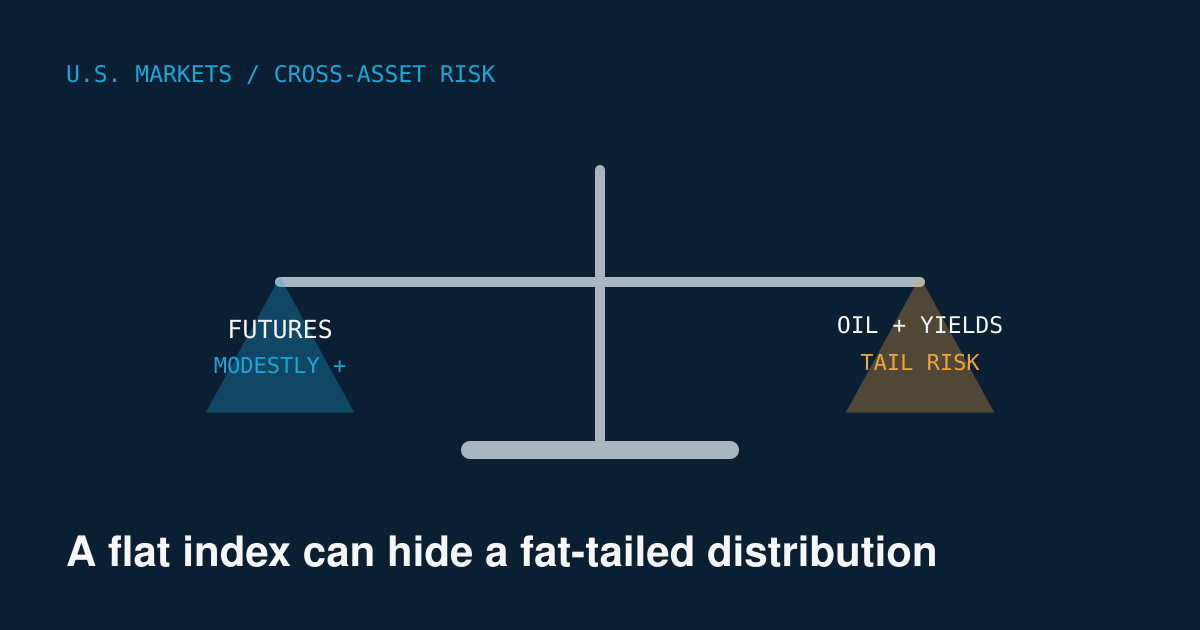
Image: original Market State Lab U.S. markets category graphic.
Fact. At Reuters' August 18 premarket snapshot, S&P 500 futures were down 0.47%, Nasdaq futures 1.21%, and Dow futures were near flat as Brent rose 0.4% and the 30-year Treasury yield reached its highest level since 2007. Nvidia was indicated down 2%, Tesla 1.4%, while Home Depot rose 2.3% after results. The figures were live-at-publication indications, not closing prices.
Inference. The cross-asset signal is duration stress rather than broad liquidation: high-multiple technology is absorbing more pressure than the Dow, while energy and rate sensitivity dominate index dispersion.
Uncertainty. Premarket prices can reverse at the opening auction; reliable consolidated depth, spread, and options-open-interest data were unavailable at the research cutoff.
Why it matters. Avoid treating the first print as executable fair value. Use participation caps, limit orders, and separate overnight-gap logic for QQQ and AI-linked names; monitor whether breadth confirms the futures move after the open.
Source: Reuters, August 18, 2026
Story 4 — U.S. Economy / Federal Reserve
A San Francisco Fed estimate says policy may already be accommodative
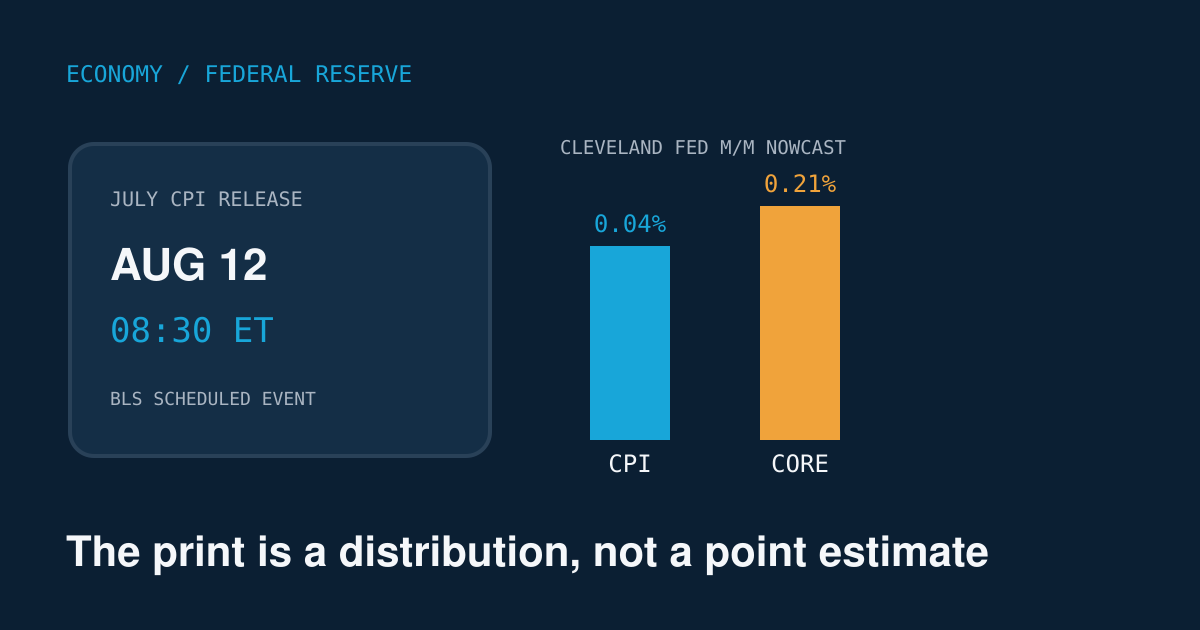
Image: original Market State Lab Federal Reserve category graphic.
Fact. San Francisco Fed research reported by Reuters on August 17 estimates that the current 3.50%–3.75% federal-funds target range sits about 0.5–0.75 percentage point below a medium-run neutral rate. That implies accommodative policy under this specific measure, contrary to most policymakers' restrictive-or-neutral characterization.
Inference. If the estimate gains influence, it strengthens the case for judging policy against a time-varying neutral rate and could make the Fed less tolerant of renewed energy-driven inflation.
Uncertainty. Neutral rates are unobservable and model-dependent. The author explicitly said uncertainty around the medium-run estimate is high; this is analysis, not a policy commitment.
Why it matters. Rate-sensitive models should carry competing policy-state estimates rather than a single neutral-rate assumption. Stress equity duration, term premium, and funding costs under both hold and renewed-tightening paths.
Source: Reuters, August 17, 2026
Story 5 — Technology / Business
Tesla reportedly prepares an August Cybercab rollout in Austin
Image: original Market State Lab technology/business category graphic.
Fact. Reuters, citing The Information, reported on August 17 that Tesla told employees it was preparing a Cybercab rollout in Austin as soon as August, beginning with employee rides before a public launch. The purpose-built autonomous vehicle has no steering wheel or pedals.
Inference. A real-world rollout would move Tesla's autonomy thesis from retrofit software toward a dedicated fleet product, shifting attention to utilization, safety intervention rates, regulatory approvals, and unit economics.
Uncertainty. The timing is based on unnamed sources and was not independently confirmed by Tesla in the report. Launch scope, permits, safety performance, and commercial availability remain unclear.
Why it matters. Treat the announcement as an execution catalyst, not proof of scale. Track verifiable fleet size, paid rides, disengagement/intervention data, service geography, and insurance/regulatory milestones.
Source: Reuters, August 17, 2026
Quant & Market Dashboard
Overnight liquidity and funding
- Index/ETF proxy: Reuters' 4:30 a.m. CT market snapshot showed S&P 500 futures -0.47% and Nasdaq futures -1.21%, with Dow futures near flat. At roughly 6:14 a.m. CT, indicative ETF prints showed SPY -0.47%, IWM -0.34%, and TLT -0.82%; QQQ's -0.17% indication conflicted with Nasdaq futures and should be treated as stale or non-representative.
- Rates/oil: The 30-year Treasury yield was about 5.32%, its highest since 2007, while Brent was near three-week highs. That combination raises both duration and inflation-risk premia.
- Depth/spreads/volume: Reliable consolidated premarket depth, bid-ask spreads, and futures volume were not available. Do not infer normal liquidity from headline ETF prices.
- Funding: The New York Fed publishes SOFR around 8:00 a.m. ET and EFFR around 9:00 a.m. ET; August 18 fixings were not yet available at cutoff. No verified funding dislocation was identified, but absence of a fresh fixing is not evidence of calm.
Volatility regime
Classification: Moderate, with low-volatility pricing and elevated gap risk. Confidence: medium. VIX was just under 16 around 6:05 a.m. CT, up roughly 0.7 point but below the conventional 20 threshold. The low level conflicts with a large Nasdaq-futures gap and a multi-decade high in the long bond yield; realized opening volatility may therefore exceed what the headline VIX suggests.
Factor performance proxy
Premarket ETF indications are uneven and some timestamps are stale, so they are a cautious short-horizon proxy, not a verified factor return panel. Momentum (MTUM) showed a positive indication, while value (VLUE) was near flat; quality (QUAL), growth (VUG), and minimum volatility (USMV) were negative. IWM's decline suggests a weak size proxy. Reliable medium-horizon factor returns were unavailable at cutoff; recompute from adjusted closes before using the signal.
Execution risk — SPY, QQQ, and options
- Expect opening-auction imbalance and gap-fill risk, especially in QQQ and AI-linked constituents. Delay marketable orders until spreads/depth normalize unless the strategy explicitly trades the auction.
- Use limit prices, participation caps, and realized-slippage kill switches. Treat thin premarket prints and stale options quotes as non-executable.
- Wednesday VIX expiry and Friday weekly equity/options expiry can amplify strike-level hedging flows. Confirm open interest and dealer-gamma estimates from current data before acting.
- Oil headlines and long-end Treasury moves are the main intraday liquidity traps: both can reverse index duration trades quickly.
Actionable microstructure watchlist
Core: SPY, QQQ, IWM, TLT, VIX. Factors: MTUM, VLUE, QUAL, VUG, USMV. Event/dispersion: XLK, XLE, NVDA, TSLA, HD. Prefer cross-asset confirmation—QQQ weakness plus TLT weakness and XLE strength—before labeling a persistent duration shock.
DRL Improvements for the MATLAB System
- Add an oil/yield-shock regime state and clip directional exposure when cross-asset stress exceeds a rolling threshold.
- Separate reward shaping from hard risk constraints: penalize downside semivariance and turnover while enforcing drawdown and concentration limits outside the reward.
- Randomize gaps, spreads, partial fills, latency, and market impact during training; evaluate on unseen cost regimes.
- Use purged, embargoed walk-forward tests across calm, inflation, and geopolitical windows, with identical seeds and a frozen benchmark policy.
Model hygiene
Guard against target leakage, survivorship and look-ahead bias, unadjusted splits/dividends, stale options quotes, and timestamp mismatches across futures, ETFs, rates, and news. Correct for multiple testing; calibrate probabilities out of sample; monitor feature, policy, and transaction-cost drift.
MATLAB optimization patterns
- Align cross-asset inputs with
timetableandsynchronize; vectorize rolling features before training. - Use
bayesoptwith parallel workers only on truly independent, purged folds; retain all trials, not only winners. - Fix reproducible random streams per fold and environment, then rerun final policies across multiple seeds.
- Profile first; reserve GPU use for sufficiently large networks and batches, and keep environment/reward modules unit-testable.
High-value quant research question
Does a joint oil-shock and long-yield filter improve the choice between QQQ momentum and gap-reversion after large overnight moves, net of auction slippage? It tests whether cross-asset confirmation distinguishes persistent duration repricing from transient headline gaps.
Disclosure
This is research and educational analysis, not individualized financial advice. Market data were gathered from public sources at the stated cutoff and may be delayed, indicative, revised, or incomplete. Validate prices, liquidity, and suitability before acting.