Quant Market Brief — August 17, 2026
Market State Lab
Research cutoff: August 17, 2026, 6:28 a.m. CT (11:28 UTC)
Data convention: Premarket and overnight readings are indicative or delayed where noted; they are not executable quotes.
Story 1 — AI / Machine Learning
U.S. draft would force AI-coalition partners to choose between Washington and Beijing
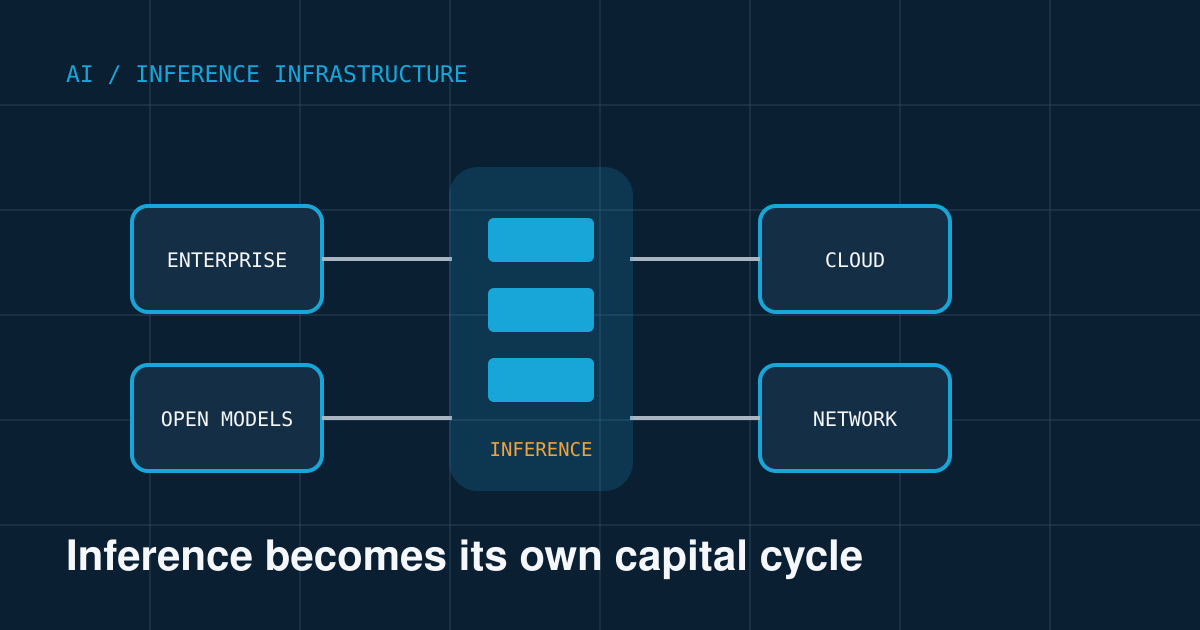
Market State Lab category graphic. Reporting-image credit: Reuters/Dado Ruvic/Illustration/File Photo.
Facts: Reuters reported on August 14 that a draft State Department letter would tell 35 signatories of the U.S. AI Opportunity Statement that membership in the U.S.-led Pax Silica framework cannot coexist with participation in a competing Chinese initiative. The draft covers cooperation on AI models, semiconductors and critical minerals. Kazakhstan is the only country publicly known to have joined both frameworks.
Inference: If enacted, the policy would fragment AI supply chains and model ecosystems further, raising compliance, vendor-selection and data-sovereignty costs for global technology firms.
Uncertainty: The letter was undated; Reuters could not determine when it would be sent or whether it would be amended. The State Department declined to comment on the leaked draft.
Why it matters: Treat country alignment as a new feature in semiconductor, cloud and model-provider risk models. For systematic portfolios, map revenue and supply-chain exposure by jurisdiction rather than relying only on sector labels.
Source: Reuters, August 14, 2026
Story 2 — Algorithmic Trading / Quantitative Finance
New factor-allocation test finds classical optimization more stable under tight risk constraints
Market State Lab category graphic. Research source: Sahoo, Tee and Griffin, arXiv.
Facts: A preprint submitted August 14 compares a photonic quantum annealer, Gurobi mixed-integer optimization and a Soft Actor-Critic reinforcement-learning allocator on a 13-factor equity library over a 164-month test window. Across 48 penalty configurations, the authors report that photonic hardware found attractive risk-return regions in a narrow range, while the classical solver was more stable for tight tail-risk mandates. They also report failure modes for the RL allocator when higher-moment rewards were insufficiently anchored.
Inference: The practical edge is likely to come from solver selection by mandate, not from replacing classical optimization wholesale. RL reward shaping needs explicit tail-risk and turnover anchors.
Uncertainty: This is a new, non-peer-reviewed preprint. Results depend on the chosen factor library, penalties, hardware and evaluation design; they do not establish live-trading superiority.
Why it matters: Use the paper as a reproducible challenger-model template: compare solvers across seeds, tail-risk constraints and transaction costs before promoting any optimizer into production.
Source: arXiv:2608.14134, submitted August 14, 2026
Story 3 — U.S. Markets / SPY / QQQ / Options
Nasdaq futures lead a mixed premarket while volatility rises from a low base
Market State Lab category graphic. Reporting-image credit: Reuters/Jeenah Moon.
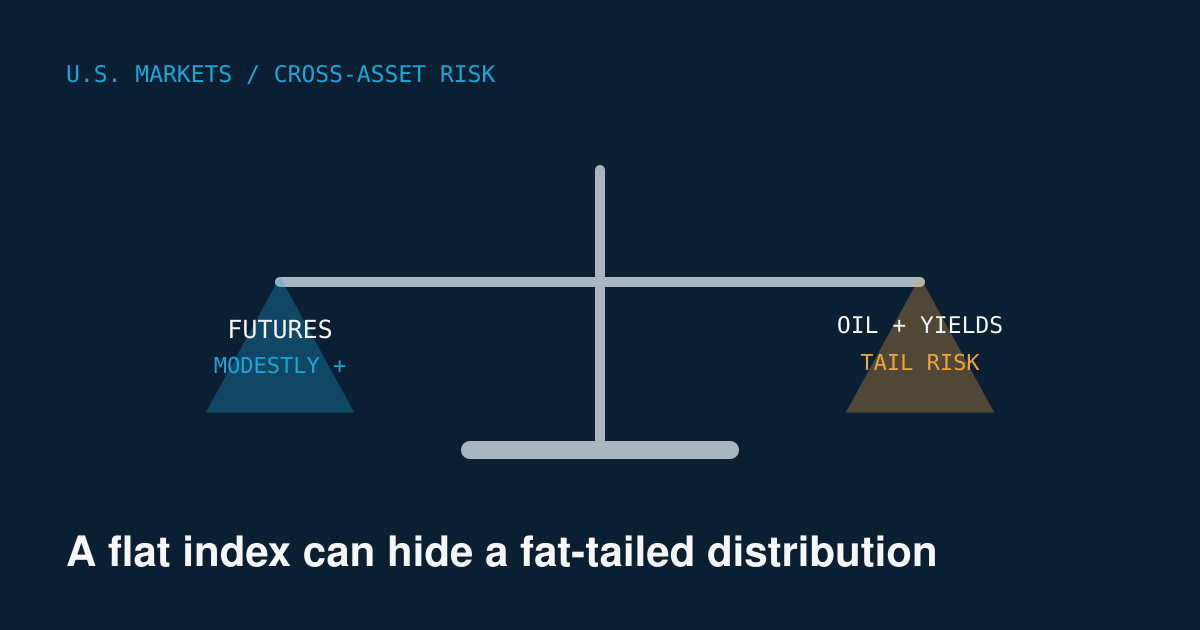
Facts: At 6:20 a.m. ET, Reuters reported Dow e-minis down 0.13%, S&P 500 e-minis up 0.14% and Nasdaq-100 e-minis up 0.49%. Micron and Broadcom were indicated higher, while investors weighed softer U.S. data against continuing Middle East risk. Cboe showed the VIX at 14.92, up 4.70% from Friday’s 14.25 close, with data delayed at least 20 minutes.
Inference: The cross-asset message is risk-on within technology rather than broad risk appetite. A higher VIX alongside positive Nasdaq futures suggests traders are retaining event hedges despite the equity bid.
Uncertainty: Premarket moves can reverse at the cash open. Public sources did not provide reliable executable ETF spreads, depth or full options gamma positioning at the research cutoff.
Why it matters: Avoid treating QQQ strength as a market-wide signal. Use opening-auction controls, cap participation and wait for spread/depth normalization before increasing size.
Sources: Reuters, August 17, 2026 · Cboe VIX
Story 4 — U.S. Economy / Federal Reserve
Economists overwhelmingly expect the Fed to hold in September and through year-end
Market State Lab category graphic. Reporting-image credit: Reuters/Elizabeth Frantz/File Photo.
Facts: In an August 12–17 Reuters poll, 94 of 104 economists expected the Fed to keep the policy range at 3.50%–3.75% at its September 15–16 meeting; 80 expected no change through year-end. Market pricing implied roughly a 70% probability of a September hold after weaker employment, inflation and retail-sales data. Poll medians still put 2026 PCE inflation at 3.5% and above target through at least 2028.
Inference: The policy distribution has shifted from near-term tightening toward a longer hold, but it remains asymmetric: renewed inflation or oil pressure could revive hike risk faster than soft data generate cut expectations.
Uncertainty: This is a survey, not a Fed commitment. July PCE, the next employment report and the path of energy prices can materially change the September decision.
Why it matters: Rate-sensitive signals should use a probability distribution, not a binary hold call. Stress equity duration and Treasury positions for both a renewed hike path and a growth slowdown.
Source: Reuters poll, August 17, 2026
Story 5 — Major Technology / Business
Apple agrees to neutralize app-tracking consent prompts across most of the EU
Market State Lab category graphic. Reporting-image credit: Reuters/Dado Ruvic/Illustration.
Facts: Germany’s Federal Cartel Office said Apple will change App Tracking Transparency consent rules after regulators found that Apple’s own apps received more favorable prompts than third-party developers. Apple has four months after service of the decision to implement changes; the commitments run for seven years and apply in almost all EU countries. Third-party consent prompts must become visually and linguistically neutral.
Inference: More neutral prompts could modestly improve opt-in rates and ad measurement for app publishers, but the revenue effect will depend on user behavior and implementation details.
Uncertainty: Neither the regulator nor Apple quantified expected opt-in or revenue changes, and the rules do not guarantee a material shift in tracking consent.
Why it matters: Ad-tech and mobile-platform models should treat consent design as a measurable product variable. Watch Meta and app-publisher conversion metrics rather than assuming an immediate structural earnings change.
Source: Reuters, August 17, 2026
Quant & Market Dashboard
Overnight liquidity and funding
- Index futures: Reuters’ 6:20 a.m. ET snapshot showed a modestly positive S&P future and stronger Nasdaq-100 future, with the Dow future slightly negative. This is indicative premarket information, not an executable quote.
- ETF liquidity: Public premarket prints for SPY and QQQ were timestamped around 6:15 a.m. CT, but no reliable consolidated bid/ask, depth or venue-volume view was available. Treat the prints as low-confidence and use primary order-book data at execution time.
- Treasury/funding proxy: The New York Fed had not yet published Monday’s prior-business-day SOFR at the 6:28 a.m. CT cutoff; the release is normally around 7:00 a.m. CT. No funding stress conclusion is drawn from unavailable data.
- Volatility term: VIX was 14.92, up from 14.25, on delayed Cboe data. Friday’s displayed term structure remained upward sloping beyond the front, a cautious proxy for orderly rather than stressed hedging demand.
Volatility regime
Classification: Moderate (low-end). Confidence: medium. Spot VIX below 15 argues against stress, but the 4.70% rise, geopolitical risk and uneven equity-futures breadth argue against a pure low-volatility label. Upgrade to high only if cash-session breadth deteriorates with sustained VIX expansion and widening spreads.
Factor performance
- Short horizon, indicative premarket: value (VLUE), momentum (MTUM) and size (IWM proxy) showed positive prints; quality (QUAL), growth (VUG) and low volatility (USMV) showed negative prints. Timestamps differed and premarket liquidity was not verified, so use direction only, not precise returns.
- Medium horizon: A consistent, total-return, same-cutoff factor series was not reliably available. Do not infer a durable rotation from one thin premarket snapshot.
- Action: Recompute factor returns after the open using adjusted prices and a common timestamp; neutralize sector and beta exposure before calling a style rotation.
SPY / QQQ and options execution risk
- Opening auction: Technology-led futures and mixed breadth increase gap and imbalance risk. Avoid market orders during the first uncross unless the strategy is auction-specific.
- Spreads, depth and slippage: Verify live NBBO, depth and odd-lot conditions. Public premarket data did not support a precise spread or slippage estimate.
- Options: Wednesday VIX expiration and weekly equity-options expiry can concentrate hedging flows. Treat public “most active” strikes as descriptive, not gamma-position evidence.
- Liquidity traps: Do not extrapolate SPX/VIX global-hours liquidity to ETF options; far OTM and very short-dated contracts can display stale quotes and weak size.
- Event timing: Fed minutes, retailer earnings and subsequent macro releases can create discontinuities; suspend latency-sensitive entries around scheduled events.
Market-microstructure implications and watchlist
- Use participation caps, limit prices and a spread/depth gate for SPY and QQQ.
- Require confirmation from cash breadth before following the Nasdaq future.
- Watch: SPY, QQQ, IWM, TLT, VIX, MTUM, VLUE, QUAL, VUG, USMV, AAPL, META, MU, AVGO.
DRL Improvements for the MATLAB System
- Add a hard drawdown and exposure constraint outside the reward so the agent cannot trade away capital preservation for episodic reward.
- Penalize turnover, spread crossing, nonlinear impact and failed-fill risk; randomize those costs by liquidity regime.
- Run anchored walk-forward evaluation with purged validation, multiple random seeds and regime-balanced test windows.
- Use a constrained classical optimizer as a safety layer that clips RL actions when tail-risk, leverage or liquidity limits would be breached.
Model hygiene
- Prevent leakage with event-time alignment, publication lags and purged/embargoed folds.
- Use point-in-time universes to control survivorship and look-ahead bias.
- Adjust for splits, dividends, symbol changes and other corporate actions.
- Reject stale or crossed options quotes; model bid/ask fills, not mid-price fantasy.
- Correct for multiple testing and record every experiment, seed and rejected hypothesis.
- Track calibration, feature drift, execution drift and regime-dependent error after deployment.
MATLAB optimization patterns
- Align market, macro and event data with
timetableandsynchronize; vectorize feature generation. - Use parallel Bayesian optimization for constrained hyperparameter searches, with reproducible random streams per worker.
- Reserve GPU arrays for sufficiently large neural-network batches; profile transfers before assuming acceleration.
- Keep environment, reward, cost model and risk governor modular; use
profileto target measured bottlenecks.
High-value quant research question
Does requiring simultaneous confirmation from cash breadth and spread/depth quality improve the out-of-sample performance of premarket Nasdaq-momentum entries?
This is worth testing because today’s technology-led futures signal may be genuine, but thin premarket ETF data and mixed breadth create a classic false-breakout setup. The test directly links signal quality to executable liquidity.
Disclosure
This publication is research and market commentary, not individualized financial advice. Market data may be delayed, indicative or prior-close. Verify all prices, spreads, depth and event times with an execution-grade source before trading.