Quant Market Brief — August 16, 2026
Research cutoff: August 16, 2026, 6:28 a.m. CT (11:28 UTC)
Market-data status: U.S. cash markets are closed for the weekend. ETF, volatility, options, and funding observations below are Friday, August 14 prior-close or latest official data—not live Sunday quotes.
1. AI / Machine Learning — Z.ai reports strong cyber-defense results for GLM-5.3
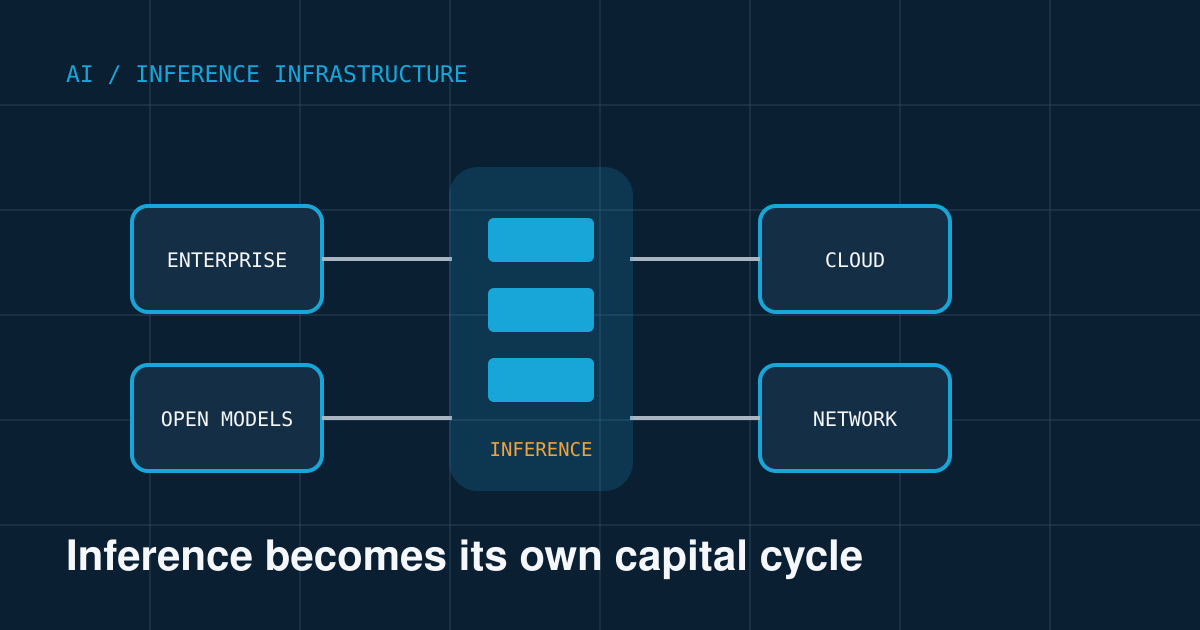
Image: Market State Lab original graphic.
Facts: Reuters reported on August 14 that Z.ai says its forthcoming open-weight GLM-5.3 model scored 84.5% on CyberGym versus 83.8% for Anthropic's restricted Mythos 5, while trailing more substantially on exploit development (54.4% versus 78.0% on ExploitBench). Z.ai plans a public release after further security assessment, with advanced capabilities gated to verified users.
Inference: Open-weight cyber models may narrow the cost and access gap for defensive code analysis, but benchmark parity on vulnerability discovery does not imply parity on real-world end-to-end security work.
Uncertainty: Results are company-reported, have not been independently reproduced here, and the planned release could change after safety review.
Why it matters: Technical teams should benchmark detection, exploitability analysis, false positives, and verification cost separately before integrating the model into secure-development pipelines.
Source: Reuters, August 14, 2026
2. Algorithmic Trading / Quant Finance — FlowLOB targets faster, controllable order-book simulation
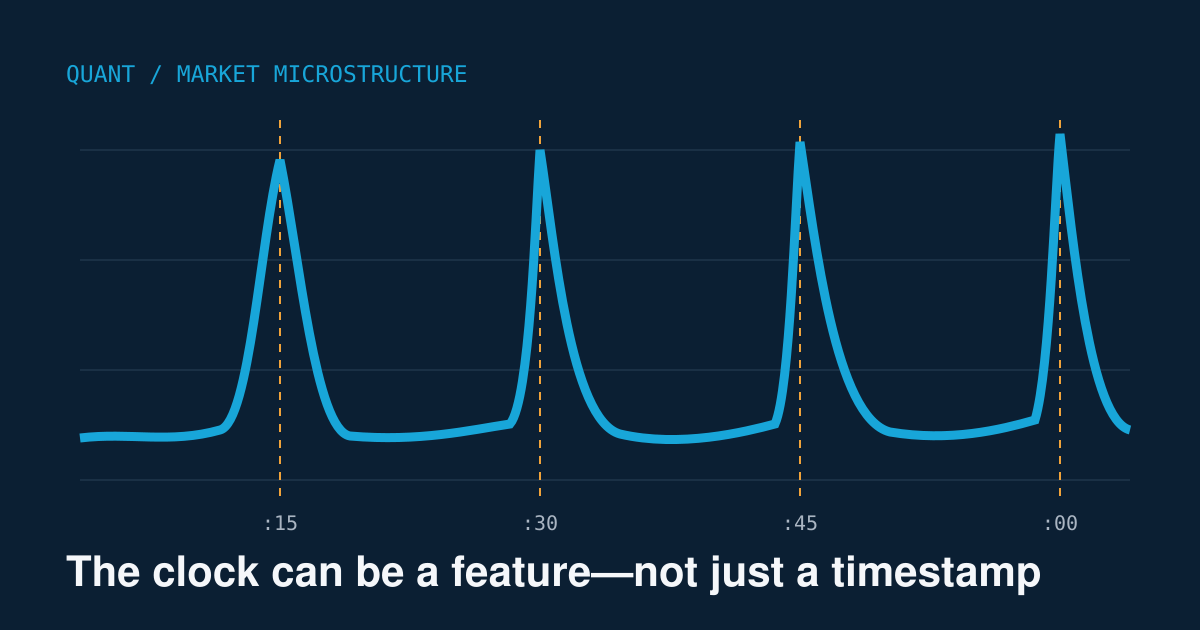
Image: Market State Lab original graphic.
Facts: A preprint submitted August 13 introduces FlowLOB, a conditional flow-matching generator trained on multiple Hong Kong Exchange symbols at 0.1-, 1-, and 10-second sampling intervals. The authors report its best quality at 10 ODE-solver steps, improved realism over four learned or agent-based baselines on most distributional metrics at the two finer frequencies, counterfactual controllability, and zero-shot transfer to one held-out symbol.
Inference: If the efficiency and transfer claims survive independent replication, flow matching could make scenario-rich execution and market-making simulations cheaper enough for broader walk-forward testing.
Uncertainty: This is an eight-page, non-peer-reviewed preprint. Evidence is limited to the authors' HKEX setup; transfer to U.S. ETFs, options, stressed markets, and queue-position dynamics is unproven.
Why it matters: Quant teams can treat FlowLOB as a candidate synthetic environment—not a production market model—and test whether it preserves spread, depth, imbalance, fill, and impact distributions that drive execution P&L.
Source: arXiv:2608.13096, submitted August 13, 2026
3. U.S. Markets / SPY / QQQ / Options — Equity-fund inflows return, but technology funds lose assets
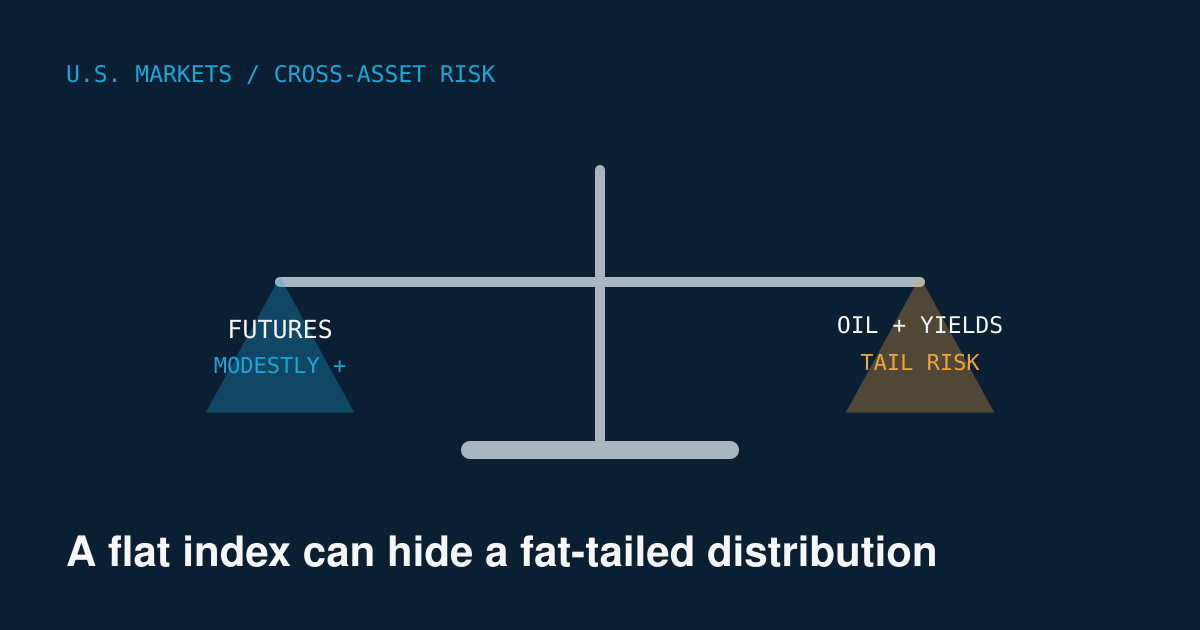
Image: Market State Lab original graphic.
Facts: Reuters reported that U.S. equity funds drew a net $2.58 billion in the week ended August 12, reversing a $1.36 billion outflow the prior week. Growth funds took in $8.78 billion, value funds $1.79 billion, while technology-sector funds lost $4.62 billion. Bond funds drew $9.4 billion and money-market funds $13.92 billion.
Inference: The combination suggests broad risk appetite with selective de-risking from crowded technology exposure, rather than a simple risk-on rotation.
Uncertainty: Weekly fund flows are lagged, can be revised, and do not identify intraday positioning, derivatives overlays, or whether flows persist after Friday's weaker retail-sales data.
Why it matters: For Monday execution, watch whether QQQ and semiconductor baskets underperform SPY/IWM despite continued index-level inflows; cross-sectional dispersion may remain more actionable than index direction.
Source: Reuters, August 14, 2026
4. U.S. Economy / Federal Reserve — Cooler inflation complicates the case for a September hike
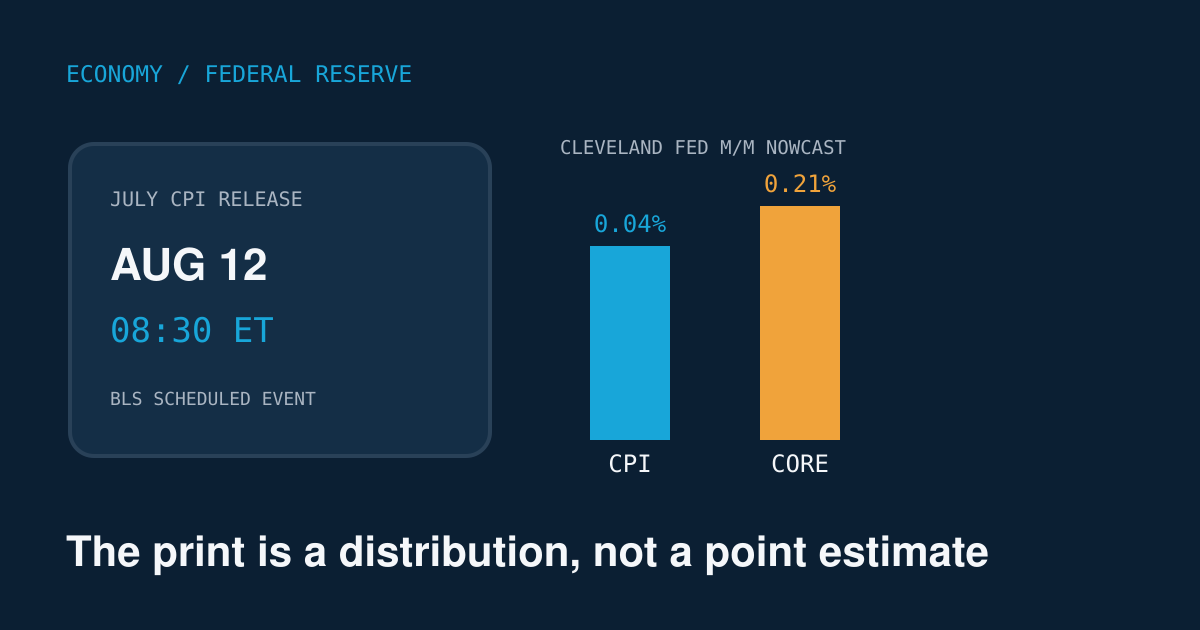
Image: Market State Lab original graphic.
Facts: Reuters reported on August 14 that the labor market is softening while inflation remains above the Federal Reserve's 2% objective but has cooled for two months. Real wages declined over the prior six months, job growth was tepid, and unemployment remained historically low at 4.1%. The July FOMC meeting held the target range at 3.50%–3.75% with three dissents favoring a hike.
Inference: The data mix raises the hurdle for an immediate increase, even as above-target inflation prevents a clean dovish pivot.
Uncertainty: Policy remains data-dependent; oil, geopolitical shocks, and the July meeting minutes can shift both inflation expectations and the September distribution.
Why it matters: Rate-sensitive models should avoid treating “hold” as “easing.” Separate the expected policy path from term-premium and energy shocks when sizing duration, growth, and volatility exposures.
Source: Reuters, August 14, 2026
5. Technology / Business — Nvidia reportedly scales back an Ohio OpenAI financing guarantee
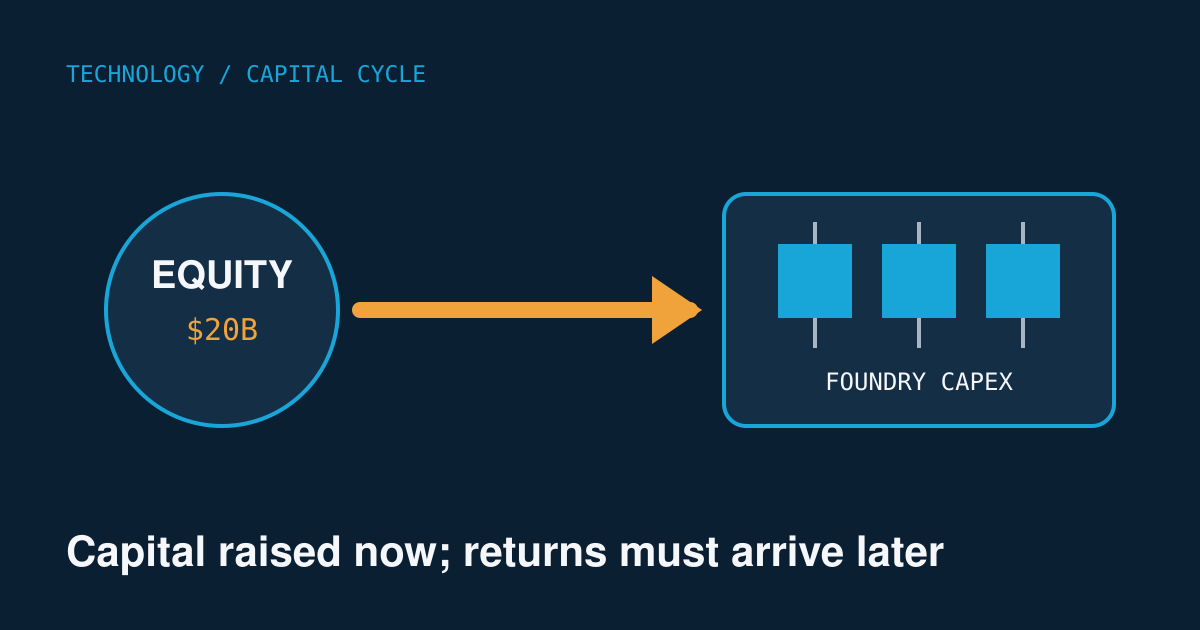
Image: Market State Lab original graphic.
Facts: Reuters, citing the Wall Street Journal, reported that Nvidia revised planned support for a proposed OpenAI Ohio data-center project and is now expected initially to guarantee less than $120 billion, down from $250 billion previously discussed.
Inference: The reported reduction may signal tighter risk-sharing or staged financing rather than lower compute demand; it nevertheless sharpens scrutiny of AI-infrastructure commitments and counterparty concentration.
Uncertainty: The report is based on unnamed sources, the project terms are not final, and neither the reason for the change nor the ultimate guarantee is confirmed publicly.
Why it matters: Investors and operators should distinguish committed capex from contingent guarantees, lease obligations, and vendor financing. Financing structure—not just chip demand—can transmit stress across the AI infrastructure stack.
Source: Reuters, August 14/15, 2026
Quant & Market Dashboard
Liquidity and funding
- Weekend state: U.S. cash equities and listed options are closed. No reliable live Sunday SPY/QQQ spreads, displayed depth, auction imbalance, or ETF creation/redemption data are available.
- Friday prior close: SPY 776.34 (-0.20%; volume 31.37 million) and QQQ 731.07 (-0.14%; volume 23.79 million). These are reference points, not executable Sunday prices.
- Options proxy: Cboe reported 3.86 million SPX option contracts traded Friday with 24.69 million open interest. Current weekend quotes are stale.
- Funding: Latest New York Fed SOFR was 3.62% for August 13 on $2.932 trillion in volume; effective fed funds was 3.63%. No obvious broad overnight-funding stress is visible in these lagged official prints.
Volatility regime
Low, with elevated tail/gap risk — confidence: medium. Cboe's Friday VIX close was 14.25 (-2.60%). Official VIX futures settlements were 15.5594 (August 19), 17.9201 (September 16), and 19.575 (October 21), a rising curve consistent with calm spot conditions but more expensive forward protection. Weekend geopolitical and financing headlines prevent high confidence.
Factor performance
Short horizon — Friday ETF proxies: momentum MTUM +0.48%; value VLUE +0.58%; quality QUAL -0.58%; size IWM +0.50%; growth VUG -0.42%; low volatility USMV -0.22%. That is a one-session value/size/momentum tilt against quality/growth. Medium horizon: a consistent point-in-time total-return series was not verified at the cutoff, so no multiweek rankings are asserted.
Execution risk: SPY, QQQ and options
- Monday's opening auction carries weekend gap and price-discovery risk; avoid extrapolating Friday's narrow index moves into the open.
- Prefer limits and staged participation until spreads, depth, and opening imbalances normalize. QQQ may show more single-name and sector-dispersion sensitivity than SPY.
- Monday-dated options have steep theta and near-strike gamma. Friday closing quotes are stale; re-price the surface after the cash open and reject crossed, locked, zero-size, or implausible-volatility quotes.
- VIX contango can favor volatility-carry strategies in calm sessions, but it does not protect against weekend discontinuities; size short-vol exposure to gap loss, not normal-session realized volatility.
Market-microstructure implications and watchlist
- Separate overnight gap capture from intraday alpha in attribution and reward functions.
- Use pre-trade spread/depth gates and post-fill implementation-shortfall monitoring; pause if adverse selection exceeds the walk-forward envelope.
- Treat fund-flow data as a cross-sectional signal to test, not a market-order trigger.
Watchlist: SPY, QQQ, IWM, TLT, MTUM, VLUE, QUAL, VUG, USMV, NVDA, MSFT, SMH, VIXY.
DRL Improvements for the MATLAB System
- Project actions through hard leverage, turnover, concentration, inventory, and drawdown constraints, including an explicit no-trade action.
- Penalize spread, impact, missed fills, latency, inventory, and tail loss; randomize cost parameters across training episodes.
- Use purged, embargoed walk-forward evaluation across low-volatility, stress, trend, and weekend-gap regimes.
- Stress-test policies against shifted volatility curves, thinner opening depth, partial fills, and synthetic LOB paths while retaining a real-data holdout.
Model hygiene
Use point-in-time constituent universes; adjust corporate actions; eliminate survivorship, look-ahead, and revision leakage; quarantine stale or crossed options quotes; purge overlapping labels; correct for multiple testing; calibrate probabilities out of sample; and monitor feature, cost, fill, and policy drift.
MATLAB optimization patterns
- Align prices, macro releases, and corporate actions with
timetable/synchronize; vectorize state and reward calculations. - Profile before optimizing; use GPU arrays only for dense batched inference or training where transfer overhead is amortized.
- Parallelize independent walk-forward folds and Bayesian-optimization trials with reproducible substreams.
- Keep data, cost, execution, risk, and reward components modular so simulator assumptions can be swapped without rewriting the agent.
High-value quant research question
Do weekly growth-fund inflows combined with technology-sector outflows predict next-week QQQ-versus-IWM dispersion after controlling for VIX term structure, Treasury yields, and opening liquidity?
This tests whether apparently contradictory flow data contain cross-sectional information after separating broad risk appetite from crowded-sector de-risking.
Data references
- Cboe VIX trade data
- Cboe VIX futures settlements
- Cboe SPX options trade data
- New York Fed reference-rate dashboard
Disclosure
Market State Lab provides research and educational analysis, not individualized investment advice. Market data may be delayed, indicative, prior-close, or revised. Verify prices, liquidity, and event timing with an execution-grade source before trading.