Quant Market Brief — October 21, 2026: Hybrid Momentum & Market Impact
Archive edition published October 22, 2026. The original October 21 research cutoff and historical observations are preserved.
Research cutoff: October 21, 2026, 6:32 a.m. CT (11:32 UTC). Futures and VIX are delayed snapshots; ETFs, factor proxies and Treasury yields are prior-close; funding fixings lag by one business day. No live consolidated liquidity was verified.
1. Hybrid Momentum blends long-memory and fast gradient updates
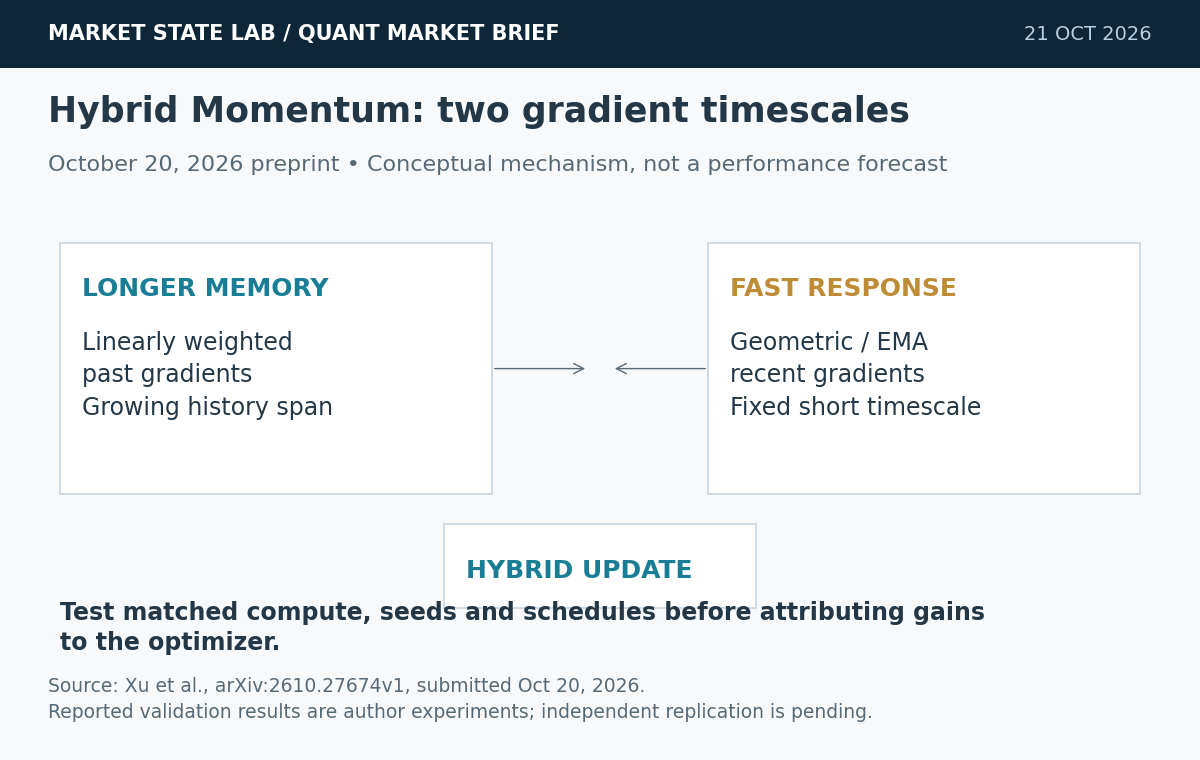
Graphic: Market State Lab; Xu et al., arXiv 2610.27674v1, submitted October 20, 2026. Conceptual mechanism—not a performance forecast.
Fact: The October 20 HyM preprint combines a linearly weighted average of past gradients with a fast exponential-moving-average momentum. The authors report matched or improved results across image classification, machine translation and language modeling; their LLaMA-1.3B C4 run ended at validation loss 2.777 versus 2.903 for Muon. Direct source
Inference: Two-timescale gradient memory may help when older gradients remain informative but recent adaptation still matters.
Uncertainty: Author-reported preprint experiments are not independent replication. Different schedules, compute or tuning budgets can explain optimizer comparisons.
Why it matters: For MATLAB-linked training, freeze data order, learning-rate schedules, compute budgets and random streams; compare validation loss, wall-clock cost and run-to-run dispersion before adopting the optimizer.
2. LOB-Impact tests whether generative order books learn market impact
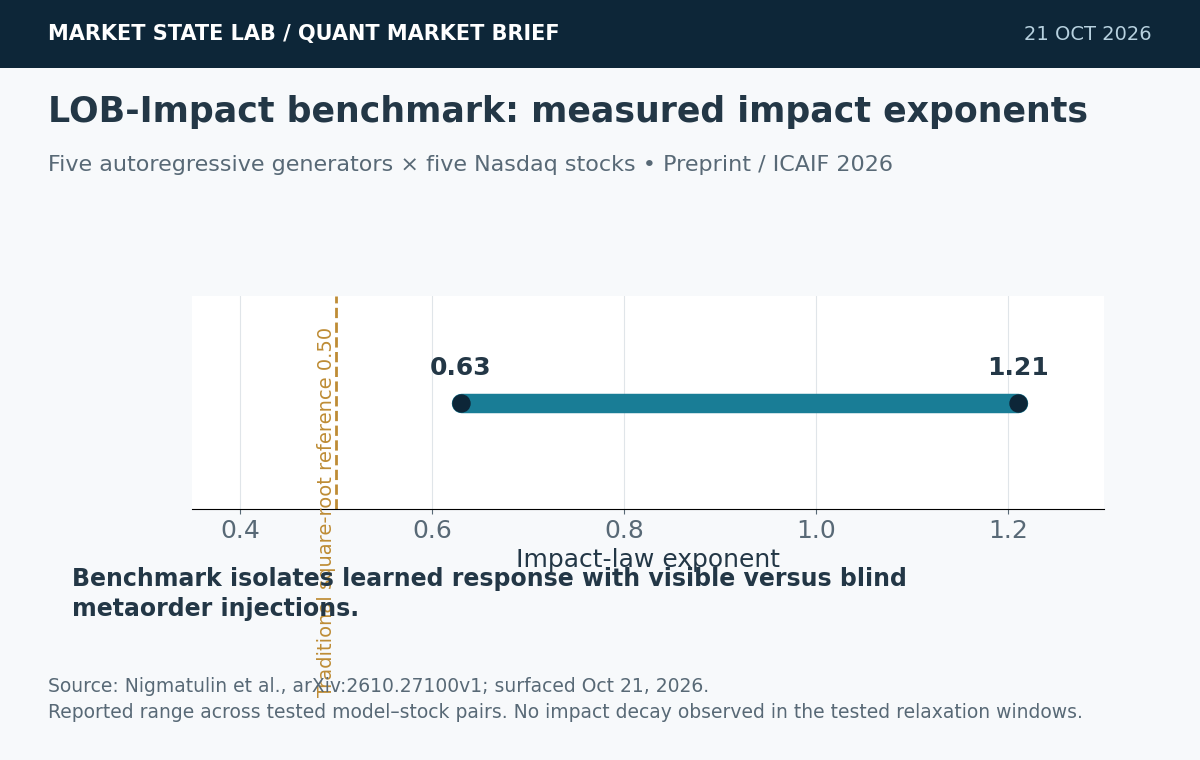
Graphic: Market State Lab; Nigmatulin et al., arXiv 2610.27100v1, surfaced October 21, 2026. Range reported across tested model–stock pairs.
Fact: LOB-Impact injects execution-style metaorders into five autoregressive limit-order-book generators across five Nasdaq stocks. Reported impact exponents span 0.63–1.21, above the traditional square-root reference of 0.5; the study did not observe decay in its post-execution windows. Direct source
Inference: A simulator can match unconditional message distributions yet still misprice an agent’s own counterfactual impact.
Uncertainty: This is a new research benchmark, not proof that any tested generator produces executable profits. The authors tentatively link absent decay to short context windows.
Why it matters: Before training execution agents, validate free-generation dynamics, visible-versus-blind metaorder response and relaxation. Reject simulators whose impact amplitude, exponent or persistence is implausible.
3. Small caps and value lead while Nasdaq finishes flat
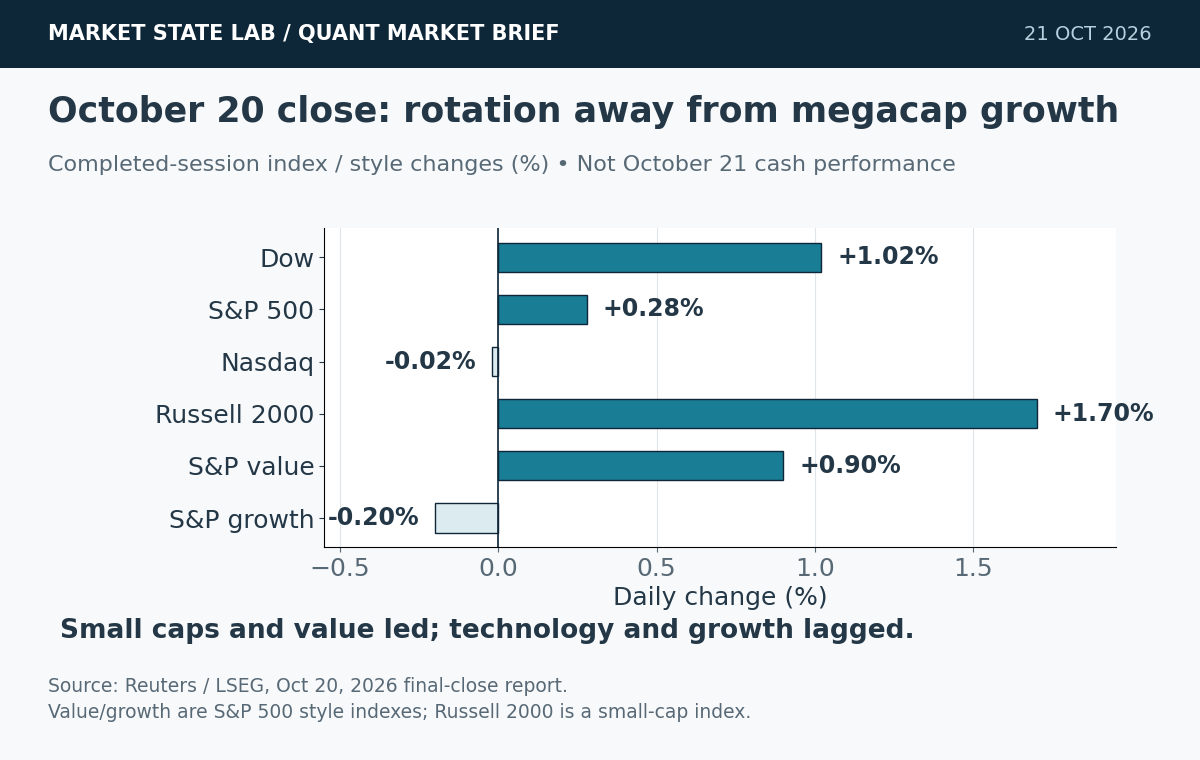
Graphic: Market State Lab; Reuters/LSEG, October 20, 2026 final close. Completed-session index/style returns—not October 21 cash performance.
Fact: Tuesday closed with the Dow +1.02%, S&P 500 +0.28%, Nasdaq −0.02% and Russell 2000 +1.7%. The S&P 500 value index gained 0.9% while its growth counterpart fell 0.2%; Nasdaq advancers outnumbered decliners 2.02 to one. Direct source
Inference: The session reflected rotation away from megacap growth rather than broad risk-off selling.
Uncertainty: One completed session does not establish a durable factor regime. Premarket strength can reverse, and index returns do not reveal current executable depth.
Why it matters: Track RSP/SPY, IWM/SPY and value/growth relative strength, but gate orders on fresh spread, depth and auction evidence rather than extrapolating Tuesday’s close.
4. September housing starts fall 5.2% as completions rise
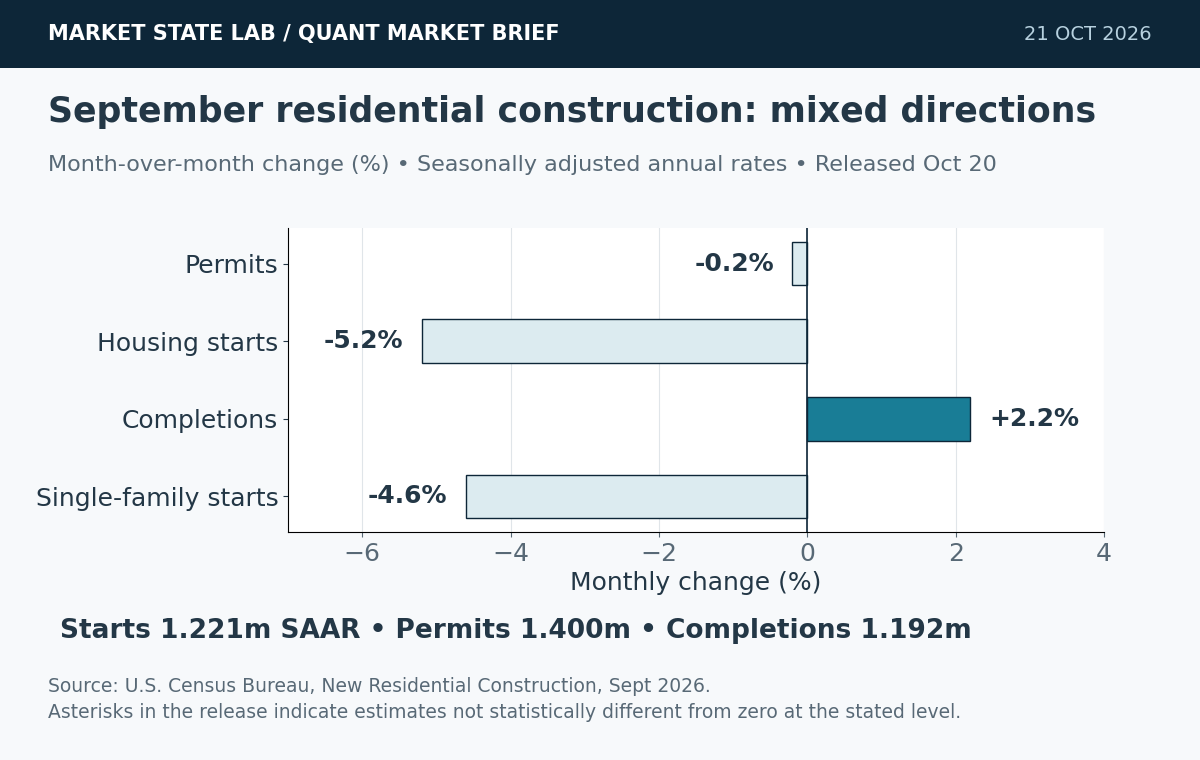
Graphic: Market State Lab; U.S. Census Bureau, September New Residential Construction, released October 20, 2026. Seasonally adjusted annual rates; sampling uncertainty applies.
Fact: September housing starts ran at a 1.221 million seasonally adjusted annual rate, down 5.2% from revised August and 7.4% year over year. Permits were 1.400 million, down 0.2% monthly; completions were 1.192 million, up 2.2% monthly. Direct source
Inference: The flow into construction weakened even as completions rose, consistent with a constrained rate-sensitive pipeline.
Uncertainty: Census marks the monthly starts, single-family starts and completions changes as not statistically different from zero at the stated confidence level; estimates are revised.
Why it matters: Store estimate, revision vintage and margin-of-error flags separately. Do not train on a point change as a certain directional macro signal.
5. SpaceX and Tesla form committees to consider a merger
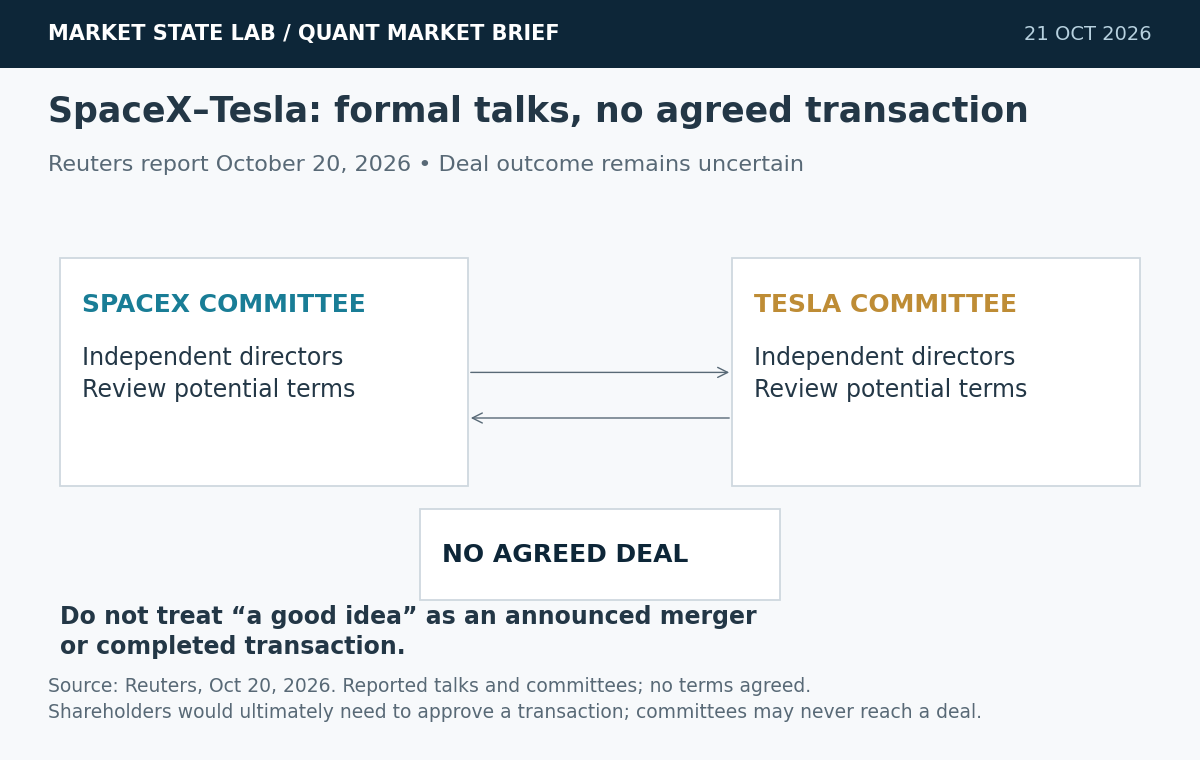
Graphic: Market State Lab; Reuters, October 20, 2026. Reported formal talks; no transaction terms are agreed.
Fact: Elon Musk said SpaceX and Tesla formed special committees to discuss a combination. Reuters reported talks began in recent weeks and could result in SpaceX acquiring Tesla; shareholders would ultimately need to approve a deal. Direct source
Inference: A transaction could reshape capital allocation across launch, connectivity, compute, chips, robotics and vehicles.
Uncertainty: No terms are agreed, the committees may never reach a deal, and Musk said assuming a merger would be premature. Reported potential structure is not confirmation.
Why it matters: Separate committee formation from deal probability. Scenario-test governance, financing, dilution and cross-company dependency without assigning a merger outcome.
Quant & Market Dashboard
Liquidity, funding and volatility
- Futures, delayed: at 5:42 a.m. ET / 4:42 a.m. CT, Reuters reported Dow e-minis +0.07%, S&P 500 e-minis +0.24% and Nasdaq-100 e-minis +0.50%. Direction does not establish spread, depth, displayed-size durability or ETF basis. Reuters.
- October 20 ETF bars, prior close: SPY 769.05, +0.34%, volume 35.05 million, high–low range 8.04 points; QQQ 717.63, −0.10%, volume 30.52 million, range 12.36 points. Activity and range are cautious proxies—not current fillability. SPY history · QQQ history.
- Treasury, October 20 official par yields: two-year 4.79%, ten-year 5.12%, thirty-year 5.42%; 2s10s +33 basis points. Prior-close yields are not executable financing rates. U.S. Treasury.
- Latest verified funding fixings, October 19: SOFR 3.87%, EFFR 3.88%. These aggregate, lagged fixings cannot prove current funding ease or stress. SOFR · EFFR.
- Volatility regime: Moderate; medium confidence. Delayed VIX was 17.36 at 6:15 a.m. CT, versus Tuesday’s 17.31 close and a 17.13–17.58 displayed range. The level is below Friday’s 19.99 spike, but current skew, VX curve and dealer gamma are unverified. MarketWatch.
Factor proxies
| Factor | ETF | October 20 daily | September 21→October 20 |
|---|---|---|---|
| Momentum | MTUM | +0.05% | -6.45% |
| Value | VLUE | +0.56% | -4.05% |
| Quality | QUAL | +0.20% | +1.24% |
| Size | IWM | +1.66% | -3.43% |
| Growth | IWF | -0.15% | -3.04% |
| Low volatility | SPLV | +1.29% | +3.27% |
Price-return proxies excluding dividends—not pure-factor premia or total returns. The uniform Alpha Vantage refresh was rate-limited; daily values use displayed latest/completed-session changes and the medium horizon uses September 21 archived closes. MTUM’s daily value is indicative because its retrieved timestamp was overnight rather than a uniform closing-series pull. Directional read: size, value and low volatility led Tuesday; medium-horizon momentum remains weak. Do not fabricate precision from mixed timestamps.
Execution and microstructure
- At the 8:30 a.m. CT cash open, refresh SPY/QQQ NBBO, futures/ETF basis, depth, quote age and auction imbalances. Use bounded limits and participation caps; stress spread widening, partial fills, cancel latency and nonlinear impact.
- VIX expiration is today. Reconcile the exact series and settlement mechanics before using volatility options or futures; no dealer-gamma sign, pinning level or reliable aggregate exposure was verified. Cboe 2026 calendar.
- Meta and Tesla report after the close. Treat scheduled earnings as event-timing risk; recheck calendars and chain freshness before carrying short-dated optionality. Thin premarket books and disappearing displayed size are liquidity traps.
- For simulator-driven execution, validate response to the agent’s own orders. Unconditional distribution matching is insufficient when simulated market impact or relaxation is wrong.
Watchlist: SPY, QQQ, RSP, IWM, TLT, VIX; ES, NQ, ZN, VX; MTUM, VLUE, QUAL, IWF, SPLV; XLV, XLK, XLRE, XLU; SPCX and TSLA for event-risk research without an assumed merger.
DRL Improvements for the MATLAB System
- Enforce drawdown, exposure, concentration and liquidity limits outside the learned reward; reject actions when quote freshness or data-quality checks fail.
- Add counterfactual market-impact tests to the environment: compare visible metaorders with blind controls, then stress persistence and missing decay across participation rates.
- Reward performance after fees, spread, impact, inventory risk, missed fills and cancel latency. Penalize unnecessary turnover around auctions, expiries and earnings.
- Use purged, embargoed chronological walk-forward tests with untouched stress regimes. Fit optimizer and regime choices only inside training folds and compare matched seeds, schedules and compute budgets.
Model hygiene
Prevent leakage, look-ahead and survivorship bias with point-in-time universes, feature-availability timestamps and release vintages. Reconcile corporate actions without using future-effective events. Reject stale options quotes and mismatched expiries. Control multiple testing, validate calibration, preserve simulator versions and monitor feature, regime and cost-model drift.
MATLAB optimization patterns
- Use time-zone-aware
timetableinputs and causalsynchronize/retime; assert availability before every decision. - Vectorize rolling features and simulator diagnostics, preallocate logs and profile bottlenecks before parallelizing.
- Parallelize independent folds or
bayesopttrials with reproducible random streams and frozen holdouts. - Use GPUs only for sufficiently large neural batches; keep data validation, execution, risk and agent environments modular.
High-value quant research question
Does enforcing realistic counterfactual market impact in a generative LOB simulator reduce live-paper implementation shortfall versus a distribution-matched simulator without impact constraints?
It tests whether better simulator physics changes policy quality. Hold signals, risk limits and data constant; compare fill rate, net shortfall, impact persistence, turnover and tail loss under matched walk-forward periods.
If this helps your research, forward it to one colleague who would value the evidence-first format.
Research and education only—not individualized financial advice. Market, model, liquidity and event risks remain; no trading performance is promised.