Quant Market Brief — October 17, 2026: Tech Selloff & Information Clocks
Research cutoff: October 17, 2026, 6:33 a.m. CT (11:33 UTC). Weekend edition: equity, ETF, VIX and Treasury observations are October 16 prior-session; funding fixings are October 15. No live executable liquidity was verified.
1. Meta releases Muse Spark Open; deployment scale still matters
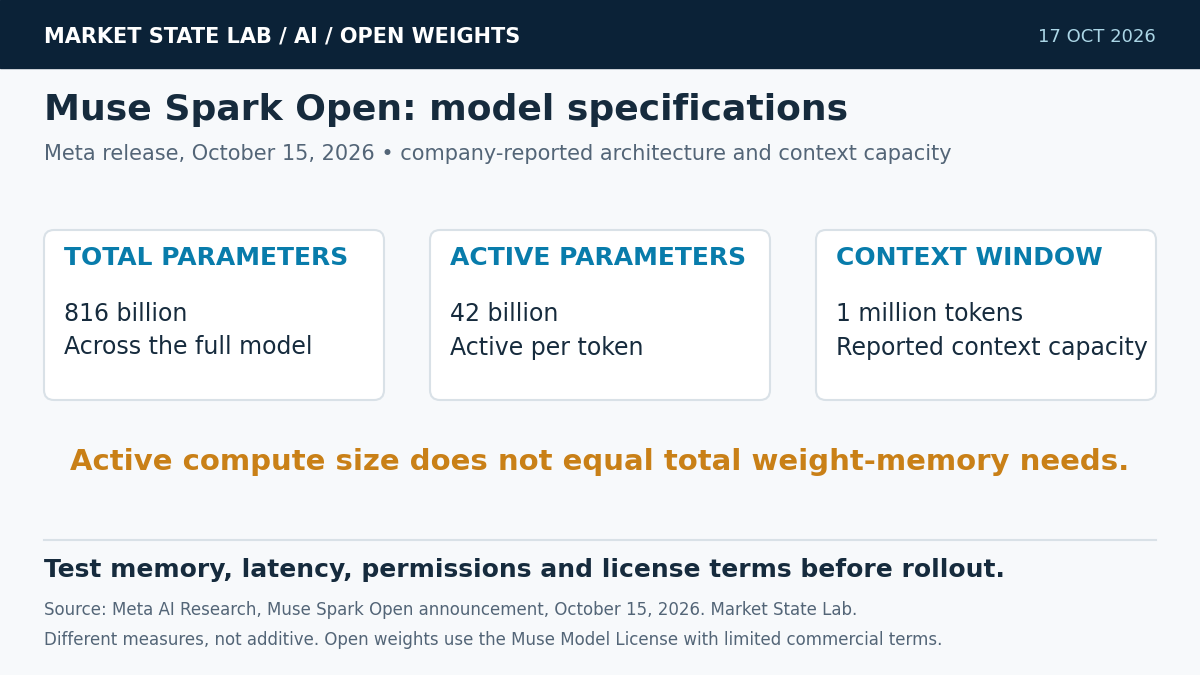
Graphic: Market State Lab; Meta AI Research release, October 15, 2026. Company-reported specifications, not independent benchmarks.
Fact: Meta released the weights for Muse Spark Open on October 15: 816 billion total parameters, 42 billion active and a one-million-token context window. The release uses the Muse Model License with limited commercial terms. Source
Inference: Open weights expand deployment choices, while total model memory remains a separate constraint from active computation.
Uncertainty: Vendor capability claims do not establish MATLAB coding accuracy, trading suitability or performance on a particular workstation.
Why it matters: Evaluate a small, isolated coding workflow for correctness, memory, latency, data permissions and license terms before choosing hosted or local deployment.
2. Earnings-call research exposes within-event timing leakage
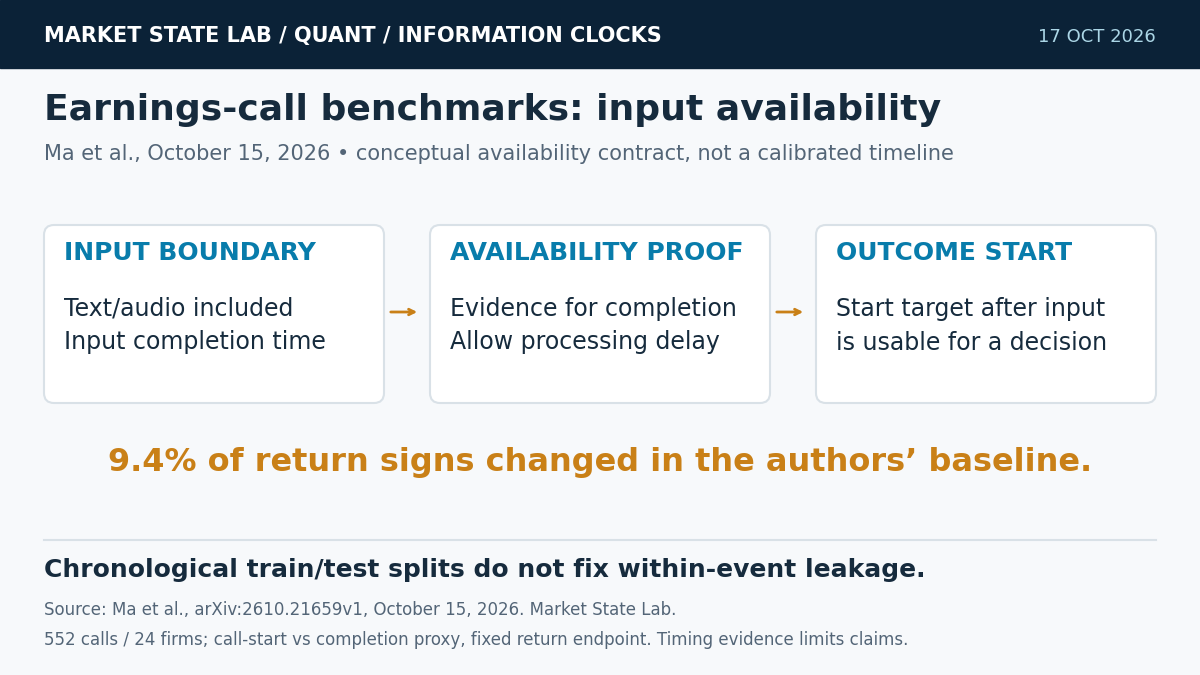
Graphic: Market State Lab; Ma et al., arXiv preprint 2610.21659v1, submitted October 15, 2026. Conceptual sequence, not a calibrated timeline.
Fact: In an October 15 arXiv preprint, Ma and coauthors examine 552 earnings calls from 24 firms. Moving the outcome start from a call-start proxy to a completion proxy changes 9.4% of return signs in their baseline, with the return endpoint held fixed. Their Availability Contract makes input and outcome clocks explicit. Source
Inference: Chronological train/test splits alone cannot remove leakage when a target begins before an event’s model input is complete.
Uncertainty: Completion is reconstructed from audio plus a stipulated processing allowance; timing evidence and benchmark design limit generalization.
Why it matters: Timestamp transcript/audio completion, processing and order eligibility separately; compare event labels under alternative availability allowances before retraining.
3. Friday’s tech-led decline leaves Nasdaq down 2.1%
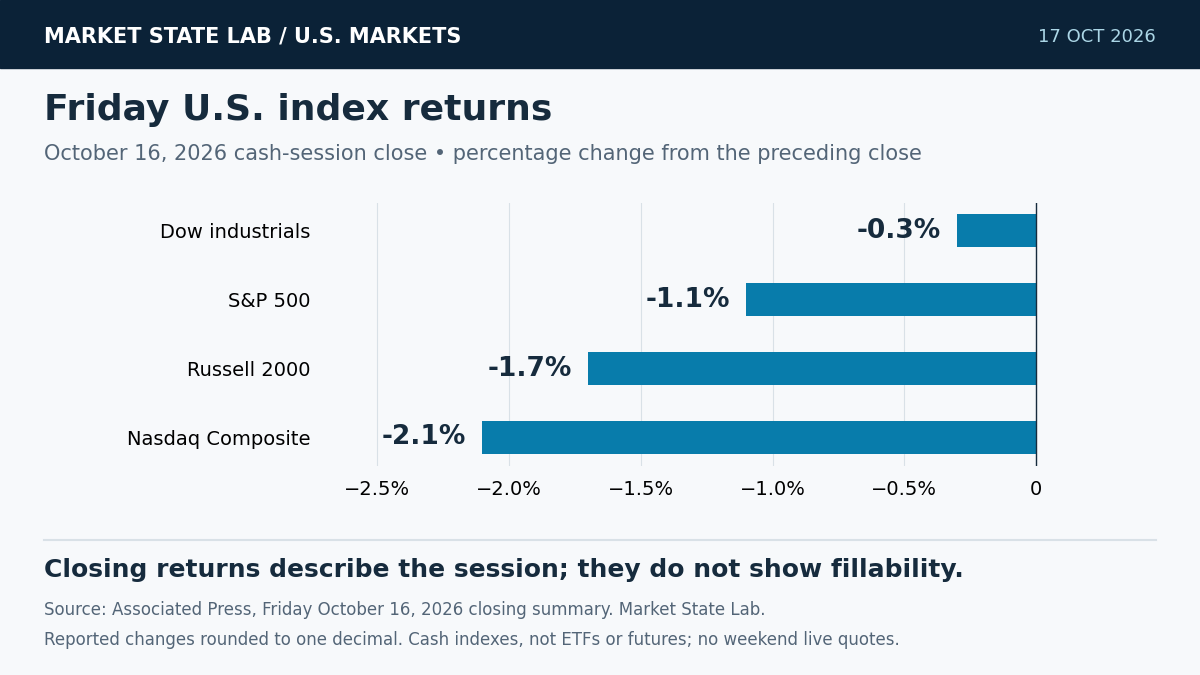
Graphic: Market State Lab; Associated Press, October 16, 2026 closing summary. Rounded cash-index returns.
Fact: U.S. stocks closed lower Friday: S&P 500 −1.1%, Nasdaq Composite −2.1%, Dow −0.3% and Russell 2000 −1.7%. Technology weakness weighed on the session. Source
Inference: A single broad-index exposure can conceal materially different sector and small-cap risk.
Uncertainty: Cash-index returns are not SPY/QQQ returns, executable quotes or proof of a specific dealer-positioning mechanism.
Why it matters: Rebuild Monday’s quote and auction baseline from fresh observations; do not carry Friday’s spread or expiry assumptions into new orders.
4. September import prices rise 1.1%, including nonfuel pressure
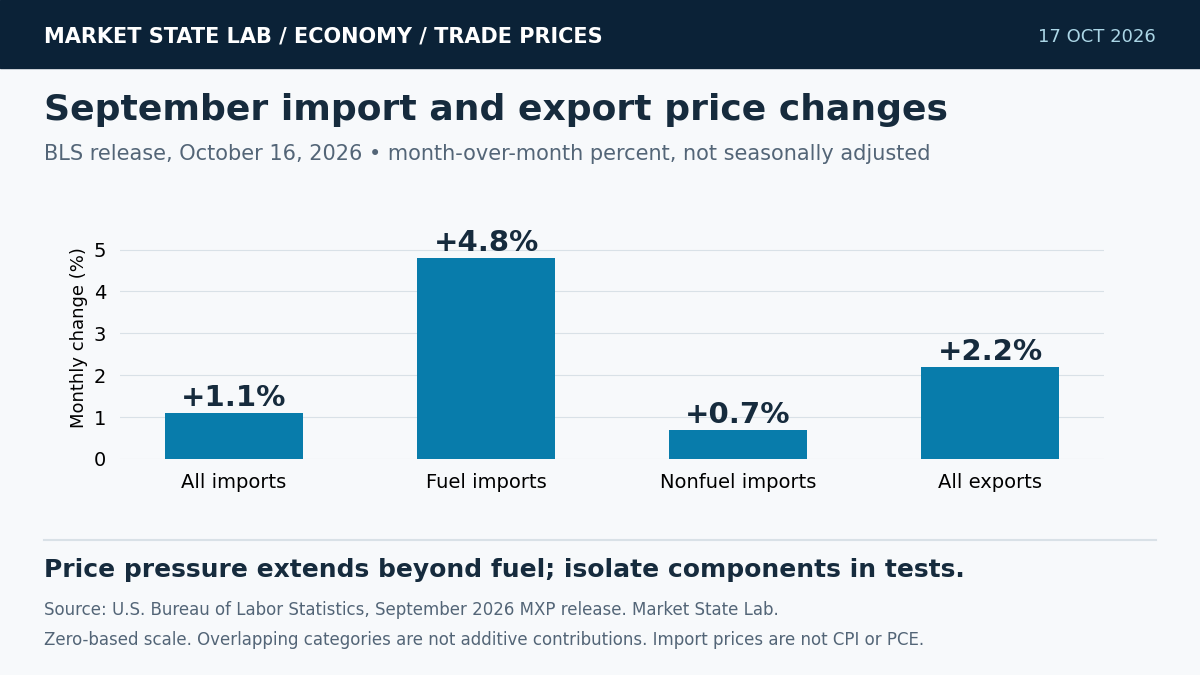
Graphic: Market State Lab; BLS October 16, 2026 release, September reference month. Overlapping categories are not additive.
Fact: BLS reported September import prices up 1.1% monthly and 8.1% annually. Fuel imports rose 4.8% monthly and nonfuel imports 0.7%; export prices rose 2.2%. These indexes are not seasonally adjusted. Source
Inference: Inflation research should separate fuel shocks from broader imported-input pressure.
Uncertainty: Import/export indexes are not CPI or PCE; revisions, currency effects, margins and uncertain pass-through limit policy conclusions.
Why it matters: Keep the 7:30 a.m. CT October 16 release vintage and test the incremental information in nonfuel prices rather than treating the headline as a direct Fed signal.
5. Travelers’ earnings show why per-share growth needs decomposition
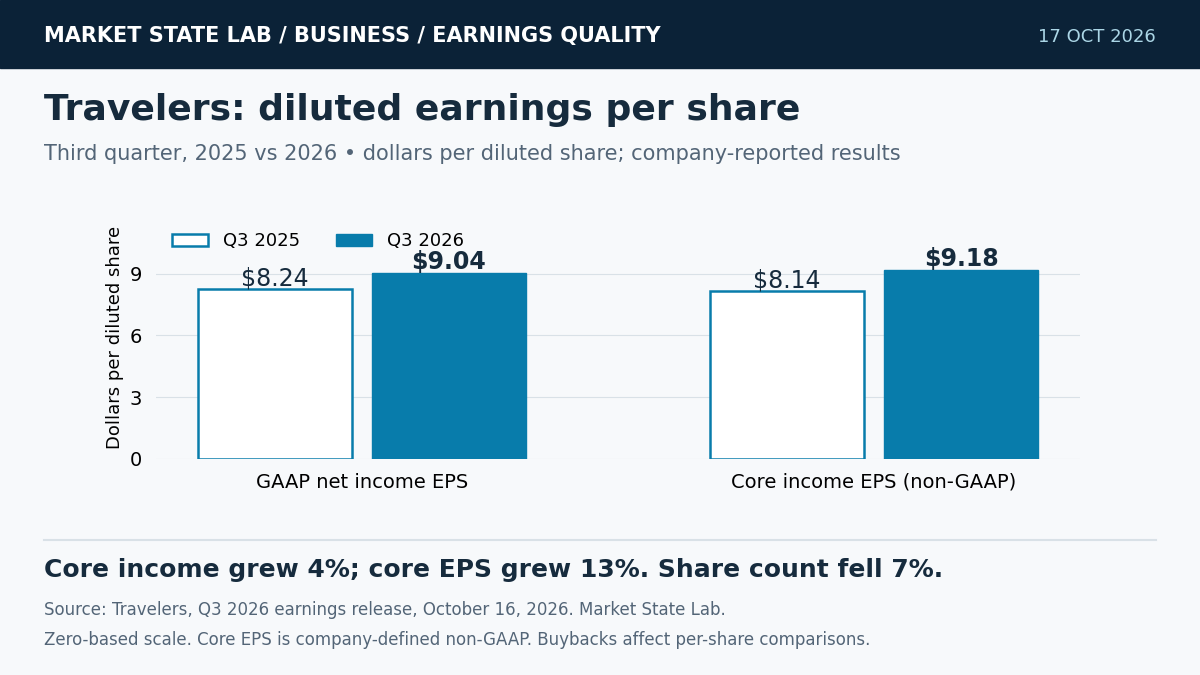
Graphic: Market State Lab; Travelers earnings release, October 16, 2026. Q3 2025 versus Q3 2026; core EPS is non-GAAP.
Fact: Travelers reported Q3 net income of $1.917 billion and core income of $1.947 billion. Core income increased 4%, while core EPS increased 13% to $9.18; diluted average shares declined 7%. Higher reserve development and investment income were partly offset by catastrophe losses. Source
Inference: Share repurchases and reserve movements can make EPS growth look stronger than growth in total underlying earnings.
Uncertainty: Core income is company-defined non-GAAP, reserve estimates can change, and catastrophe losses remain volatile.
Why it matters: Decompose earnings into total income, share count, investment yield, reserve development and underwriting performance before scoring an earnings surprise.
Quant & Market Dashboard
Liquidity, funding and volatility
- Weekend conditions: U.S. cash equities, listed equity options and the usual equity-index futures session are closed at this Saturday cutoff. No current consolidated ETF/futures spread, depth, overnight volume, options book or auction imbalance was verified. Friday’s volume is context, not current fillability.
- October 16 completed-session ETF observations: SPY 763.25, −1.11%, volume 64.38 million shares; QQQ 709.80, −2.50%, volume 66.93 million. High–low ranges were 12.61 and 18.73 price points respectively. These are Alpha Vantage daily bars, not live quotes. Daily-data methodology.
- Treasuries, October 16 official daily par yields: 2-year 4.74%, 10-year 5.09%, 30-year 5.43%; 2s10s +35 basis points. Versus October 15, the 2-year fell 3 basis points and 10-year fell 1. These are prior-session curve observations, not a Treasury order book. U.S. Treasury.
- Funding, latest verified October 15 fixings: SOFR 3.89%, EFFR 3.88%; FRED updated October 16 at 7:02 and 8:02 a.m. CT respectively. The one-basis-point difference is lagged context, not evidence of current funding stress or its absence. SOFR, EFFR.
- Volatility regime: High; medium confidence. October 16 VIX closed at 19.99, up 21.45%, after reaching 22.31 intraday. The jump and wide ETF ranges support a cautious high-risk label even though the closing VIX was just below 20. This is a qualitative synthesis, not a calibrated model output. Current skew, VX term structure and liquidity degradation were not verified. VIX history.
Factor proxies
| Factor | ETF | October 15→16 | September 18→October 16 |
|---|---|---|---|
| Momentum | MTUM | -2.78% | -5.31% |
| Value | VLUE | -1.67% | -3.81% |
| Quality | QUAL | -0.79% | +2.62% |
| Size | IWM | -1.69% | -4.81% |
| Growth | IWF | -2.22% | -1.44% |
| Low volatility | SPLV | +1.04% | +2.62% |
Four weeks is exactly 28 calendar days, with common endpoints and no holiday substitution. These are split-screened price returns excluding dividends. Fresh vendor split histories show no effective split inside the window; announced future events are not applied. The raw endpoint prices therefore coincide with split-only comparisons for this window. Source: Alpha Vantage daily bars and SPLITS snapshots retained with this edition. These ETF exposures are not pure factors or total returns. Momentum and growth fell sharply Friday while low volatility gained; this does not establish a lasting factor rotation.
Execution and microstructure
- Next-session timing: Build a fresh premarket and opening-auction baseline before the next regular cash open at 8:30 a.m. CT. Recheck the official release/earnings calendar before enabling orders; this weekend snapshot is not an event-time trading feed.
- Post-expiry: October monthly expiry was Friday, October 16. Reconcile exercises, assignments, residual positions, collateral and contract mappings. Refresh chains and strike-specific liquidity; do not carry expired open interest, Friday gamma assumptions or stale option marks into Monday. Cboe 2026 calendar.
- Use limit prices, participation caps and explicit cancel/replace controls. Opening imbalances, thin displayed depth, quote withdrawal, gaps and adverse selection can make apparent spread liquidity misleading. Stress partial fills, latency and nonlinear impact; do not assume midpoint fills.
- Dealer gamma sign, live strike concentrations, options depth and opening-auction imbalances were not verified. Prefer spread/depth/quote-age gates over an unsupported directional gamma trade.
Watchlist: SPY, QQQ, IWM, TLT, VIX; MTUM, VLUE, QUAL, IWF, SPLV; META, TRV; ES, NQ, ZN and VX futures.
DRL Improvements for the MATLAB System
- Add an information-availability gate: a feature becomes observable only after its full input and processing latency are complete. Test multiple plausible completion allowances without moving the outcome endpoint opportunistically.
- Enforce drawdown, exposure, concentration and liquidity limits outside the learned reward. Reconcile expiry-generated positions before the policy can submit new orders; preserve deterministic stop and recovery behavior.
- Reward net implementation performance after spread, impact, fees and inventory risk. Randomize quote withdrawal, partial fills, failed cancels and latency; include a penalty for unnecessary turnover.
- Use purged, embargoed walk-forward folds, multiple seeds and held-out volatility/expiry regimes. Freeze model-selection rules and report both pathwise risk breaches and calibration/drift diagnostics.
Model hygiene
Prevent within-event leakage as well as cross-sample look-ahead: retain input-completion, release-vintage and decision timestamps. Use point-in-time universes including delisted securities to limit survivorship bias. Reconcile splits and distributions while separating adjusted research prices from executable raw prices. Reject stale options quotes, verify contract identifiers and time zones, control multiple testing, and monitor calibration and feature/policy drift.
MATLAB optimization patterns
- Use time-zone-aware
timetablelogs and causalsynchronize/retimerules; assert that feature-availability timestamps precede decisions. - Vectorize event-clock and order-log comparisons, preallocate diagnostics, and profile the environment before adding workers.
- Parallelize independent walk-forward folds or
bayesopttrials with reproducible random streams; keep holdout selection frozen. - Use GPUs for large neural-network batches when profiling supports them; separate data, availability, execution-cost, risk and agent modules.
High-value quant research question
How much does enforcing input-completion plus processing latency change earnings-call volatility forecasts and SPY/QQQ hedge decisions under a fixed outcome endpoint?
This tests whether apparent signal quality survives a tradable information clock. Report label/sign changes, forecast loss, hedge turnover and implementation shortfall; no predictive alpha is assumed.
Technical companion: 2026-10-17 GitHub archive.
If this helps your research, forward it to one colleague who would find it useful.
Research and education only—not individualized financial advice.