Quant Market Brief — October 16, 2026: Expiry Execution & Backtest Integrity
Research cutoff: October 16, 2026, 6:31 a.m. CT (11:31 UTC). Futures are earlier reported indications; VIX is delayed; ETF and Treasury observations are prior-session. No live consolidated book was verified.
1. TaskVM makes agent state and recovery explicit
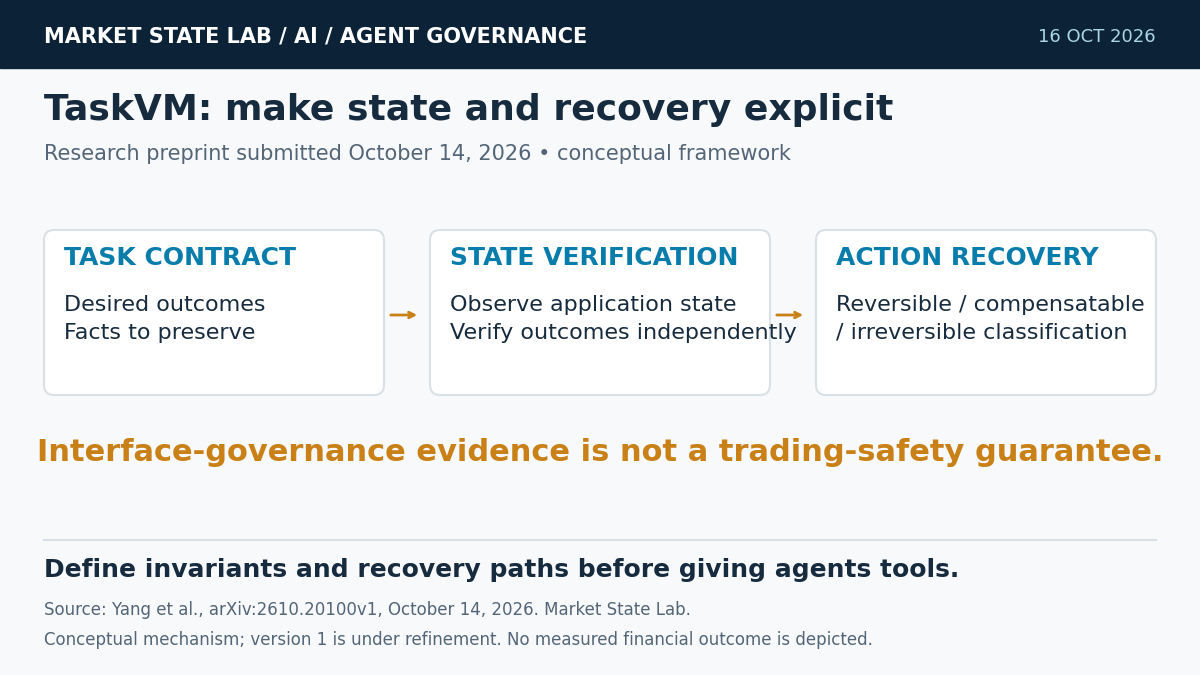
Graphic: Market State Lab. Source/date: Yang et al.; arXiv preprint submitted October 14, 2026. Research mechanisms and transaction panels are conceptual; quantitative charts use cited data.
Fact: TaskVM represents an agent task as desired outcomes, facts to preserve and observed application state. It independently verifies outcomes and labels actions by recoverability. The authors report improved contract compliance and recovery control in their evaluations. Source — Yang et al.; arXiv preprint submitted October 14, 2026
Inference: Agent governance should specify state invariants and recovery options in addition to procedural plans.
Uncertainty: Version 1 is under refinement; interface-study results do not establish trading safety or financial performance.
Why it matters: For MATLAB-connected agents, define allowed state changes, preserve data and risk settings, verify outcomes independently, and require approval for irreversible actions.
2. A live-system case study finds six backtest/replay defects
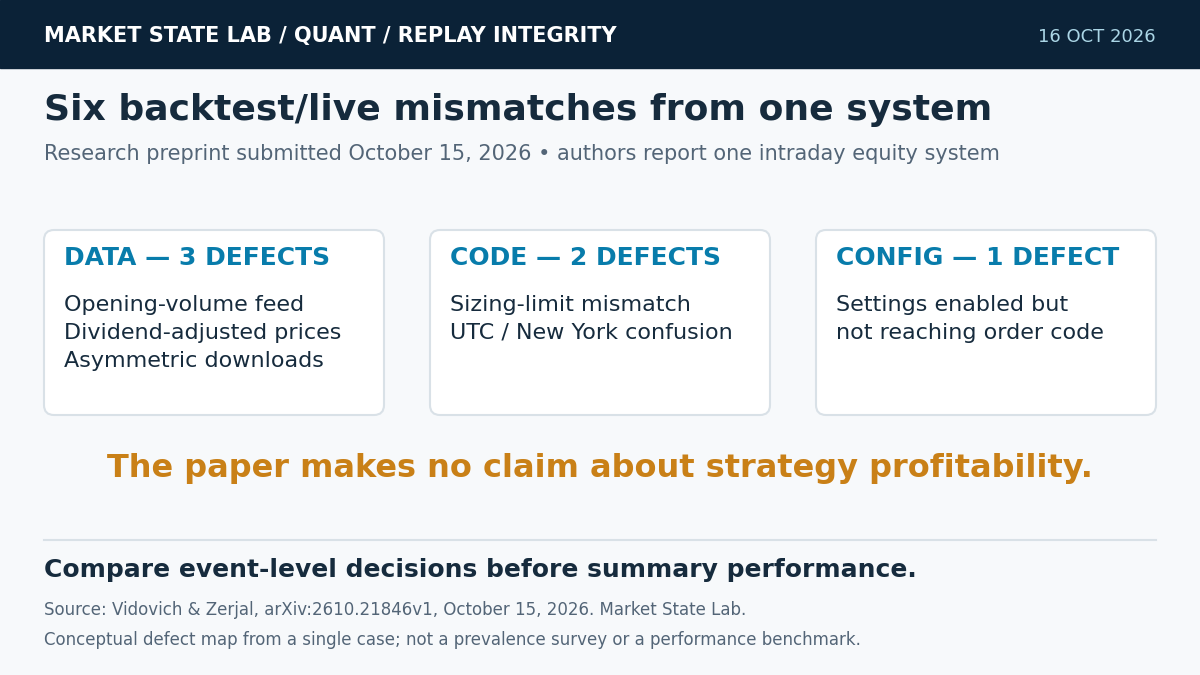
Graphic: Market State Lab. Source/date: Vidovich and Zerjal; arXiv preprint submitted October 15, 2026. Research mechanisms and transaction panels are conceptual; quantitative charts use cited data.
Fact: The authors report six defects in one intraday U.S. equity system: opening-volume feed coverage, dividend-adjusted historical prices, asymmetric downloads, sizing-limit mismatch, UTC/New York confusion, and settings not reaching order code. They say summary statistics did not expose the drift. Source — Vidovich and Zerjal; arXiv preprint submitted October 15, 2026
Inference: Agreement at the event and order level is a prerequisite for interpreting aggregate backtest results.
Uncertainty: This is one authors’ case study, not a prevalence estimate or independent profitability validation; the paper makes no profitability claim.
Why it matters: Replay the same timestamped inputs through research and paper-order paths, comparing quantities, prices, rejected orders and configuration fingerprints.
3. Dow and S&P futures edge higher; Nasdaq lags before expiry
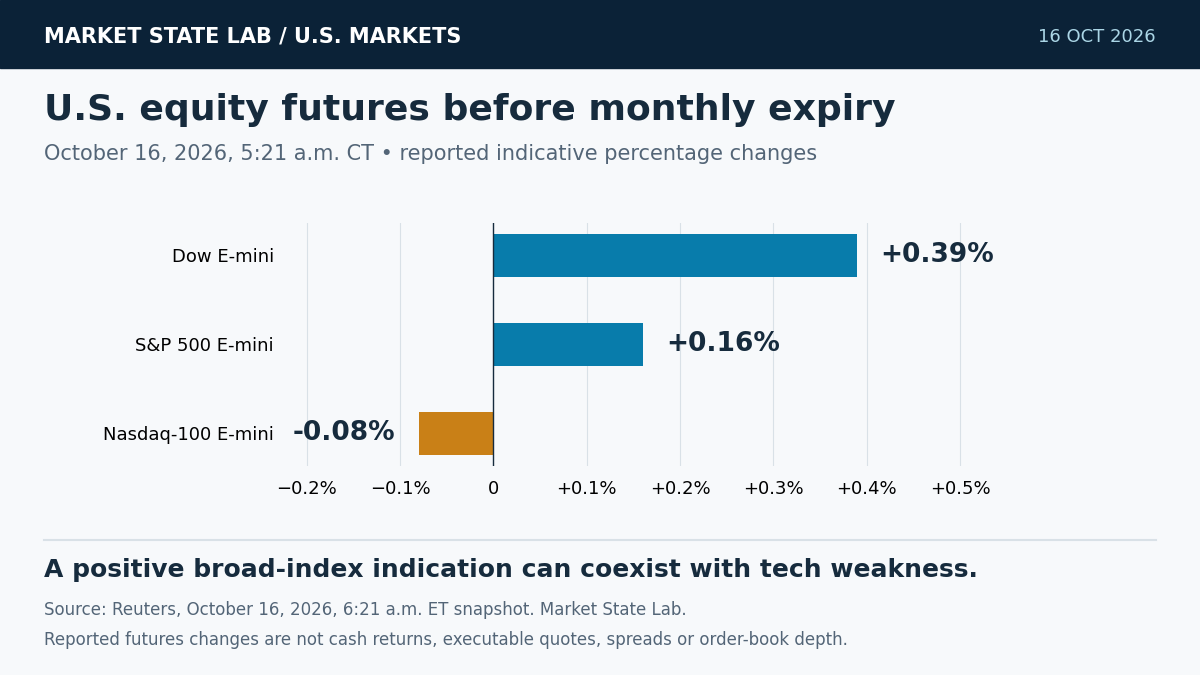
Graphic: Market State Lab. Source/date: Reuters, October 16, 2026; 5:21 a.m. CT snapshot. Research mechanisms and transaction panels are conceptual; quantitative charts use cited data.
Fact: At 5:21 a.m. CT, Dow E-minis were +0.39%, S&P 500 E-minis +0.16% and Nasdaq-100 E-minis −0.08%. Technology shares remained under pressure despite support elsewhere. Source — Reuters, October 16, 2026; 5:21 a.m. CT snapshot
Inference: Broad-index resilience may conceal sector-specific execution and concentration risk.
Uncertainty: Reported futures changes are not executable quotes; consolidated spreads, depth and auction imbalances were not verified.
Why it matters: On monthly-expiry day, reassess SPY/QQQ separately after scheduled data and at the opening auction; do not infer dealer gamma direction from index moves.
4. September producer prices rise 1.3%; pressure extends beyond energy
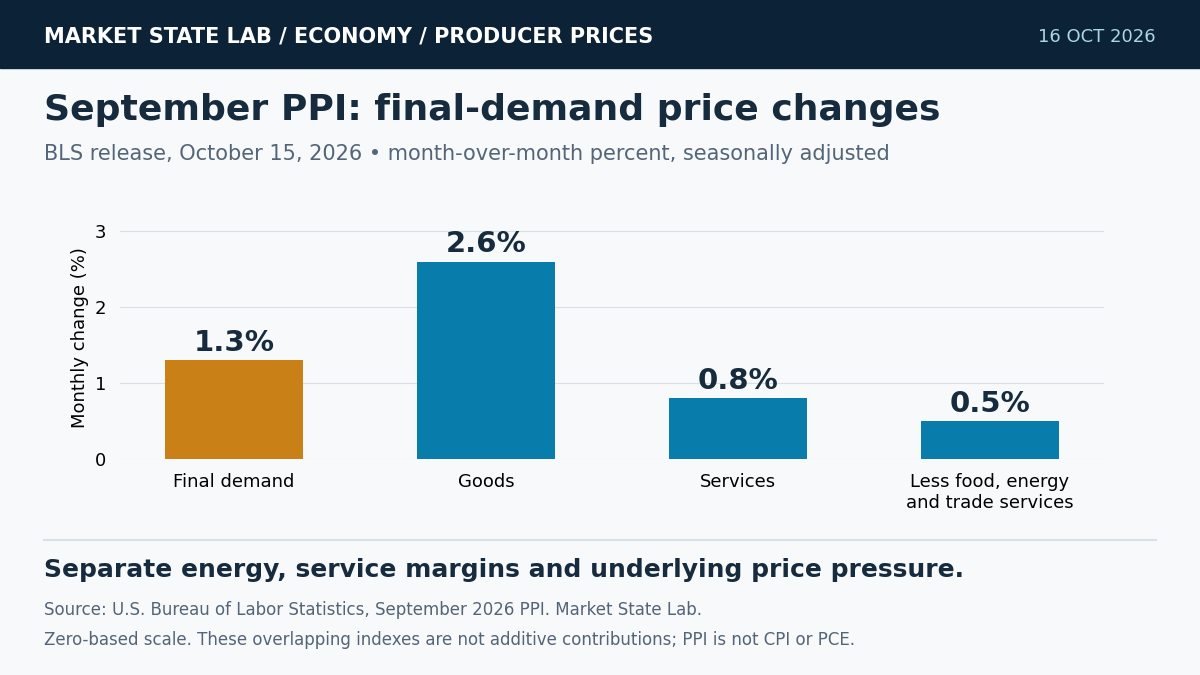
Graphic: Market State Lab. Source/date: BLS, October 15, 2026 release; September reference month. Research mechanisms and transaction panels are conceptual; quantitative charts use cited data.
Fact: Final-demand PPI rose 1.3% monthly, seasonally adjusted, and 6.3% annually, unadjusted. Goods rose 2.6% and services 0.8% monthly; excluding foods, energy and trade services, prices increased 0.5%. Source — BLS, October 15, 2026 release; September reference month
Inference: Energy and service-margin shocks warrant separate treatment from underlying producer-price pressure.
Uncertainty: PPI is not CPI or PCE; one release does not establish consumer pass-through or the next Fed decision. Earlier months were revised.
Why it matters: Preserve release vintages and distinguish headline, goods, services and margin-sensitive components when testing inflation surprises.
5. Proofpoint agrees to acquire Varonis in a $6.3 billion transaction
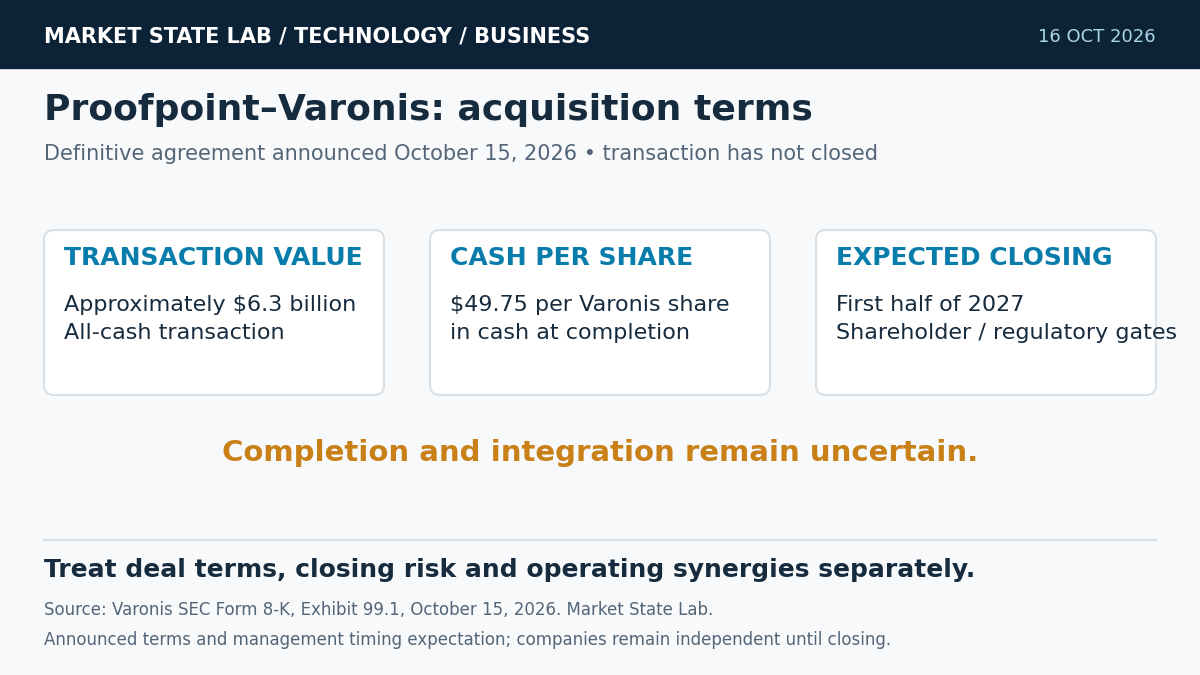
Graphic: Market State Lab. Source/date: Company announcement filed with the SEC, October 15, 2026. Research mechanisms and transaction panels are conceptual; quantitative charts use cited data.
Fact: Proofpoint and Varonis announced a definitive all-cash agreement valued at approximately $6.3 billion. Varonis shareholders would receive $49.75 per share. Management expects completion in the first half of 2027, subject to shareholder and regulatory approvals. Source — Company announcement filed with the SEC, October 15, 2026
Inference: The proposed combination highlights demand for controls spanning enterprise data, identity, communications and AI agents.
Uncertainty: The deal has not closed; financing, approvals, timing and integration remain material risks. Announced synergies are not verified outcomes.
Why it matters: For business analysis, separate deal completion risk from operating assumptions; for technical systems, inventory agent permissions and sensitive-data access.
Quant & Market Dashboard
Liquidity, funding and volatility
- Overnight: Use the 5:21 a.m. CT futures indications above as directional context only. Overnight futures/ETF volume, executable spreads, consolidated depth and current funding dislocations were not verified. Prior volume cannot establish present fillability.
- ETFs, October 15 prior close: SPY 771.79, +0.28%, volume 43.26 million shares; QQQ 728.00, -0.13%, volume 49.83 million. Completed-session vendor data, not current premarket quotes. Alpha Vantage daily-data methodology.
- Treasuries, October 15 official daily par yields: 2-year 4.77%, 10-year 5.10%, 30-year 5.43%; 2s10s +33 basis points. The 2-year fell 5 basis points and 10-year fell 9 versus October 14. These are prior-session indicative curve observations, not overnight transactions or depth. U.S. Treasury.
- Funding: Latest verified October 14 SOFR and EFFR were both 3.88%. Newer fixings were unavailable at cutoff. This lagged pair does not establish current repo stress or its absence. SOFR, EFFR.
- Volatility regime: Moderate, with elevated expiry/execution risk; medium confidence. October 15 VIX close was 16.46, down 2.43%; the vendor’s delayed October 16 reading was 16.11 at 5:19 a.m. CT. Benchmark volatility eased, but expiry and index divergence limit confidence. Current skew, VX term structure and liquidity degradation were not verified. VIX history and delayed snapshot.
Factor proxies
| Factor | ETF | October 14→15 | September 17→October 15 |
|---|---|---|---|
| Momentum | MTUM | -1.09% | -1.50% |
| Value | VLUE | +1.06% | -2.35% |
| Quality | QUAL | +0.35% | +3.55% |
| Size | IWM | +1.37% | -3.63% |
| Growth | IWF | -0.02% | +1.40% |
| Low volatility | SPLV | +0.57% | +0.89% |
Four weeks is exactly 28 calendar days. Returns use common-date Alpha Vantage raw closing prices, excluding dividends. A provider limit prevented complete fresh corporate-action reconciliation; this is an indicative price-proxy panel, rather than the fully reconciled split-adjusted standard panel. No ticker substitutions were made. ETF exposures are not pure factors; interpret the small-cap rebound and momentum weakness alongside still-negative four-week price changes, not as proof of durable rotation.
Execution and microstructure
- Timing, October 16: Import/export prices are scheduled 7:30 a.m. CT; cash equities open 8:30 a.m. CT. The release was unavailable at cutoff. BLS calendar.
- Monthly expiry is today. Distinguish SPY/QQQ ETF options, 0DTE and standard index contracts; verify each contract’s settlement, last-trade and exercise terms. Opening and closing auctions can concentrate imbalances. Cboe 2026 expiration calendar.
- Refresh quote age, spread, displayed size and auction imbalance after data and before entry. Use limits, participation caps and explicit cancel/replace handling; a narrow spread can conceal disappearing depth. Avoid chasing isolated prints or assuming midpoint fills.
- Dealer gamma sign, strike concentration, live open-interest changes and options depth were not verified. Stress pinning risk, adverse selection, partial fills, assignment exposure, gaps and nonlinear impact rather than assigning an unsupported gamma regime.
Watchlist: SPY, QQQ, IWM, TLT, VIX, MTUM, VLUE, QUAL, IWF, SPLV, VRNS, CRWV, NVDA, TSLA, ES, NQ, ZT, ZN, VX.
DRL Improvements for the MATLAB System
- Keep drawdown, concentration, turnover, liquidity and daily-loss limits outside the learned reward; verify constraints on the actual order path, with deterministic stop and recovery behavior.
- Penalize implementation shortfall, inventory risk and excessive churn. Randomize spreads, depth withdrawal, latency, rejected cancels, partial fills and nonlinear impact.
- Require event-level replay parity for timestamps, raw execution prices, sizing and configuration before evaluating a learned policy. Log observation, action, risk decision, order request and outcome separately.
- Use purged, embargoed walk-forward folds and multiple seeds; hold out entire inflation and expiry blocks. Freeze selection rules, test regime robustness, and monitor calibration and drift.
Model hygiene
Prevent leakage and look-ahead bias with decision-time timestamps and release vintages. Include delisted constituents to limit survivorship bias. Keep raw execution prices separate from adjusted research series; reconcile splits, distributions and other corporate actions. Reject stale options quotes, verify time zones and contract mappings, control multiple testing, and monitor calibration and feature/policy drift.
MATLAB optimization patterns
- Align event, quote and order logs with time-zone-aware
timetable,retimeandsynchronize; keep causal alignment explicit. - Vectorize replay comparisons, preallocate diagnostic tables and profile environment/order steps before parallelizing.
- Run parallel
bayesoptacross independent purged folds with reproducible random streams and multiple seeds. - Use GPUs for sufficiently large network batches; separate data, execution-cost, constraint, agent and logging modules.
High-value quant research question
Does enforcing feed, raw-price, time-zone, sizing and configuration parity reduce SPY/QQQ replay-to-paper-order divergence on monthly-expiry days?
It is worth testing because event-level mismatch rates can expose implementation defects before aggregate returns obscure them; it does not require assuming predictive alpha.
Technical companion: 2026-10-16 GitHub archive (public after the approved commit).
If this helps your research, forward it to one colleague who would find it useful.
Research and education only—not individualized financial advice.