Quant Market Brief — October 15, 2026: Post-CPI Execution & TSMC Guidance
Research cutoff: October 15, 2026, 6:40 a.m. CT (11:40 UTC). Futures and VIX readings are earlier reported/delayed indications; ETF and Treasury observations are prior-session. No live consolidated book was verified.
1. AI research targets better-calibrated weather probabilities
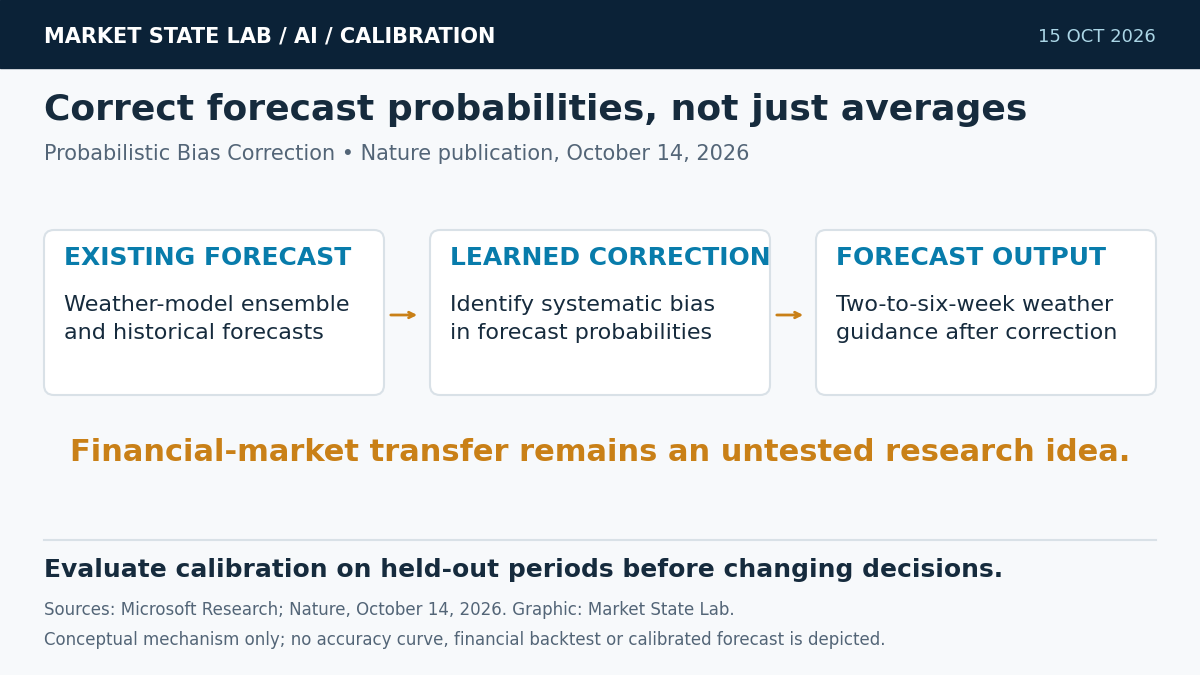
Graphic: Market State Lab; source/date: Microsoft Research; Nature paper published October 14, 2026. Conceptual panels are illustrative; quantitative charts use the cited data.
Fact: Probabilistic Bias Correction learns systematic errors in existing weather forecasts and corrects their probabilities. Microsoft reports improved two-to-six-week forecasting and top competition results for its PBC-based MicroDuet system. Source — Microsoft Research; Nature paper published October 14, 2026
Inference: A separate calibration layer may be worth testing before replacing an entire financial forecasting model.
Uncertainty: Weather results do not establish trading alpha or robustness under financial regime changes.
Why it matters: In MATLAB, freeze the base forecaster, fit calibration only on training data, and compare held-out proper probability scores and decision costs.
2. Hawkes-structured RL adds order-flow memory to market making
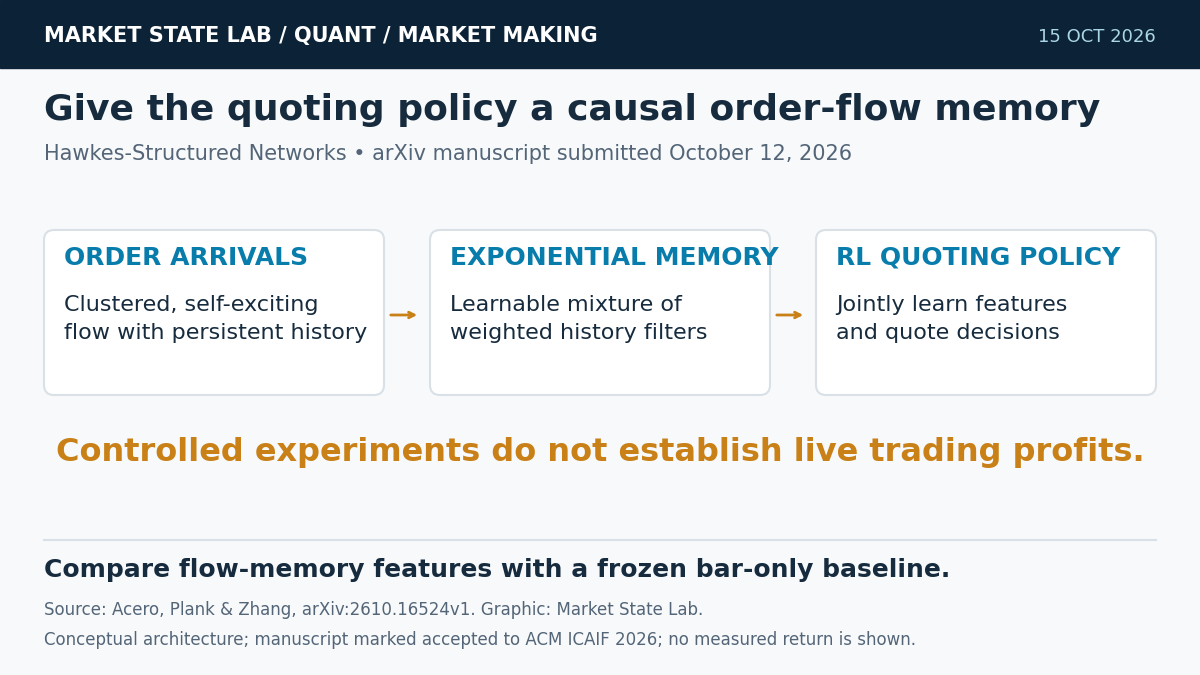
Graphic: Market State Lab; source/date: Acero, Plank and Zhang; arXiv submission October 12, 2026; marked accepted to ACM ICAIF 2026. Conceptual panels are illustrative; quantitative charts use the cited data.
Fact: The authors propose a model-free RL market-making system with learnable mixtures of exponential history filters. Their controlled single- and multi-asset experiments outperform generic neural architectures on reward under several Hawkes order-flow kernels. Source — Acero, Plank and Zhang; arXiv submission October 12, 2026; marked accepted to ACM ICAIF 2026
Inference: Causal flow memory may improve policy state representation beyond bar-only features.
Uncertainty: The manuscript does not establish independently verified live profitability or transfer under actual queue, latency and impact costs.
Why it matters: Ablate multi-timescale order-flow features against a frozen baseline using identical seeds, fill assumptions, risk limits and costs.
3. Nasdaq futures underperform as the AI selloff continues
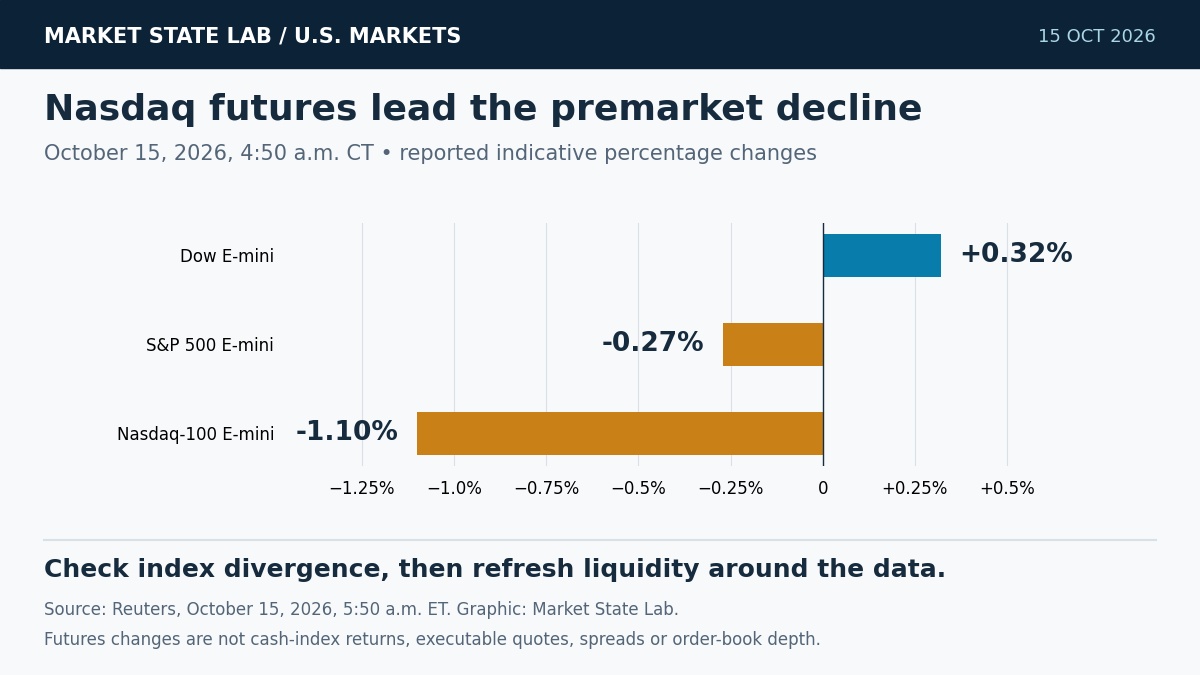
Graphic: Market State Lab; source/date: Reuters, October 15, 2026; reported 4:50 a.m. CT snapshot. Conceptual panels are illustrative; quantitative charts use the cited data.
Fact: At 4:50 a.m. CT, Dow E-minis were +0.32%, S&P 500 E-minis −0.27% and Nasdaq-100 E-minis −1.10%. Reuters linked technology weakness to AI-debt concerns after the inflation-driven selloff. Source — Reuters, October 15, 2026; reported 4:50 a.m. CT snapshot
Inference: Index divergence argues for checking breadth and funding sensitivity before applying a broad-index signal to QQQ.
Uncertainty: These indications are not executable quotes; current spreads, depth and auction imbalances were not verified.
Why it matters: Refresh SPY/QQQ execution assumptions after the next data releases and at the cash open.
4. September CPI rises 0.6% monthly; core inflation rises 0.3%
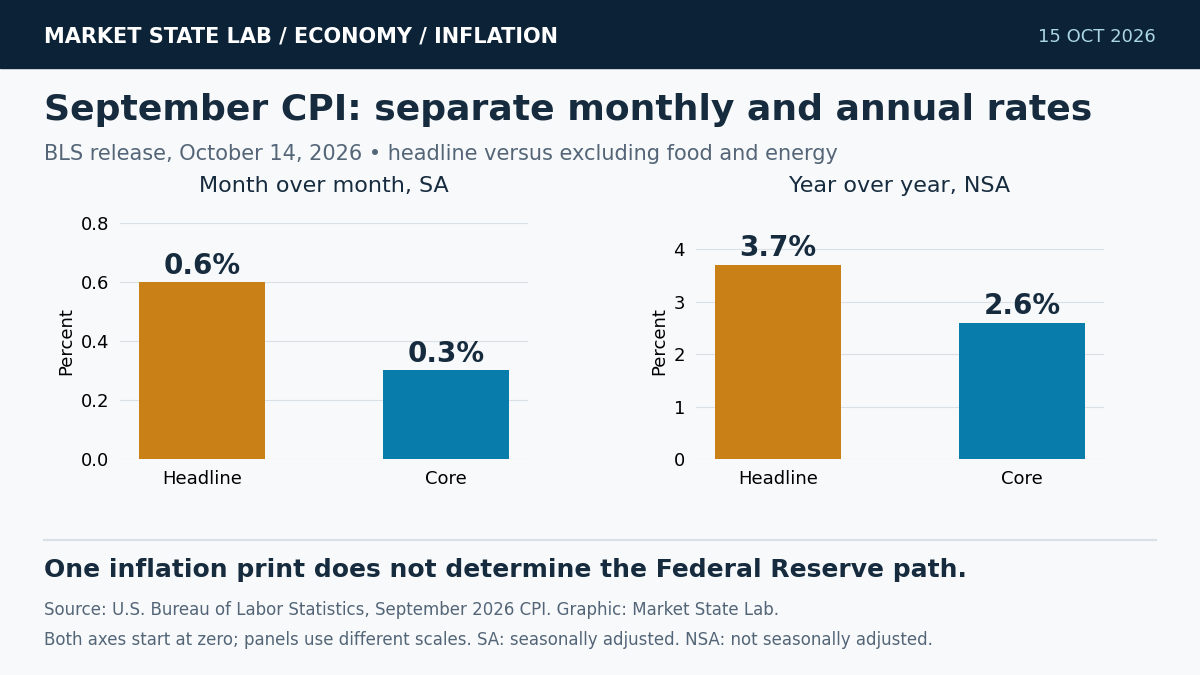
Graphic: Market State Lab; source/date: U.S. Bureau of Labor Statistics, October 14, 2026 release; September reference month. Conceptual panels are illustrative; quantitative charts use the cited data.
Fact: Headline CPI rose 0.6% month over month, seasonally adjusted, and 3.7% over twelve months, unadjusted. Core rose 0.3% monthly and 2.6% annually. Gasoline accounted for more than half the monthly headline increase. Source — U.S. Bureau of Labor Statistics, October 14, 2026 release; September reference month
Inference: Separate the energy shock from persistent core pressure when updating rate-sensitive scenarios.
Uncertainty: One CPI print does not determine the Fed path; CPI is not the Fed’s PCE inflation measure.
Why it matters: Test inflation components separately and retain the release timestamp and data vintage in event studies.
5. TSMC reports strong Q3 revenue and guides higher for Q4
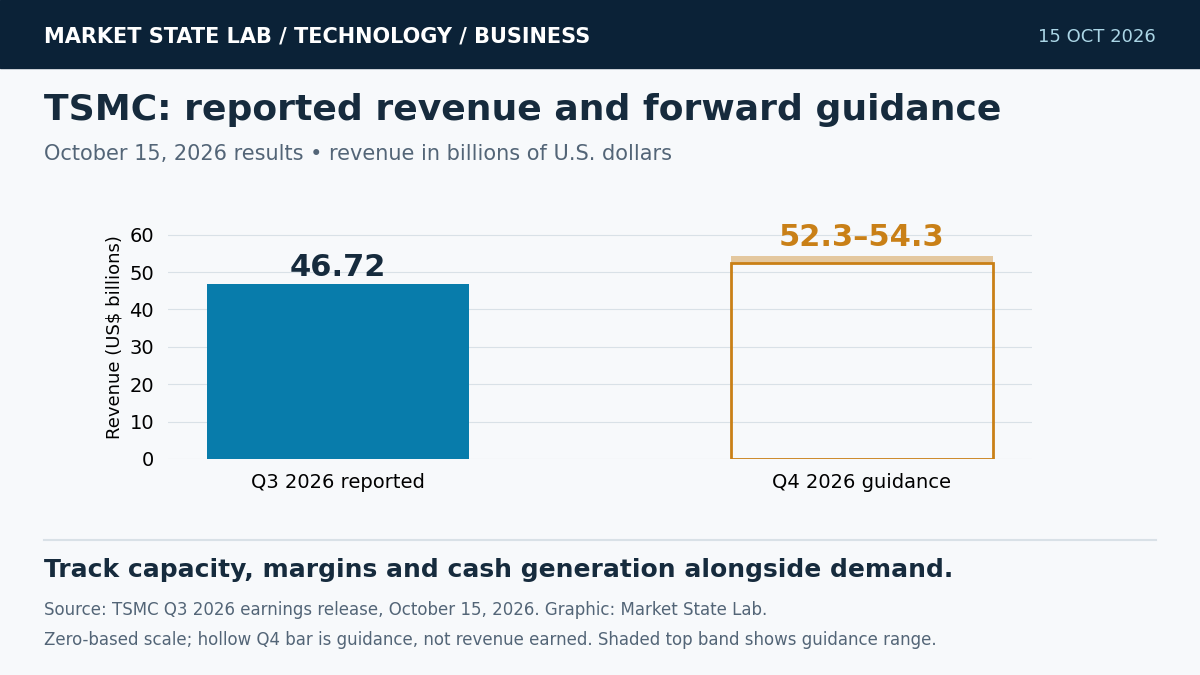
Graphic: Market State Lab; source/date: TSMC earnings release, October 15, 2026. Conceptual panels are illustrative; quantitative charts use the cited data.
Fact: TSMC reported Q3 revenue of US$46.72 billion, up 41.2% year over year in U.S. dollars, with a 66.4% gross margin. Q4 revenue guidance is US$52.3–54.3 billion, supported by leading-edge demand and the 2-nanometer ramp. Source — TSMC earnings release, October 15, 2026
Inference: Foundry revenue and margins provide a useful operating check on AI investment narratives.
Uncertainty: Guidance is conditional; strong foundry demand does not by itself resolve customer financing or valuation risk.
Why it matters: Track capacity conversion, packaging constraints, margins and cash generation alongside semiconductor price momentum.
Quant & Market Dashboard
Liquidity, funding and volatility
- Overnight: The futures indications in story 3 are directional proxies. Overnight futures/ETF volume, executable spreads, consolidated depth and funding dislocations were not verified. Prior-session volume is not evidence of current fillability.
- ETFs, October 14 prior close: SPY 769.60, −1.08%, volume 55.72 million shares; QQQ 728.95, −1.97%, volume 52.38 million. Completed-session vendor observations, not live premarket quotes. Alpha Vantage daily-data methodology.
- Treasuries, October 14 official daily par yields: 2-year 4.82%, 10-year 5.19%, 30-year 5.52%; 2s10s +37 basis points. The 2-year rose 3 basis points while the 10-year fell 2 versus October 13. These are prior-session curve observations, not overnight market depth. U.S. Treasury.
- Funding: Latest verified October 13 SOFR was 3.89% and EFFR 3.88%; newer fixings were not available at cutoff. The one-basis-point difference does not establish repo stress. SOFR, EFFR.
- Volatility regime: Moderate, with elevated event/execution risk; medium confidence. VIX closed October 14 at 16.87, up 10.48%; the vendor’s delayed October 15 reading was 17.59 at 5:32 a.m. CT. This is consistent with rising protection demand, not a verified stressed-liquidity regime. VX term structure and current option skew were unavailable. VIX history and delayed snapshot.
Factor proxies
| Factor | ETF | October 13→14 | September 16→October 14 |
|---|---|---|---|
| Momentum | MTUM | -2.63% | +1.68% |
| Value | VLUE | -1.55% | -1.64% |
| Quality | QUAL | -0.51% | +3.94% |
| Size | IWM | -1.93% | -4.42% |
| Growth | IWF | -2.24% | +3.09% |
| Low volatility | SPLV | +0.42% | +0.51% |
Four-week window is 28 calendar days. Returns use common-date Alpha Vantage raw closing prices, excluding dividends. Historical split screens for these six symbols showed no split effective inside this window; future-dated November events were excluded. These are ETF price proxies, not pure-factor or total returns. Growth and momentum weakened sharply Wednesday; compare their short-run losses with still-positive four-week changes rather than inferring an established trend reversal.
Execution and microstructure
- Event timing, October 15: PPI and retail sales are scheduled 7:30 a.m. CT; cash equities open 8:30 a.m. CT. Results were not available at the research cutoff. BLS calendar, Census retail calendar.
- For SPY/QQQ, refresh quote age, spread, displayed size, auction imbalance and implementation shortfall after the data and before entry. Use auction-aware limits and participation caps. A narrow spread can conceal vanishing depth; avoid chasing an apparent rebound on thin prints.
- October 16 monthly expiry increases positioning uncertainty. Distinguish 0DTE from monthly contracts and check each contract’s settlement/last-trade terms. Dealer gamma direction, strike concentration and live open-interest changes were not verified. Cboe 2026 expiration calendar.
- Reject stale, crossed, zero-bid and one-sided option quotes. Stress partial fills, adverse selection, gap risk and nonlinear impact; midpoint marks are not guaranteed fills. A falling futures price is not evidence of a particular dealer gamma sign.
Watchlist: SPY, QQQ, IWM, TLT, VIX, MTUM, VLUE, QUAL, IWF, SPLV, TSM, NVDA, SMH, SOXX, ES, NQ, ZT, ZN, VX.
DRL Improvements for the MATLAB System
- Enforce drawdown, concentration, turnover, liquidity and daily-loss limits outside the learned reward, with a deterministic stop and recovery policy.
- Add causal multi-timescale order-flow memory, quote age, auction phase and expiry state. Ablate each feature against a frozen bar-only baseline.
- Penalize implementation shortfall and adverse inventory risk; randomize latency, partial fills, cancel failures, spread widening and nonlinear impact. Require capital-preserving behavior across regimes.
- Use purged, embargoed walk-forward folds, multiple seeds and entire inflation/expiry blocks held out. Fit probability calibration only within training folds and monitor held-out coverage and drift.
Model hygiene
Use decision-time timestamps and release vintages to prevent leakage and look-ahead bias. Keep delisted constituents to limit survivorship bias; reconcile splits, distributions and corporate actions. Reject stale options quotes and repair symbol/contract mappings. Control multiple testing, freeze selection rules, inspect calibration by regime and monitor feature, reward and policy drift.
MATLAB optimization patterns
- Use
timetable,retimeandsynchronizewith explicit time zones and causal alignment of events, trades and quotes. - Vectorize exponential-memory updates, preallocate buffers and profile environment steps before adding workers.
- Run parallel
bayesoptonly across independent purged folds, with reproducible random streams and multiple policy seeds. - Use GPUs for sufficiently large network batches; keep market, execution-cost, constraint and agent modules separate.
High-value quant research question
Does causal multi-timescale order-flow memory improve QQQ post-inflation execution versus bar-only features after latency, queue and impact costs?
It is worth testing because a matched ablation can distinguish useful flow-state information from reward overfitting and unrealistic fills.
Technical companion: 2026-10-15 GitHub archive (public after the approved commit).
If this helps your research, forward it to one colleague who would find it useful.
Research and education only—not individualized financial advice.