Quant Market Brief — November 9, 2026: Selective Rebound & Consumer Credit
Research cutoff: November 9, 2026, 6:38 a.m. CST (12:38 UTC). Monday premarket edition; market data are explicitly timestamped reported/delayed snapshots or prior-close observations, not live executable quotes.
1. WorldParticle unifies particle-based physical simulation
Graphic: Market State Lab; MIT News, November 9, 2026.
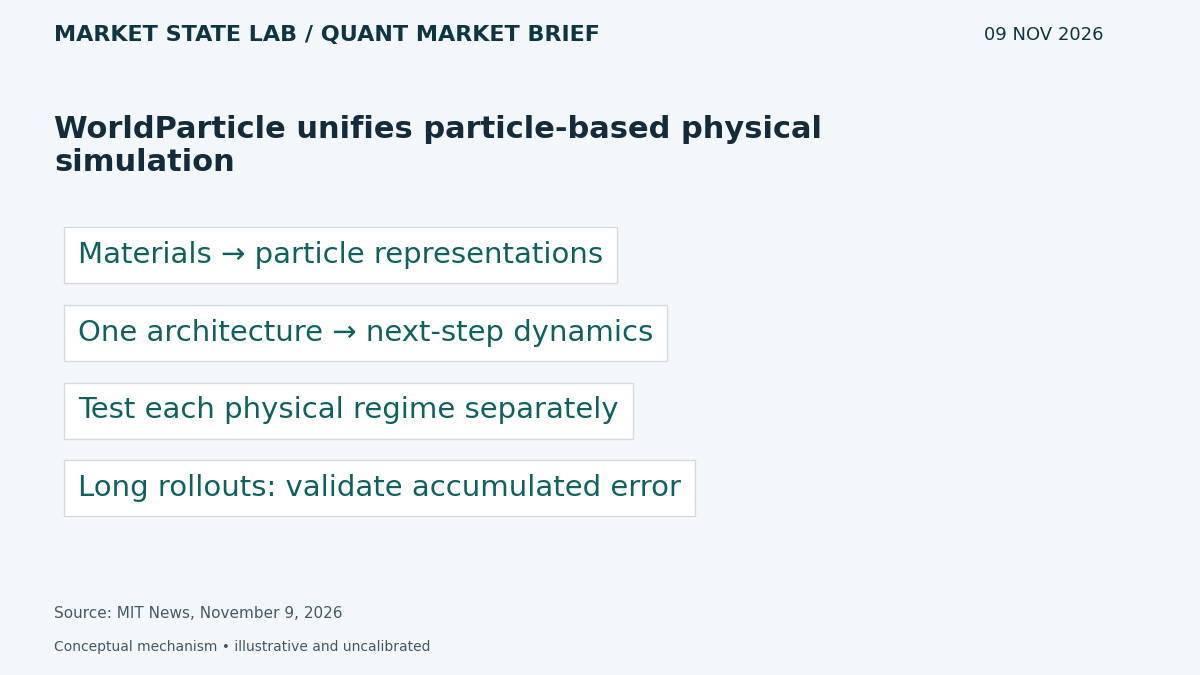
Fact — MIT report November 9, 2026: MIT and collaborators describe WorldParticle, a deep-learning architecture that represents materials as particles and predicts their next movements across physical phenomena, including granular materials and proteins. Direct source
Inference / Why it matters: For MATLAB surrogate models, test shared representations against specialist baselines and measure long-rollout stability.
Uncertainty: Research demonstrations do not establish universal physical fidelity or applicability to financial prices.
2. New review separates agentic finance capability from prediction
Graphic: Market State Lab; Islam and Pere, JRFM, November 5, 2026.
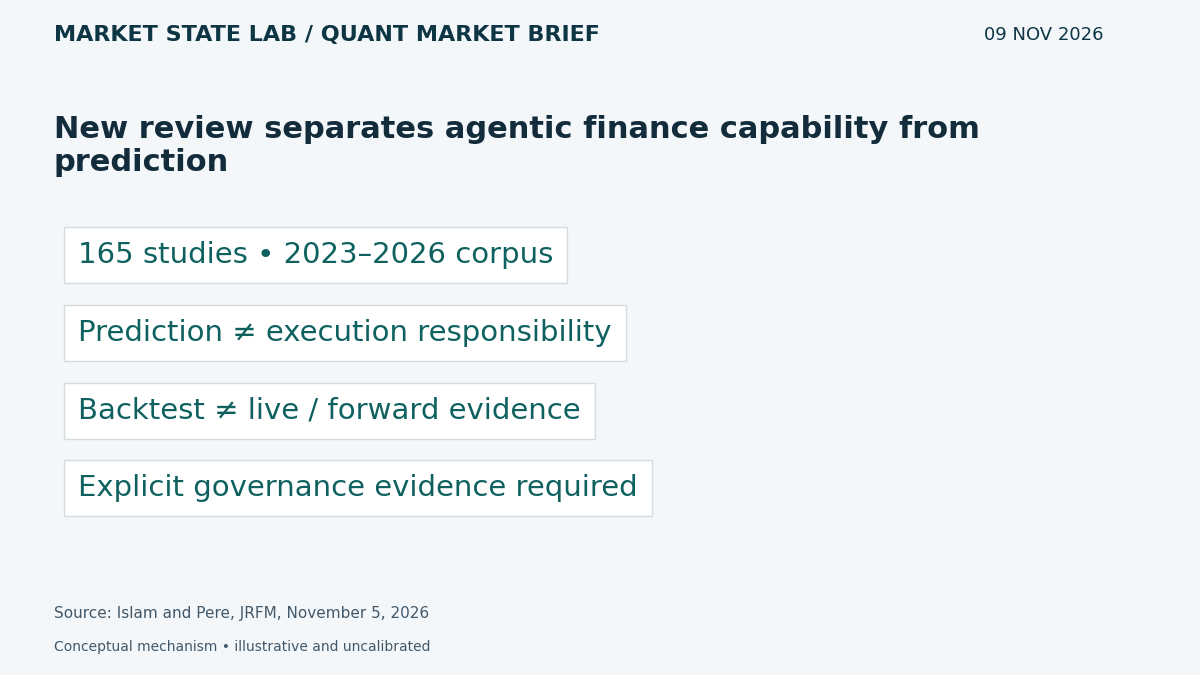
Fact — Published November 5, 2026: A scoping review synthesizes 165 studies from 2023–2026. Its framework distinguishes prediction, interpretation, recommendation, execution and coordination, and explicitly separates historical or simulated evaluation from live or forward testing. Direct source
Inference / Why it matters: Require evidence for the decision responsibility an agent actually assumes; preserve external risk controls and forward evaluation.
Uncertainty: A literature synthesis is not a validated profitable strategy. Tool use alone does not establish agentic capability.
3. Index futures rebound, with Nasdaq trailing the Dow
Graphic: Market State Lab; Reuters, November 9, 2026; 06:39 EST.
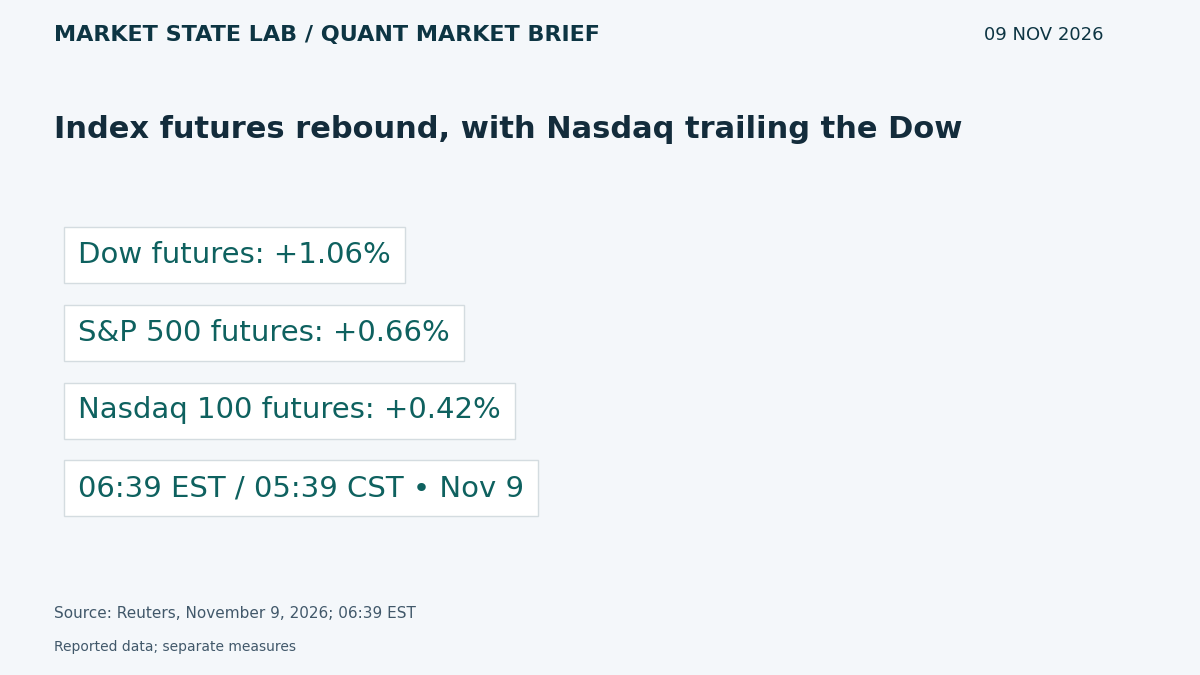
Fact — Reuters November 9, 2026; 06:39 EST snapshot: At 6:39 a.m. EST, Reuters reported Dow futures up 1.06%, S&P 500 futures up 0.66%, and Nasdaq 100 futures up 0.42% following last week’s selloff. Direct source
Inference / Why it matters: Check breadth and ES/NQ relative strength before treating the rebound as broad risk recovery.
Uncertainty: Reported snapshot, not executable quotes. Positive futures do not establish healthy order-book depth.
4. Fed reports faster September consumer-credit growth
Graphic: Market State Lab; Federal Reserve G.19, November 6, 2026.
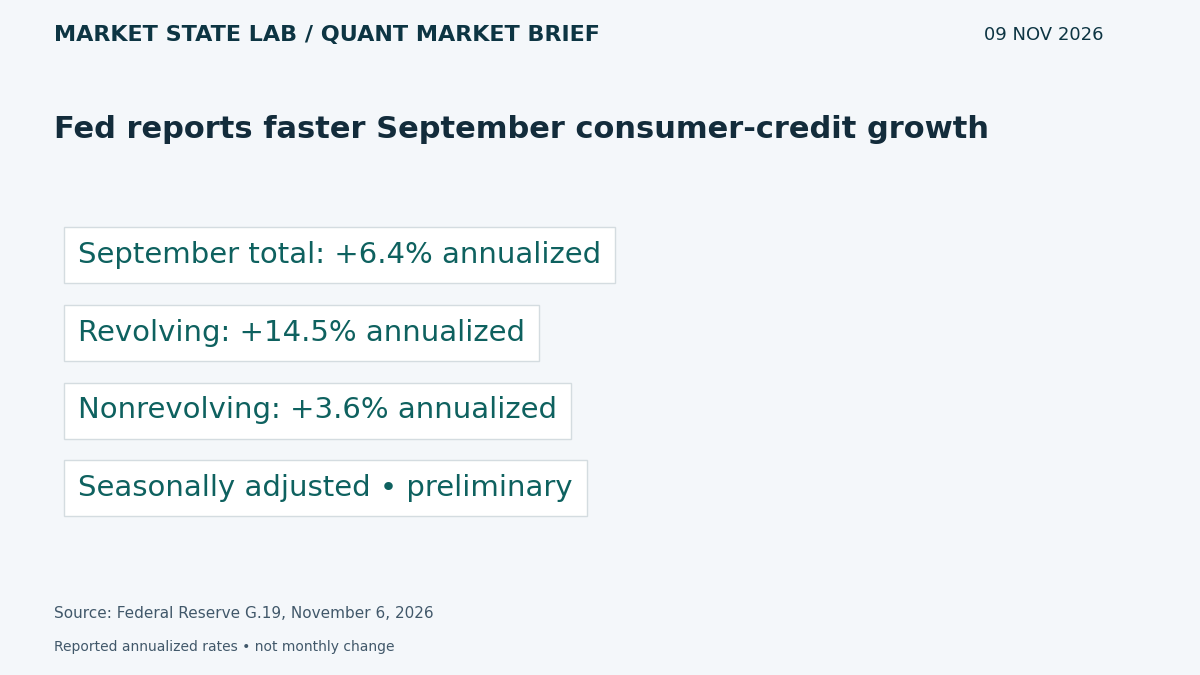
Fact — Federal Reserve release November 6, 2026: Consumer credit grew at a seasonally adjusted annual rate of 6.4% in September and 4.2% in Q3. September revolving credit grew 14.5% annualized, versus 3.6% for nonrevolving credit. Direct source
Inference / Why it matters: Separate revolving from nonrevolving borrowing when testing consumer-demand and credit-risk signals.
Uncertainty: Preliminary and revisable; annualized growth is not a monthly percentage change, and borrowing growth alone does not prove household distress.
5. KKR reports record adjusted earnings and fee growth
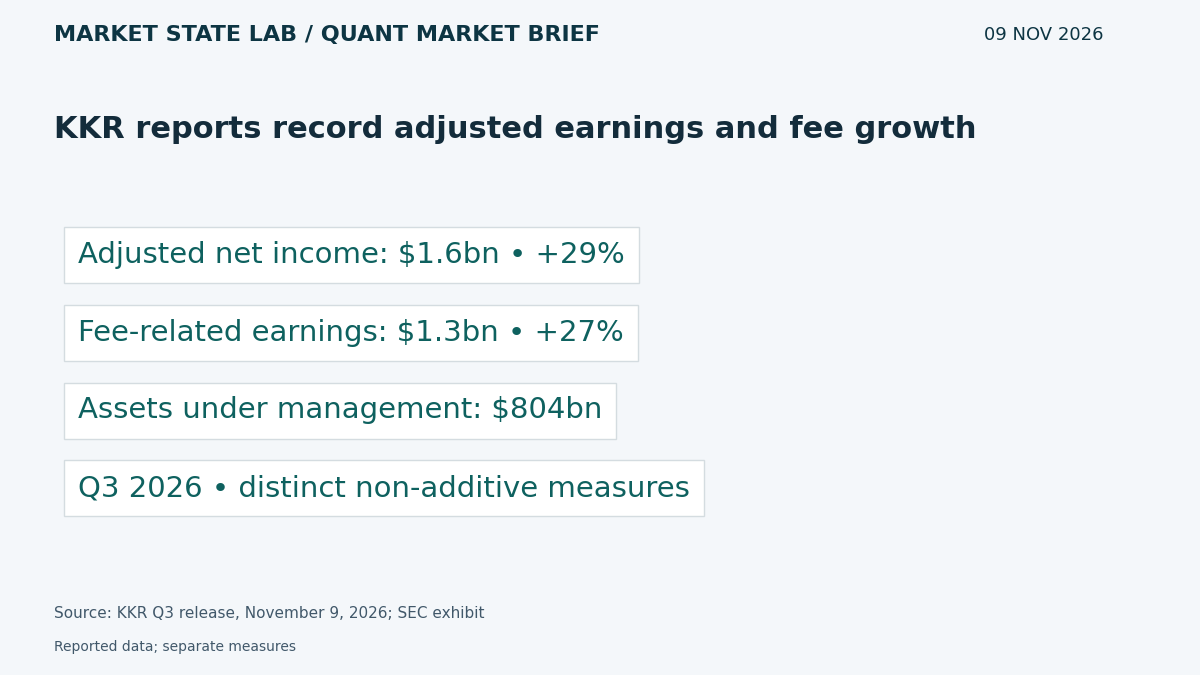
Graphic: Market State Lab; KKR Q3 release, November 9, 2026; SEC exhibit.
Fact — Company release November 9, 2026: KKR reports Q3 adjusted net income of $1.6 billion, up 29% year over year, and fee-related earnings of $1.3 billion, up 27%. Assets under management reached $804 billion. Direct source
Inference / Why it matters: Separate recurring fee earnings from realization-sensitive income when assessing alternative asset managers.
Uncertainty: Adjusted measures are non-GAAP; AUM is not revenue or immediately deployable liquidity.
Quant & Market Dashboard
Liquidity and volatility
- Overnight: Index futures are higher at the story’s 05:39 CST checkpoint. ES/NQ spreads, depth, overnight volume, ETF executable quotes and Treasury-market depth are unverified; price direction is not a liquidity measure. Refresh the execution feed before the cash auction.
- Funding: Latest verified SOFR is 3.92% for November 5, published November 6 at 07:02 CST. Today’s fixing was not yet available at cutoff. Lagged funding is not a current stress diagnosis. FRED SOFR.
- Regime: Moderate, with elevated transition risk; medium confidence. Delayed VIX was 23.31 at November 9 06:39 EST / 05:39 CST, versus Friday’s daily-row close of 25.64. House thresholds: below 15 low, 15–25 moderate, 25–35 high, above 35 stressed; not calibrated forecasts. Current skew, term structure and dealer gamma remain unverified. VIX.
Factor proxies
| Factor | ETF | Nov 5→6 | Oct 9→Nov 6 (4 weeks) |
|---|---|---|---|
| Momentum | MTUM | +1.85% | -20.30% |
| Value | VLUE | +0.11% | -8.69% |
| Quality | QUAL | +0.07% | -3.43% |
| Size | IWM | +0.99% | -1.89% |
| Growth | IWF | +1.26% | -12.63% |
| Low volatility | SPLV | -0.93% | +6.56% |
Price returns from the source-linked Close columns, excluding distributions; these are ETF proxies, not isolated factor premia. October 9 comparison inputs are archived from November 7; November 6 closes were rechecked November 9; no new completed cash session exists. Corporate-action histories were not independently refreshed; keep a common adjustment basis. Momentum and growth rebounded on Friday but remain sharply negative over four weeks; low volatility fell Friday but remains positive over that horizon.
Execution and microstructure
- For today, Monday November 9, cash opening auction is 8:30 a.m. CST / 14:30 UTC. Recheck the economic calendar before staging orders; CPI is Tuesday at 7:30 a.m. CST; results unknown at cutoff. BLS calendar.
- Inspect quote age, NBBO spreads, displayed depth, auction imbalances and ES/NQ basis. Use bounded limits and participation caps; stress gaps, cancellations, missed fills, latency and widened spreads. Rising prices on thin depth can trap liquidity takers.
- Options: refresh post-expiry positions and hedge requirements; verify expiry, deliverables and settlement. Reject stale, crossed or one-sided quotes. Dealer-gamma sign, expiry concentrations and pinning remain unknown.
Research watchlist: SPY, QQQ, IWM, RSP, TLT; ES, NQ, ZN, VX; MTUM, VLUE, QUAL, IWF, SPLV; NVDA, KKR.
DRL Improvements for the MATLAB System
- Keep drawdown, exposure, participation and stale-data limits outside the policy, with a safe fallback.
- Penalize spread, impact, turnover, latency and missed fills; evaluate tail losses separately from reward.
- Keep future-return targets in training folds only; purge overlapping horizons and reserve a one-use final holdout.
- Randomize liquidity and observation delays across regimes; test whether abstention preserves risk compliance under distribution shift.
Model hygiene
Audit leakage, survivorship bias, look-ahead, corporate actions, stale options quotes, multiple testing, calibration and drift. Use point-in-time universes, release vintages and availability timestamps. Fit preprocessing on training folds only; keep memory curation separate from point-in-time numerical evaluation.
MATLAB optimization patterns
- Use named-zone timetables and causal synchronize/retime; never backfill unreleased observations.
- Vectorize rolling features, preallocate logs and profile before optimizing.
- Parallelize independent folds or Bayesian trials with reproducible random streams and fixed budgets.
- Use GPUs for suitable batches; keep data, risk controls and evaluation in modular environments.
High-value quant research question
Does an explicit abstention gate based on spread, depth and quote age improve net out-of-sample results during volatility-regime transitions?
Compare identical policies with and without the gate, matching seeds, action budgets and costs. Test missed opportunity alongside drawdown and slippage; it distinguishes useful restraint from accidental underexposure.
Please forward this edition to one colleague who would find it useful.
Research and education only—not individualized financial advice. No trading performance is promised.