Quant Market Brief — November 8, 2026: CPI Watch & Training-Only Forecasts
Research cutoff: November 8, 2026, 6:36 a.m. CST (12:36 UTC). Sunday morning edition; market data are Friday prior-close or lagged, not live quotes.
1. Anthropic separates memory capture from memory correction
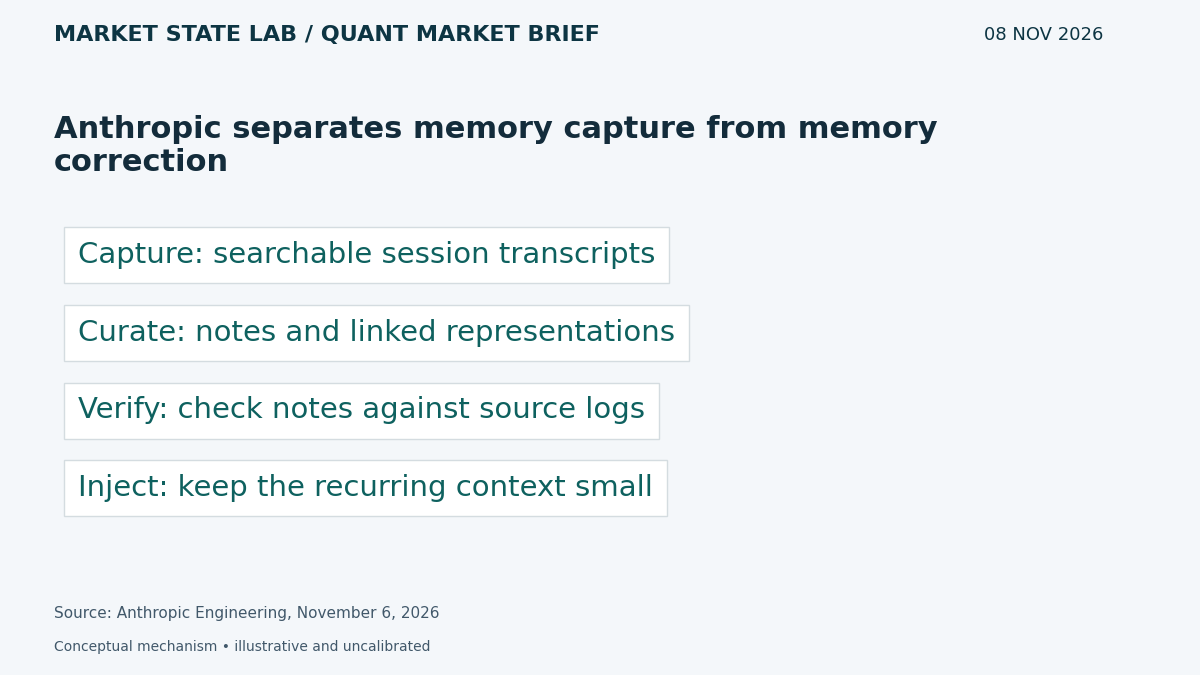
Graphic: Market State Lab; Anthropic Engineering, November 6, 2026.
Fact — Published November 6, 2026: Anthropic describes a hierarchy of transcripts, notes, structured representations and injected context. Offline reflection, called dreaming, checks notes against original transcripts and can repair errors. Direct source
Inference / Why it matters: Keep source transcripts and provenance when curating research memory; test correction of deliberately planted wrong notes.
Uncertainty: Vendor experiments; reflection consumes compute and can introduce errors. Larger memory is not automatically better.
2. FRPO adds forecast supervision to portfolio-policy training
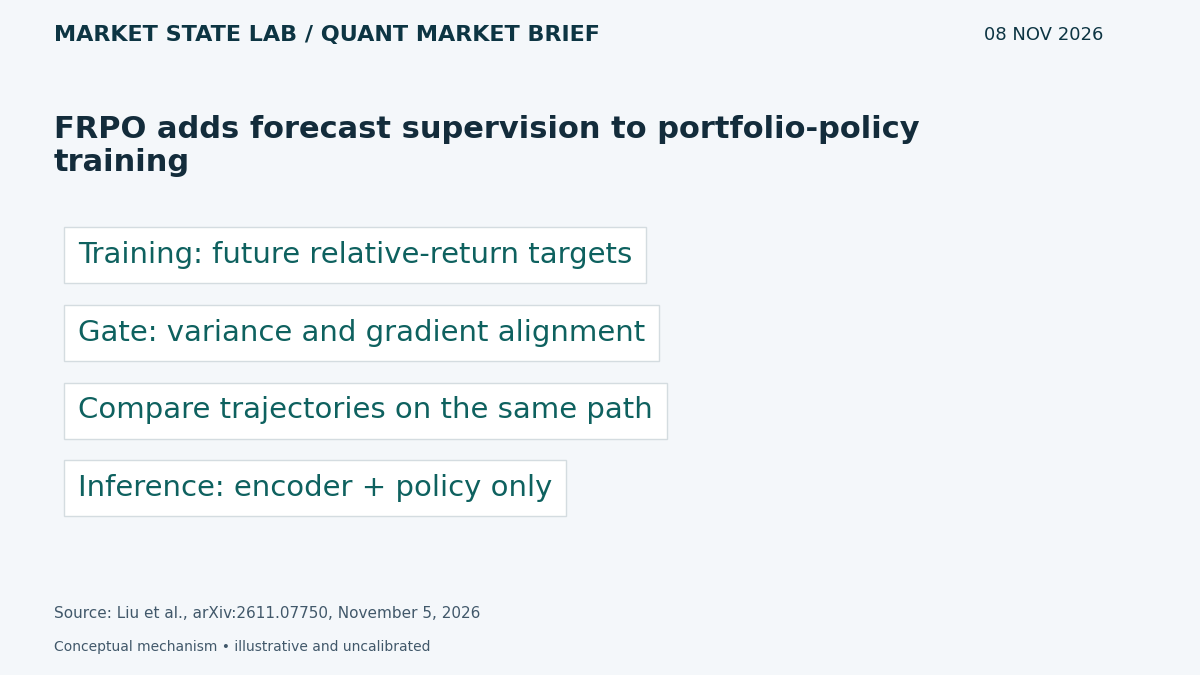
Graphic: Market State Lab; Liu et al., arXiv:2611.07750, November 5, 2026.
Fact — Preprint submitted November 5, 2026: Foresee to Trade proposes Forecast-Augmented Relative Policy Optimization. A training-only Financial State Head learns future relative-return targets; a gate uses predictive variance and gradient alignment. Inference uses the encoder and trading policy. Direct source
Inference / Why it matters: Test auxiliary forecasts against an otherwise identical policy, preserving holdings, cash constraints and transaction costs.
Uncertainty: Preprint with author-reported backtests; future targets must remain inside training folds and never become inference inputs.
3. Cboe’s Friday snapshot records 77.97 million options contracts
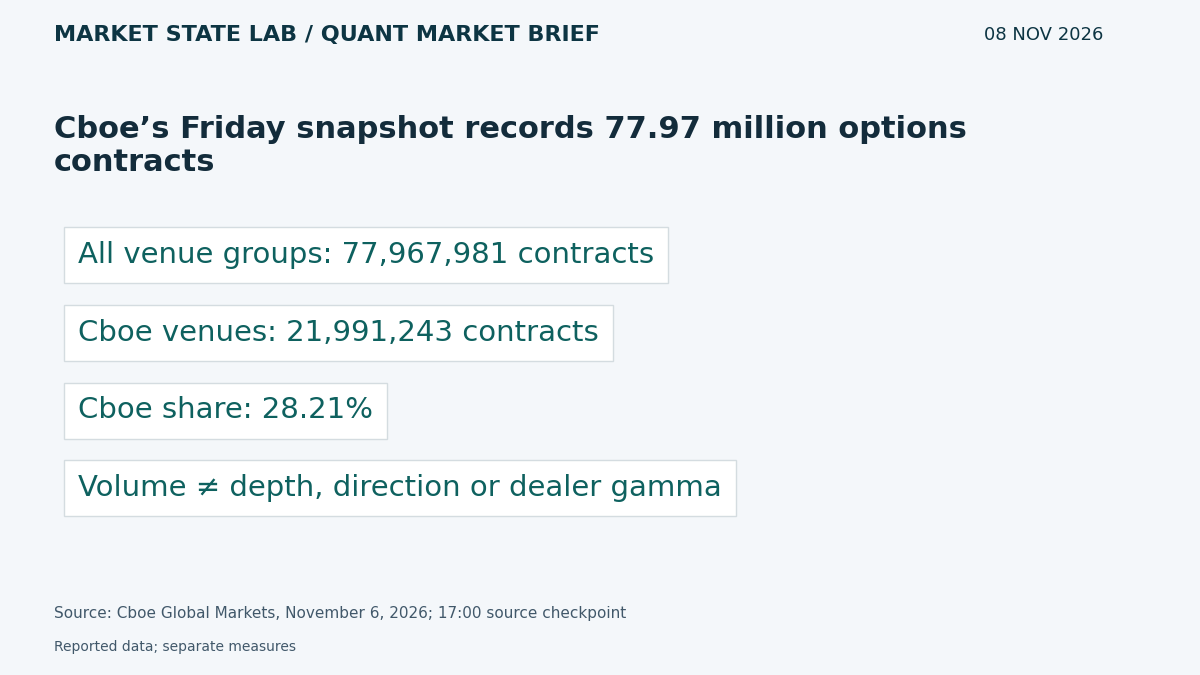
Graphic: Market State Lab; Cboe Global Markets, November 6, 2026; 17:00 source checkpoint.
Fact — November 6, 2026; source checkpoint 17:00: Cboe’s market-volume summary reports 77,967,981 matched contracts across listed venue groups; Cboe venues account for 21,991,243, or 28.21%. Direct source
Inference / Why it matters: Use aggregate activity to plan capacity checks, then inspect actual SPY/QQQ chain spreads and depth before execution.
Uncertainty: Prior-session volume, not current liquidity or directional positioning. Snapshot time zone is not specified in the extracted table.
4. Tuesday’s CPI release is the next inflation checkpoint
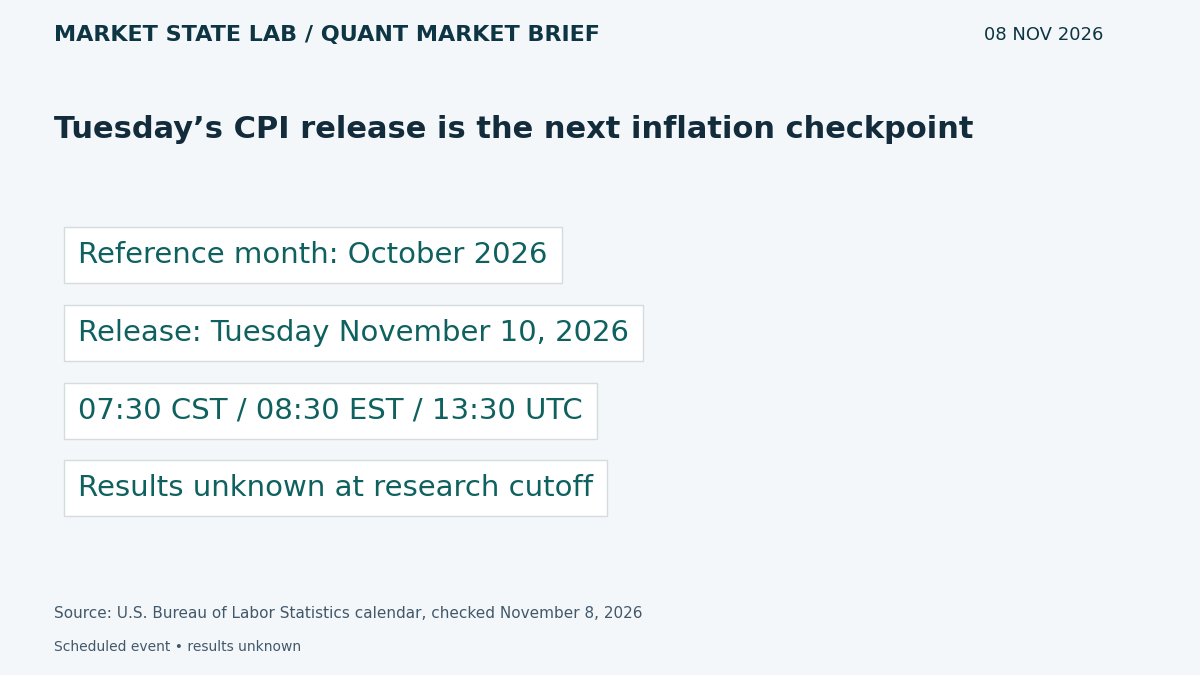
Graphic: Market State Lab; U.S. Bureau of Labor Statistics calendar, checked November 8, 2026.
Fact — Schedule checked November 8, 2026: BLS schedules October CPI for Tuesday November 10 at 8:30 a.m. Eastern, or 7:30 a.m. CST. Results are not yet available. Direct source
Inference / Why it matters: Apply event-conditioned risk limits; compare headline, core and component surprises without importing unreleased values into signals.
Uncertainty: Calendar event, not a forecast or released inflation reading; recheck timing before placing orders.
5. Berkshire increases buybacks as operating earnings fall
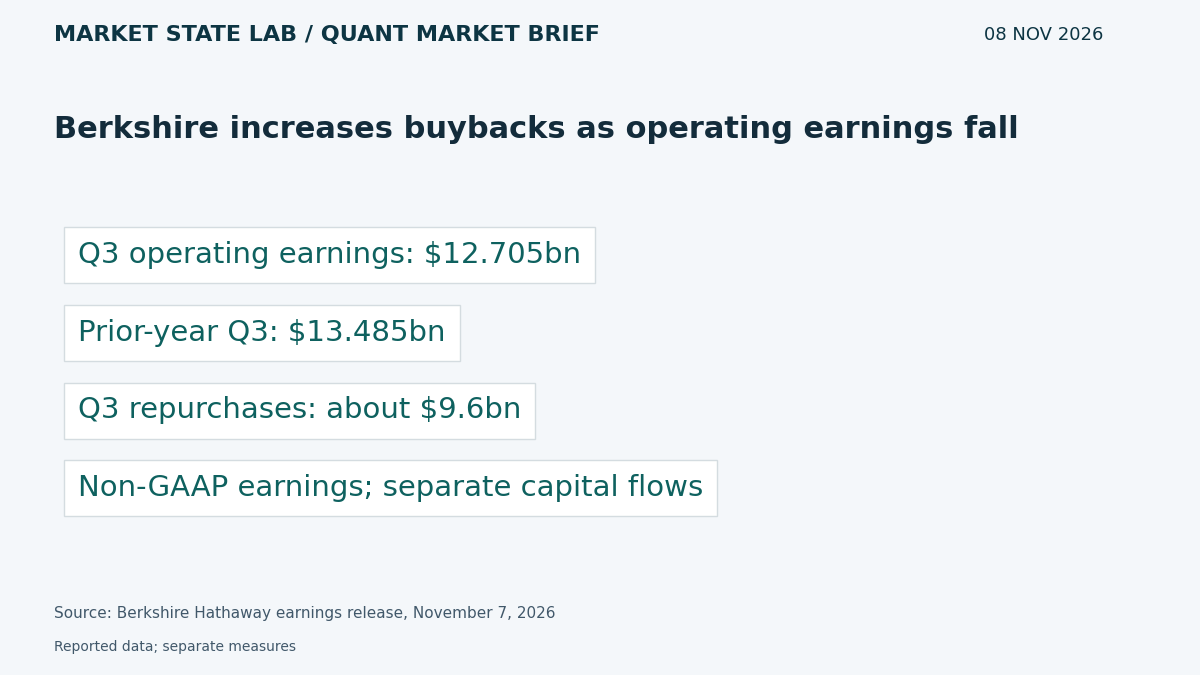
Graphic: Market State Lab; Berkshire Hathaway earnings release, November 7, 2026.
Fact — Company release November 7, 2026: Berkshire reports Q3 operating earnings of $12.705 billion versus $13.485 billion a year earlier, and approximately $9.6 billion of share repurchases during the quarter. Direct source
Inference / Why it matters: Separate operating performance from investment mark-to-market gains and evaluate buybacks against valuation and liquidity needs.
Uncertainty: Operating earnings are non-GAAP; repurchases do not establish undervaluation. The company says the release alone is insufficient for an investment judgment.
Quant & Market Dashboard
Liquidity and volatility
- Weekend state: U.S. cash equities are closed Sunday morning. Current ES/NQ depth, spreads, overnight volume, ETF executable quotes, Treasury liquidity and options positioning are unverified. Friday activity is a proxy only; refresh after futures reopen and before Monday’s cash auction.
- November 6 completed daily rows: SPY 735.29, volume 58.98m; QQQ 656.10, volume 70.69m. Provider banners show different closing levels; reconcile against the execution feed rather than mixing snapshots. Volume does not measure depth. SPY · QQQ.
- Funding: November 5 SOFR 3.92% versus EFFR 3.88%, a four-basis-point gap. Published November 6; lagged fixings do not establish current funding stress. SOFR · EFFR.
- Regime: High; medium confidence. November 6 delayed close VIX 25.64 at 4:00 p.m. EST / 3:00 p.m. CST, versus 28.18 November 5. House thresholds: below 15 low, 15–25 moderate, 25–35 high, above 35 stressed. This operating convention is not a calibrated forecast. Skew, term structure and dealer gamma remain unverified. VIX.
Factor proxies
| Factor | ETF | Nov 5→6 | Oct 9→Nov 6 (4 weeks) |
|---|---|---|---|
| Momentum | MTUM | +1.85% | -20.30% |
| Value | VLUE | +0.11% | -8.69% |
| Quality | QUAL | +0.07% | -3.43% |
| Size | IWM | +0.99% | -1.89% |
| Growth | IWF | +1.26% | -12.63% |
| Low volatility | SPLV | -0.93% | +6.56% |
Price returns from the source-linked Close columns, excluding distributions; these are ETF proxies, not isolated factor premia. October 9 comparison inputs are archived from November 7; November 6 closes were rechecked today. Corporate-action histories were not independently refreshed; keep a common adjustment basis. Momentum and growth rebounded on Friday but remain sharply negative over four weeks; low volatility fell Friday but remains positive over that horizon.
Execution and microstructure
- No regular SPY/QQQ trading session Sunday. For Monday November 9, cash opening auction is 8:30 a.m. CST / 14:30 UTC. Recheck the economic calendar before staging orders; CPI is Tuesday at 7:30 a.m. CST; check the full calendar before orders.
- Inspect quote age, NBBO spreads, displayed depth, auction imbalances and ES/NQ basis. Use bounded limits and participation caps; stress gaps, cancellations, missed fills, latency and widened spreads. Rising prices on thin depth can trap liquidity takers.
- Options: refresh post-expiry positions and hedge requirements; verify expiry, deliverables and settlement. Reject stale, crossed or one-sided quotes. Dealer-gamma sign, expiry concentrations and pinning remain unknown.
Research watchlist: SPY, QQQ, IWM, RSP, TLT; ES, NQ, ZN, VX; MTUM, VLUE, QUAL, IWF, SPLV; BRK.B.
DRL Improvements for the MATLAB System
- Keep drawdown, exposure, participation and stale-data limits outside the policy, with a safe fallback.
- Penalize spread, impact, turnover, latency and missed fills; evaluate tail losses separately from reward.
- Keep future-return targets in training folds only; purge overlapping horizons and reserve a one-use final holdout.
- Randomize liquidity and observation delays across regimes; test whether abstention preserves risk compliance under distribution shift.
Model hygiene
Audit leakage, survivorship bias, look-ahead, corporate actions, stale options quotes, multiple testing, calibration and drift. Use point-in-time universes, release vintages and availability timestamps. Fit preprocessing on training folds only; keep memory curation separate from point-in-time numerical evaluation.
MATLAB optimization patterns
- Use named-zone timetables and causal synchronize/retime; never backfill unreleased observations.
- Vectorize rolling features, preallocate logs and profile before optimizing.
- Parallelize independent folds or Bayesian trials with reproducible random streams and fixed budgets.
- Use GPUs for suitable batches; keep data, risk controls and evaluation in modular environments.
High-value quant research question
Does training-only forecast supervision improve net risk-adjusted results versus an identical policy without the auxiliary head?
Match seeds, initial states, search budgets and costs; purge target horizons at fold boundaries. It tests whether forecast learning adds decision value without leakage.
Please forward this edition to one colleague who would find it useful.
Research and education only—not individualized financial advice. No trading performance is promised.