Quant Market Brief — November 6, 2026: Jobs Risk & Research Gates
Research cutoff: November 6, 2026, 6:30 a.m. CST (12:30 UTC). Futures are an earlier reported snapshot; ETF factors are November 5 prior-close, VIX delayed and funding lagged. No live execution feed verified.
1. Apple details learned retrieval for faster RAG
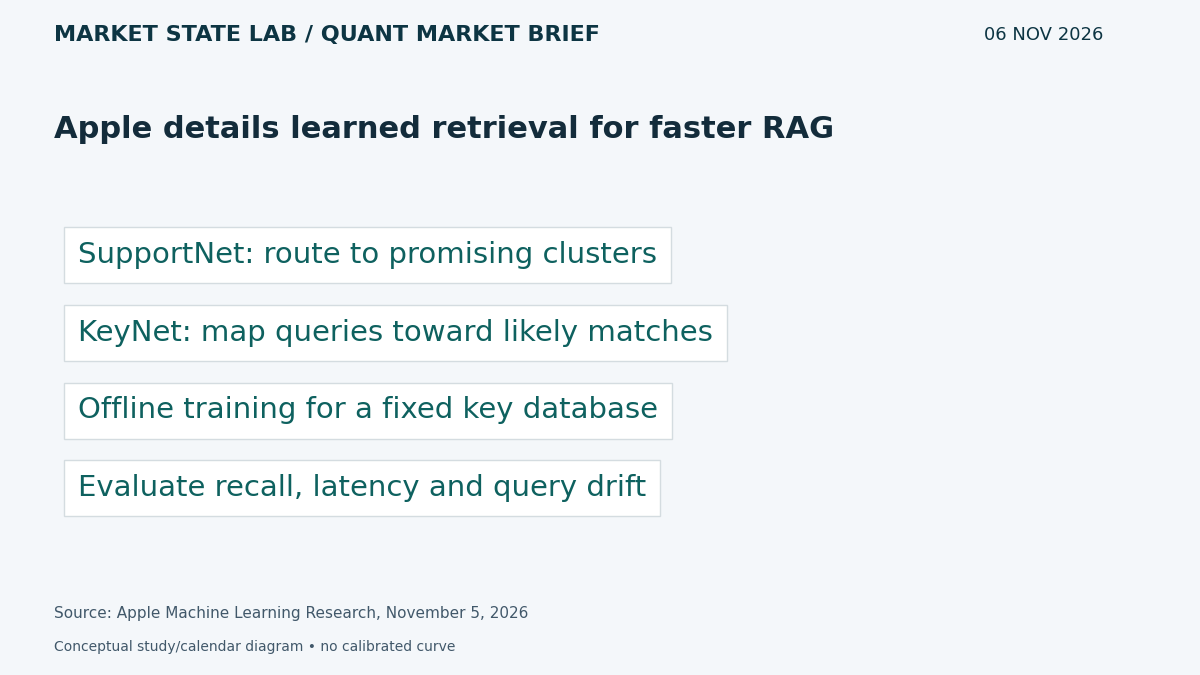
Graphic: Market State Lab; Apple Machine Learning Research, November 5, 2026.
Fact — Research highlight published November 5, 2026; underlying paper July 2026: Apple describes SupportNet cluster routing and KeyNet query mapping, trained offline for a fixed key database and a known query distribution. Direct source
Inference / Why it matters: Benchmark recall, end-to-end latency and query drift on your own research archive before replacing retrieval infrastructure.
Uncertainty: Reported gains are dataset- and setup-dependent; the highlight explains existing research rather than a newly released trading tool.
2. A bounded quant research loop makes rejection a first-class result
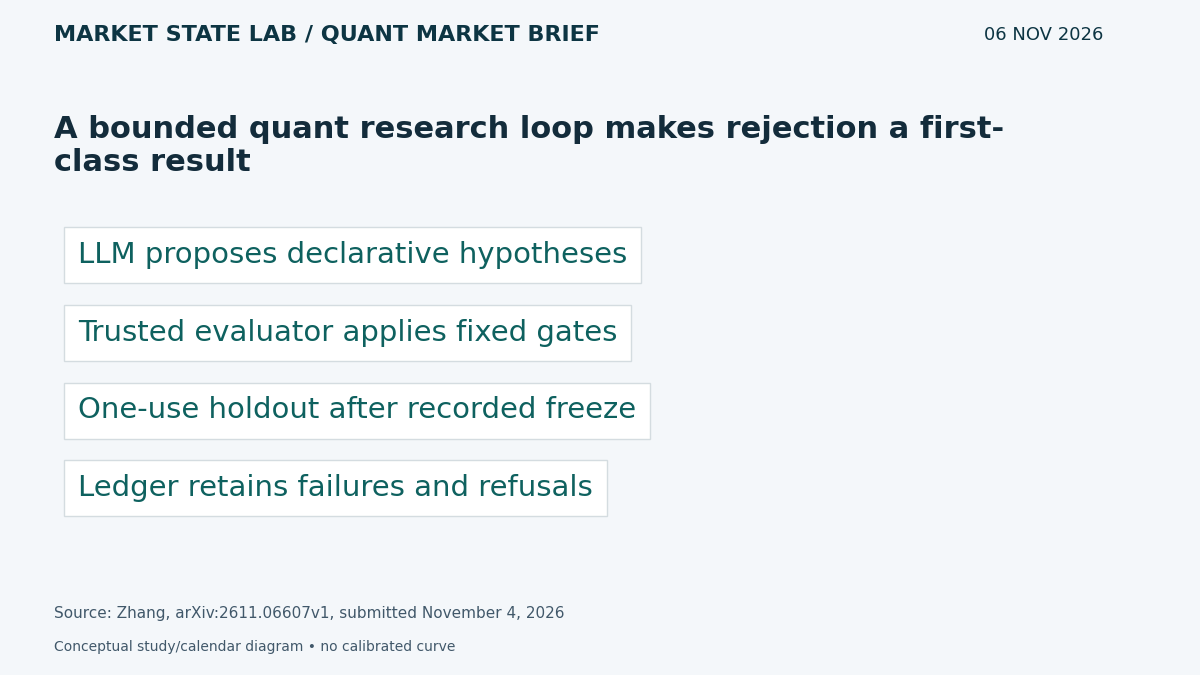
Graphic: Market State Lab; Zhang, arXiv:2611.06607v1, submitted November 4, 2026.
Fact — Preprint submitted November 4, 2026; listed November 5: Henry Zhang describes a loop in which an LLM proposes declarative hypotheses while trusted code applies acceptance gates and a one-use chronological holdout. Most reported hypotheses fail. Direct source
Inference / Why it matters: Separate proposal generation from evaluation authority; retain refusals and failed trials, and lock final tests before opening results.
Uncertainty: Independent preprint and author-reported campaigns; this is a reference design, not proof that an automated strategy will earn returns.
3. Nasdaq futures rebound after Thursday’s technology selloff
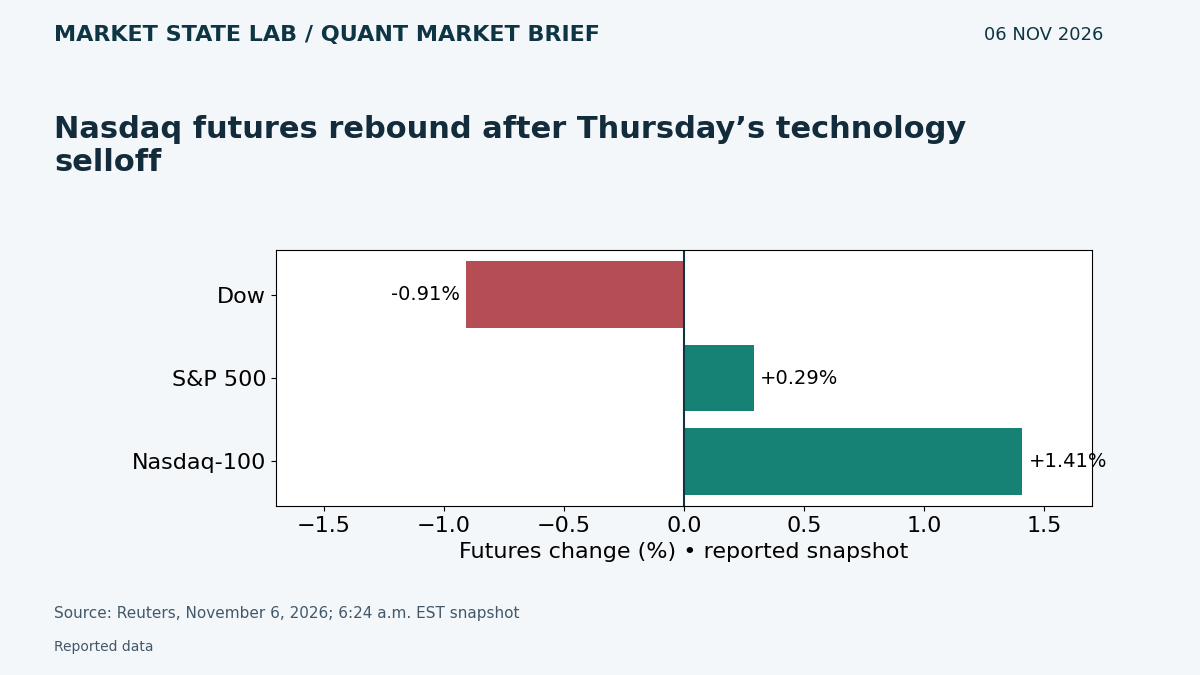
Graphic: Market State Lab; Reuters, November 6, 2026; 6:24 a.m. EST snapshot.
Fact — November 6, 2026; 5:24 a.m. CST snapshot: Reuters reports Dow futures −0.91%, S&P 500 futures +0.29% and Nasdaq-100 futures +1.41% at 6:24 a.m. EST, after Thursday’s sharp technology-led decline. Direct source
Inference / Why it matters: Stress two-way gaps and refresh SPY/QQQ relative risk; a rebound does not establish restored market depth.
Uncertainty: Earlier press snapshot, not executable quotes; regulation-related explanations are reported market interpretations, not established causality.
4. October jobs report is today’s key premarket event
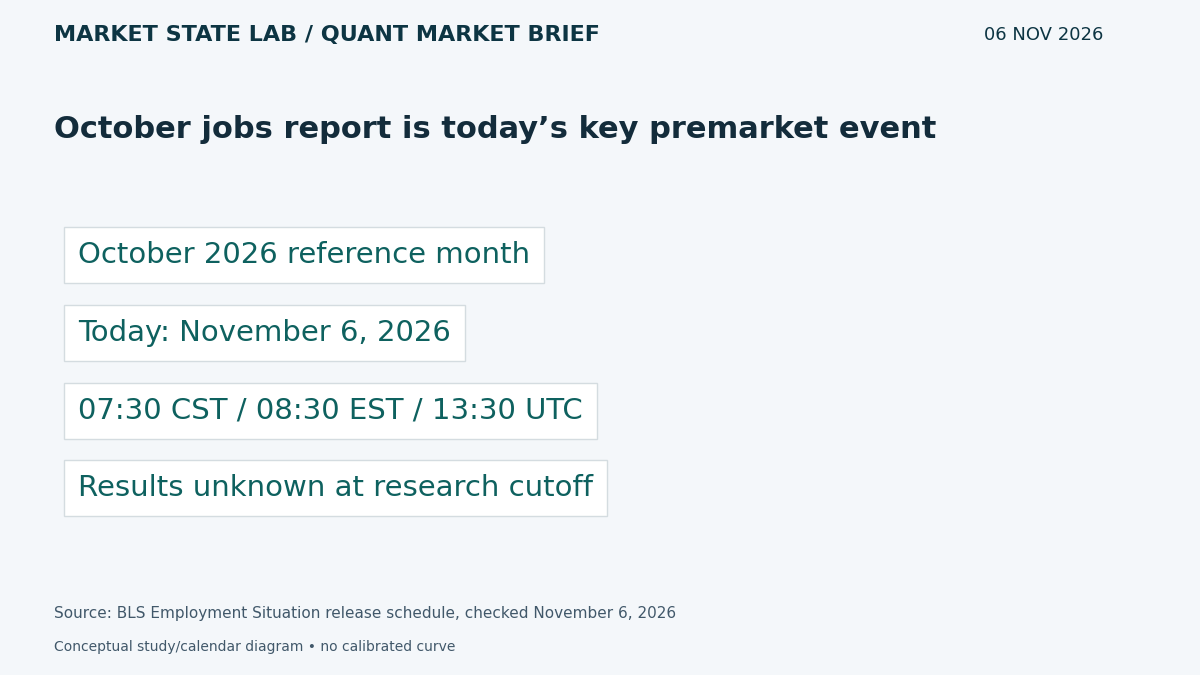
Graphic: Market State Lab; BLS Employment Situation release schedule, checked November 6, 2026.
Fact — November 6, 2026 scheduled release: BLS schedules the October 2026 Employment Situation for November 6 at 8:30 a.m. Eastern, or 7:30 a.m. CST. Direct source
Inference / Why it matters: Reset labor-sensitive signals only when the release arrives; evaluate payrolls, unemployment, earnings and revisions jointly.
Uncertainty: Results and surprises were unknown at cutoff. The release does not mechanically determine the Federal Reserve’s next decision.
5. Airbnb reports faster revenue and booking growth
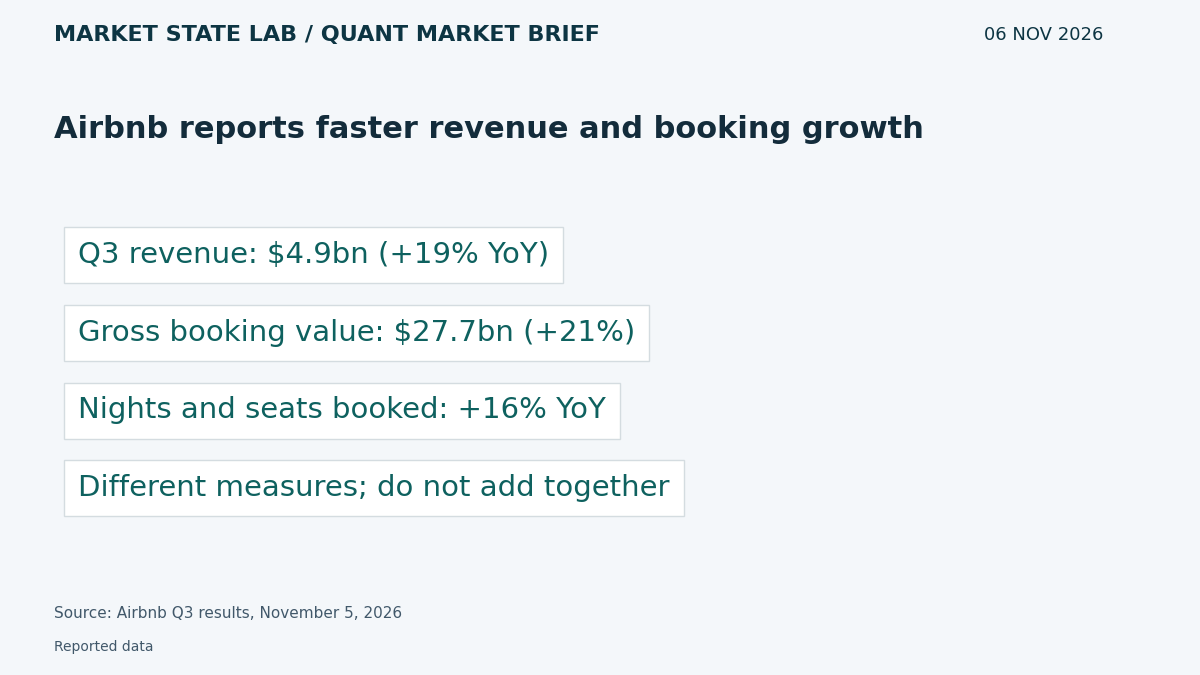
Graphic: Market State Lab; Airbnb Q3 results, November 5, 2026.
Fact — Results released November 5, 2026: Airbnb reports Q3 revenue of $4.9 billion, up 19% year over year; gross booking value of $27.7 billion, up 21%; and nights and seats booked growth of 16%. Direct source
Inference / Why it matters: Separate booking volume, pricing and recognized revenue when evaluating demand and operating performance.
Uncertainty: Company-reported figures; booking value is not revenue, and non-GAAP measures and forward guidance require separate evaluation.
Quant & Market Dashboard
Liquidity and volatility
- Overnight: Current ES/NQ and ETF spreads, depth, overnight volume, Treasury liquidity and options positioning are unverified. The futures rebound is a direction proxy, not evidence of easy execution.
- Prior-close activity, November 5: completed daily rows show SPY 733.00, volume 125.89m, and QQQ 647.05, volume 130.68m. Quote banners differ from daily rows; use the latter consistently and reconcile against the execution feed before trading. Heavy volume is not narrow spreads or available depth. SPY · QQQ.
- Funding: latest verified November 4 SOFR 3.94% versus EFFR 3.88%, a six-basis-point gap. FRED updated November 5 at 7:02 and 8:02 a.m. CST respectively. SOFR fell three basis points from November 3; these lagged fixings do not establish current Treasury or funding stress. SOFR · EFFR.
- Regime: High; medium confidence. Delayed VIX 26.44 at November 6 5:36 a.m. CST, versus November 5 close 28.18 and November 4 close 16.61. House thresholds: below 15 low, 15–25 moderate, 25–35 high, above 35 stressed. This is an explicit operating convention, not a calibrated forecast. Skew, term structure and dealer gamma remain unknown. VIX.
Factor proxies
| Factor | ETF | Nov 4→5 | Oct 8→Nov 5 (4 weeks) |
|---|---|---|---|
| Momentum | MTUM | -8.24% | -21.09% |
| Value | VLUE | -5.71% | -9.06% |
| Quality | QUAL | -3.47% | -3.08% |
| Size | IWM | -4.59% | -2.37% |
| Growth | IWF | -6.40% | -13.18% |
| Low volatility | SPLV | -1.17% | +7.81% |
Source-linked Close columns on a common provider scale; price returns exclude distributions and are not isolated factor premia. Corporate-action histories were not independently refreshed. Do not splice these levels into differently adjusted series. All six proxies fell on the day; low volatility lost less and remained positive over four weeks. Rounded-close calculations can differ from provider percentage columns.
Execution and microstructure
- Jobs release 7:30 a.m. CST / 13:30 UTC; cash opening auction 8:30 a.m. CST / 14:30 UTC. Refresh state after each rather than carrying pre-release quotes into orders.
- For SPY/QQQ, inspect quote age, NBBO spreads, displayed depth, auction imbalances and ES/NQ basis. Reduce participation when depth thins; use bounded limits, cancellation controls and realistic slippage budgets. A rising price on thin depth is a liquidity trap.
- For options, verify expiry, deliverables and settlement; reject stale, crossed and one-sided quotes, and price packages coherently. Friday expiry and short-dated gamma can accelerate hedging flows, but dealer-gamma sign, pinning and flow magnitude are unverified.
- Recalibrate impact estimates after the volatility jump. Treat missed fills, gaps, latency and spread expansion as separate stress dimensions.
Research watchlist: SPY, QQQ, IWM, RSP, TLT; ES, NQ, ZN, VX; MTUM, VLUE, QUAL, IWF, SPLV; ABNB, SOXX.
DRL Improvements for the MATLAB System
- Enforce drawdown, exposure, participation and stale-data limits outside the policy, with a safe fallback.
- Penalize spread, impact, turnover, latency and missed fills; report tail losses and risk breaches separately from reward.
- Lock feature and reward choices before a purged walk-forward test; use a one-use final holdout and retain the full trial ledger.
- Stress unseen high-volatility regimes with widened spreads and delayed observations; require calibrated uncertainty or abstention before restoring normal risk.
Model hygiene
Audit leakage, survivorship bias, look-ahead, corporate actions, stale options, multiple testing, calibration and drift. Preserve point-in-time universes, economic vintages and availability timestamps. Fit preprocessing only on training folds; never recycle an inspected final holdout.
MATLAB optimization patterns
- Align named-zone timetables causally with synchronize/retime; do not backfill unreleased data.
- Vectorize rolling features, preallocate logs and profile the actual bottleneck.
- Parallelize independent folds or Bayesian trials with reproducible random streams and an explicit search budget.
- Use GPUs only for suitable batches; keep hypothesis proposals separate from trusted risk and evaluation modules.
High-value quant research question
Does requiring a frozen trial ledger and one-use holdout reduce false strategy acceptance compared with repeatedly selecting the best validation score?
Compare acceptance and subsequent performance under matched data, search budgets, costs and seeds. It tests research-process reliability rather than another unconstrained alpha search.
Please forward this edition to one colleague who would find it useful.
Research and education only—not individualized financial advice. No trading performance is promised.