Quant Market Brief — November 2, 2026: Risk Synchrony & AI Connectivity
Research cutoff: November 2, 2026, 8:42 a.m. CST (14:42 UTC). Cash trading has opened; market observations below are explicitly timestamped and are not live execution quotes. Factor comparisons use October 30 completed closes. No current depth or options-positioning feed verified.
1. JEPA research makes positive-view design central to alignment
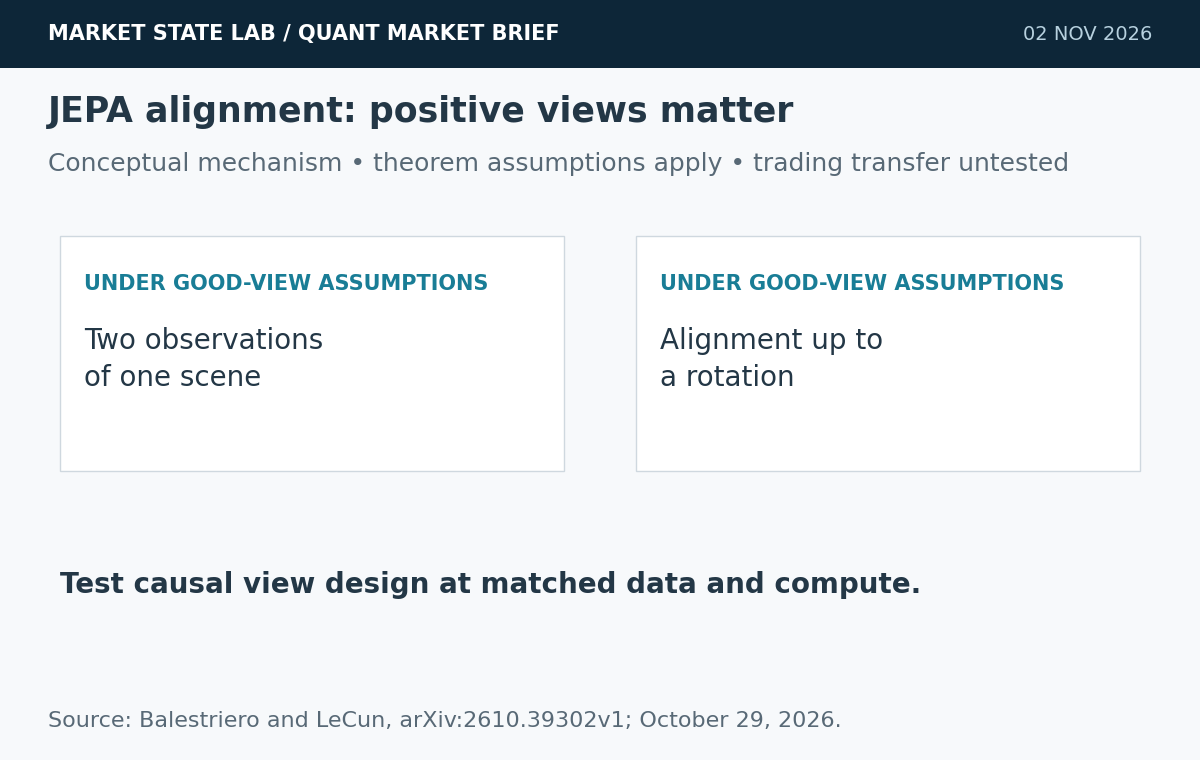
Graphic: Market State Lab; Balestriero and LeCun, arXiv:2610.39302v1; October 29, 2026. Conceptual or quantitative as labeled.
Date: Preprint submitted October 29, 2026.
Fact: Balestriero and LeCun prove representation alignment up to a rotation for separately trained JEPAs under their good-view assumptions. Their experiments find that positive-pair design can improve alignment efficiency beyond simply increasing model scale. Direct source
Inference: How training observations are paired may matter as much as encoder capacity.
Uncertainty: The theorem has assumptions; vision/language results do not establish financial prediction or trading performance.
Why it matters: Compare causal market-view constructions at matched data and compute, with untouched temporal holdouts.
2. Quant model identifies synchronized risk automation as a liquidation amplifier
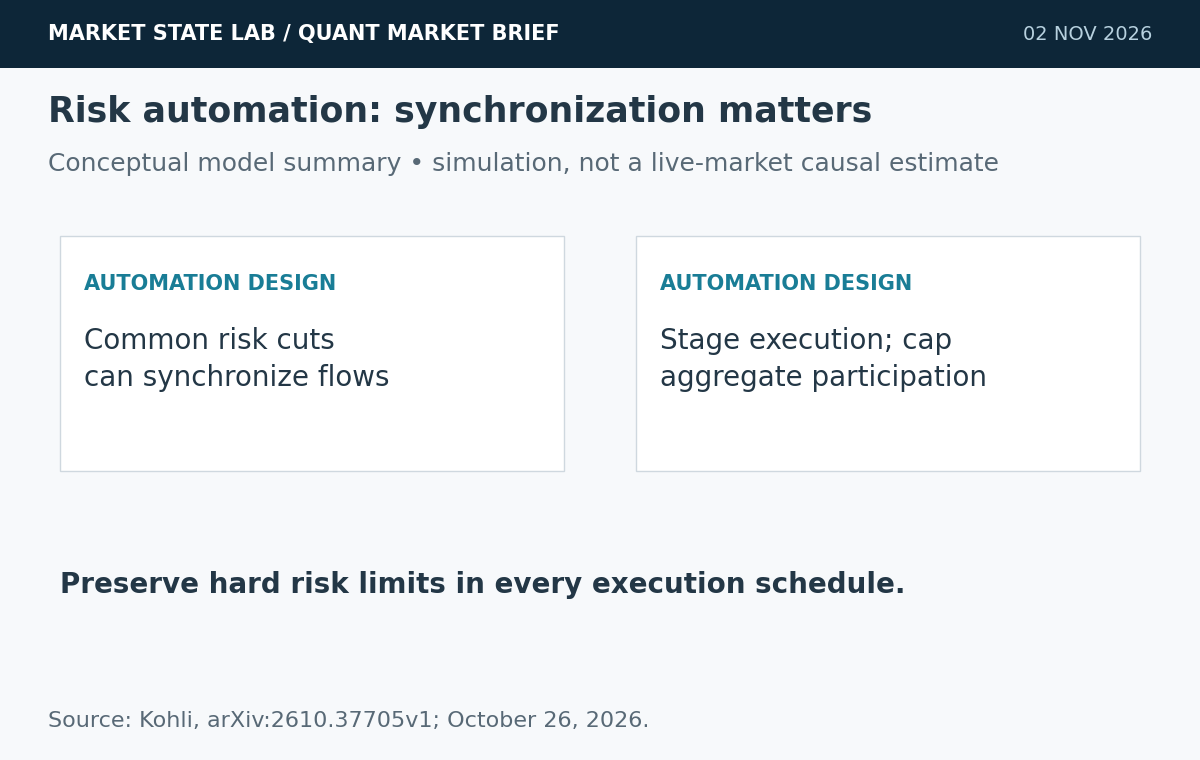
Graphic: Market State Lab; Kohli, arXiv:2610.37705v1; October 26, 2026. Conceptual or quantitative as labeled.
Date: Preprint submitted October 26, 2026.
Fact: Kohli’s calibrated agent-based model attributes market-wide liquidation amplification to synchronized risk overlays and execution. Dispersed overlay parameters, staged execution and a participation breaker reduce modeled tail liquidation when combined. Direct source
Inference: Diversifying model providers alone may leave common execution triggers intact.
Uncertainty: These are model-dependent simulations and historical replays, not an observed live-market causal estimate or guaranteed mitigation.
Why it matters: Stress common-shock risk cuts; compare staged execution with identical hard risk limits and measure tail loss, shortfall and coverage.
3. Early futures rebound precedes a busy election week
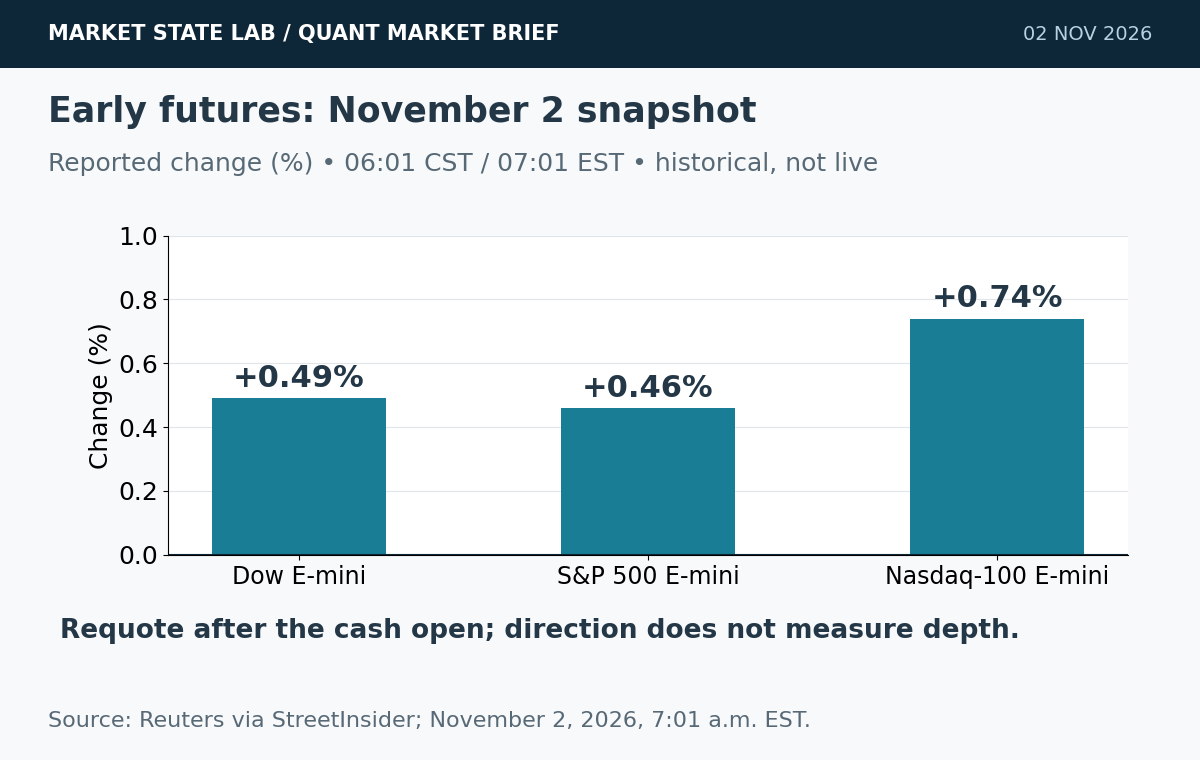
Graphic: Market State Lab; Reuters via StreetInsider; November 2, 2026, 7:01 a.m. EST. Conceptual or quantitative as labeled.
Date: Reuters November 2, 2026; snapshot 7:01 a.m. EST / 6:01 a.m. CST.
Fact: Reuters reported Dow E-mini futures up 0.49%, S&P 500 E-minis up 0.46% and Nasdaq-100 E-minis up 0.74% at 7:01 a.m. Eastern, as technology shares steadied ahead of the midterms and earnings. Direct source
Inference: The early rebound does not establish durable post-open liquidity or a reversal of October’s weakness.
Uncertainty: This is a historical premarket snapshot, not a current executable quote. Cash trading began after this observation.
Why it matters: Requote SPY/QQQ after the open and around data releases; validate depth and futures basis before sizing execution.
4. Manufacturing and construction releases create a 9 a.m. execution checkpoint
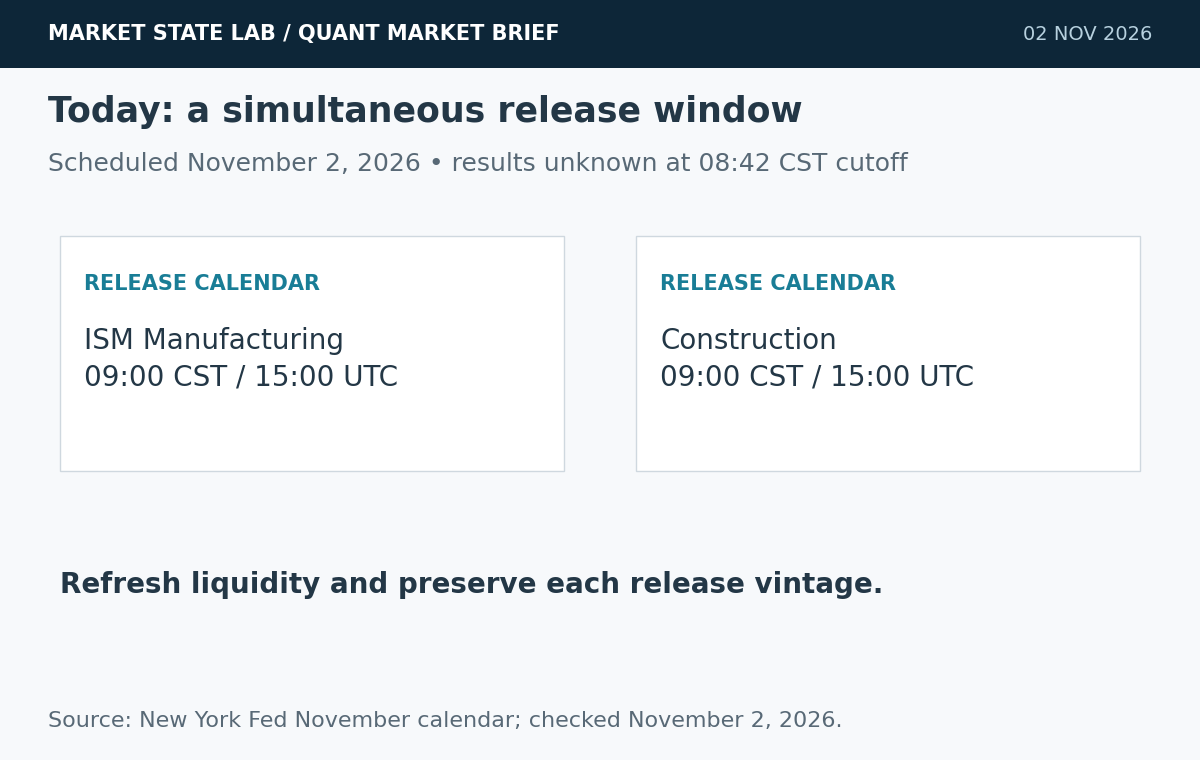
Graphic: Market State Lab; New York Fed November calendar; checked November 2, 2026. Conceptual or quantitative as labeled.
Date: November 2, 2026 releases scheduled for 10:00 a.m. EST / 9:00 a.m. CST.
Fact: The New York Fed calendar schedules ISM Manufacturing and construction data for November 2 at 10:00 a.m. Eastern, or 9:00 a.m. Central. Both results remain unavailable at this edition’s cutoff. Direct source
Inference: Simultaneous activity releases can change rate-sensitive features and execution conditions together.
Uncertainty: Calendar times are tentative; no release result, surprise or policy response is assumed.
Why it matters: Record availability timestamps, separate release vintages and refresh spreads/depth after the data window.
5. Marvell agrees to acquire Lumentum in a fixed-ratio stock deal
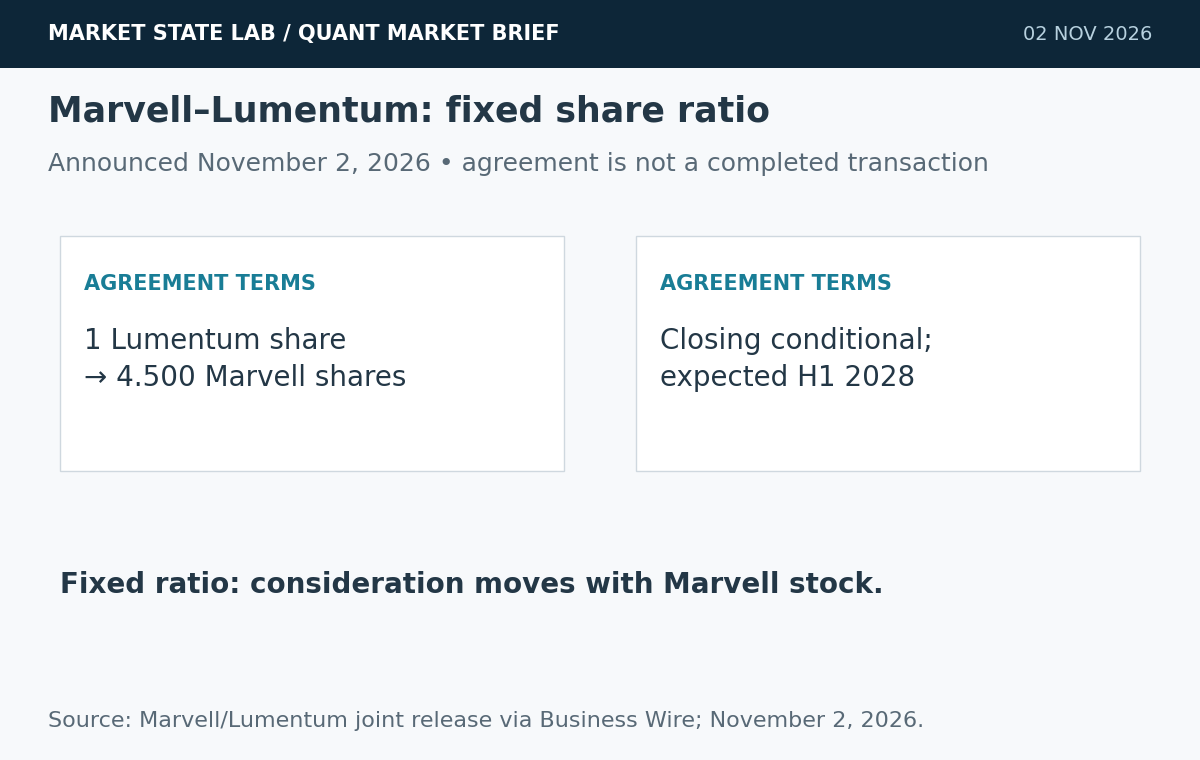
Graphic: Market State Lab; Marvell/Lumentum joint release via Business Wire; November 2, 2026. Conceptual or quantitative as labeled.
Date: Company announcement November 2, 2026; agreement signed November 1.
Fact: Marvell and Lumentum announced an all-stock acquisition agreement: each Lumentum share would receive 4.500 Marvell shares. The companies expect closing in the first half of 2028, subject to shareholder and regulatory approvals and other conditions. Direct source
Inference: The agreement combines electrical and optical AI connectivity; fixed-ratio consideration fluctuates with Marvell’s share price.
Uncertainty: The deal is not completed. Closing, integration and projected commercial benefits remain uncertain.
Why it matters: Model the share ratio, dilution and closing conditions separately from AI demand forecasts; do not treat a headline deal value as fixed cash consideration.
Quant & Market Dashboard
Liquidity, funding and volatility
- Data state: The 8:30 a.m. CST cash open has passed. Current futures/ETF depth, consolidated spreads, overnight volume and executable Treasury liquidity are not verified. Early futures direction is not evidence of market depth. Use fresh broker/exchange quotes before acting.
- ETF activity proxy: October 30 completed daily rows: SPY 755.72, volume 77.70m, high–low 11.10 points; QQQ 690.49, volume 85.24m, high–low 15.18 points. A November 2 SPY observation at 8:32:14 a.m. CST was 759.42, cumulative volume 2.22m; delay status unspecified. QQQ’s banner conflicts with its completed row, so it is excluded. These are historical/delayed context, not executable quotes. Volume does not measure depth or slippage. SPY · QQQ.
- Funding: October 30 SOFR 3.95%, up one basis point; EFFR 3.88%, unchanged. FRED updated November 2 at 7:02 and 8:02 a.m. CST, respectively. The seven-basis-point gap is a lagged aggregate proxy, not proof of current Treasury-market stress. SOFR · EFFR.
- Volatility: Moderate with elevated event risk; medium confidence. Delayed VIX 18.99 at 8:10 a.m. CST November 2, versus Friday’s 19.42. A sub-20 reading supports the moderate classification; Friday’s wide ranges and today’s releases argue for conservative execution. This observation predates the cash open. Term structure, skew and dealer gamma are unverified. VIX.
Factor performance proxies
| Factor | ETF | October 30 daily | September 23→October 30 |
|---|---|---|---|
| Momentum | MTUM | -4.77% | -10.36% |
| Value | VLUE | -1.70% | -3.34% |
| Quality | QUAL | -0.99% | +0.16% |
| Size | IWM | -1.65% | -0.92% |
| Growth | IWF | -2.89% | -6.20% |
| Low volatility | SPLV | +0.33% | +7.32% |
Unadjusted close-to-close price returns exclude distributions; ETF exposures are not isolated factor premia. October 30 endpoints rechecked November 2; September 23 anchors preserved from the dated archive. These are completed-session comparisons, not today’s factor performance. Low volatility was the only positive daily proxy; momentum had the largest daily decline.
Execution and microstructure
- Refresh SPY/QQQ NBBO, quote age, displayed depth, ES/NQ basis and opening-auction outcomes now that the 8:30 a.m. CST / 14:30 UTC open has passed. Reduce participation while spreads, basis or cancellation rates remain unstable.
- Today’s 9:00 a.m. CST / 15:00 UTC manufacturing/construction window is a separate liquidity reset. Use bounded limit orders; stress spread widening, impact, slippage, partial fills and adverse selection. Small displayed size and stale indicative quotes can create liquidity traps.
- For options, verify each contract’s expiry, settlement and deliverable. Reject stale, crossed or one-sided quotes; compare package execution costs. Short-dated gamma can amplify sensitivity, but dealer-gamma sign, pinning and current positioning are unknown.
- Stage discretionary risk reductions without relaxing hard drawdown/exposure limits. Test aggregate participation breakers under common shocks rather than assuming diversification of AI providers removes synchronization risk.
Research watchlist: SPY, QQQ, IWM, RSP, TLT; ES, NQ, ZN, VX; MTUM, VLUE, QUAL, IWF, SPLV; MRVL, LITE, SOXX.
DRL Improvements for the MATLAB System
- Enforce drawdown, exposure, participation and stale-data limits outside the policy; retain a safe fallback.
- Charge spread, impact, turnover, latency and missed fills in rewards; report tail loss, shortfall and trade coverage separately.
- Test staged risk-cut timing and a shared participation breaker under common shocks, while preserving identical hard risk constraints.
- Use purged, embargoed walk-forward folds, paired seeds and unseen regimes; stress transaction costs and avoid future information in positive-view construction.
Model hygiene
Preserve availability timestamps, economic release vintages and point-in-time universes. Check leakage, survivorship and look-ahead bias, causal corporate actions, stale options quotes, multiple testing, calibration and drift. Freeze final holdouts; archive source and retrieval versions.
MATLAB optimization patterns
- Use named-zone timetables with causal synchronize/retime alignment and explicit release timestamps.
- Vectorize features, preallocate logs and profile before parallelizing.
- Parallelize independent folds or Bayesian trials with reproducible random streams and immutable holdouts.
- Use GPUs for suitable large batches only; keep policy, risk and execution modules separate.
High-value quant research question
Does staging otherwise identical risk reductions lower tail liquidation without increasing drawdown breaches or execution shortfall?
Compare synchronized and staged schedules under matched shocks, participation limits and transaction costs. This tests whether execution coordination adds resilience beyond provider diversification.
Please forward this edition to one colleague who would find it useful.
Research and education only—not individualized financial advice. No trading performance is promised.