Quant Market Brief — November 13, 2026: PPI Risk & Forecast Stability
Research cutoff: November 13, 2026, 6:40 a.m. CST (12:40 UTC). Friday premarket edition; market data are explicitly timestamped reported/delayed snapshots or prior-close observations, not live executable quotes.
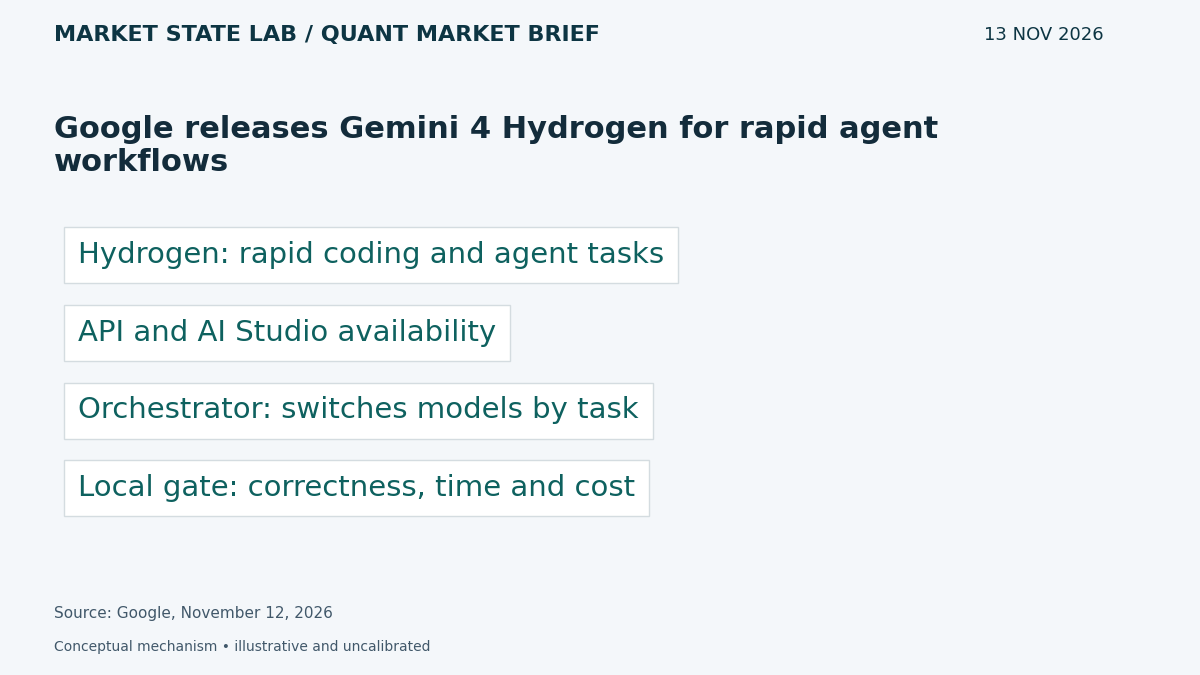
1. Google releases Gemini 4 Hydrogen for rapid agent workflows
Graphic: Market State Lab; Google, November 12, 2026.
Fact — Google announcement November 12, 2026: Google released Hydrogen across the Gemini API, AI Studio and other products. It targets rapid coding and agent workflows; Antigravity’s Orchestrator switches between models within a session. Direct source
Inference / Why it matters: Benchmark task routing for MATLAB research: measure verified correctness, elapsed time and total cost against a single-model baseline.
Uncertainty: Vendor benchmarks and orchestration claims do not establish reliable financial research or gains on your own workload.
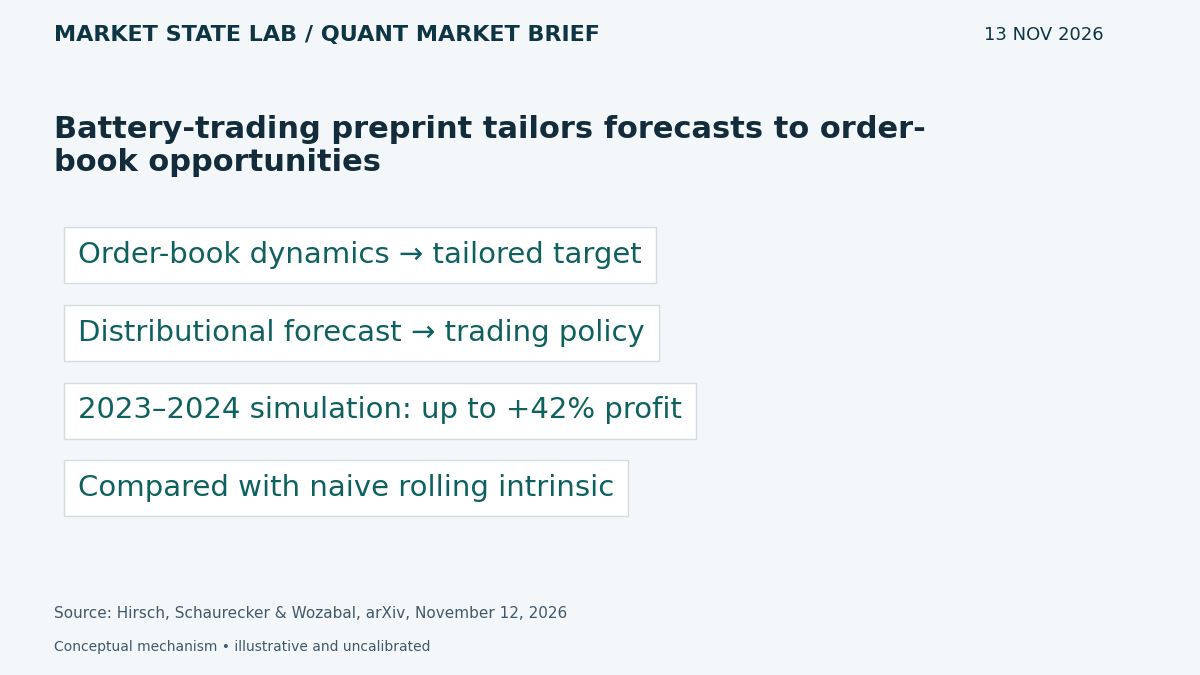
2. Battery-trading preprint tailors forecasts to order-book opportunities
Graphic: Market State Lab; Hirsch, Schaurecker & Wozabal, arXiv, November 12, 2026.
Fact — Hirsch, Schaurecker and Wozabal preprint submitted November 12, 2026, 17:43:52 UTC: The authors extend a rolling intrinsic battery-trading policy using distributional forecasts of an order-book-derived target. Their 2023–2024 high-frequency simulation reports profit improvements up to 42% over the naive policy. Direct source
Inference / Why it matters: Test targets aligned with feasible actions and compare forecast accuracy with decision value and stability under matched risk and costs.
Uncertainty: The reported maximum is simulation evidence, not live profit or an expected equity-market return; battery constraints and market design limit transfer.
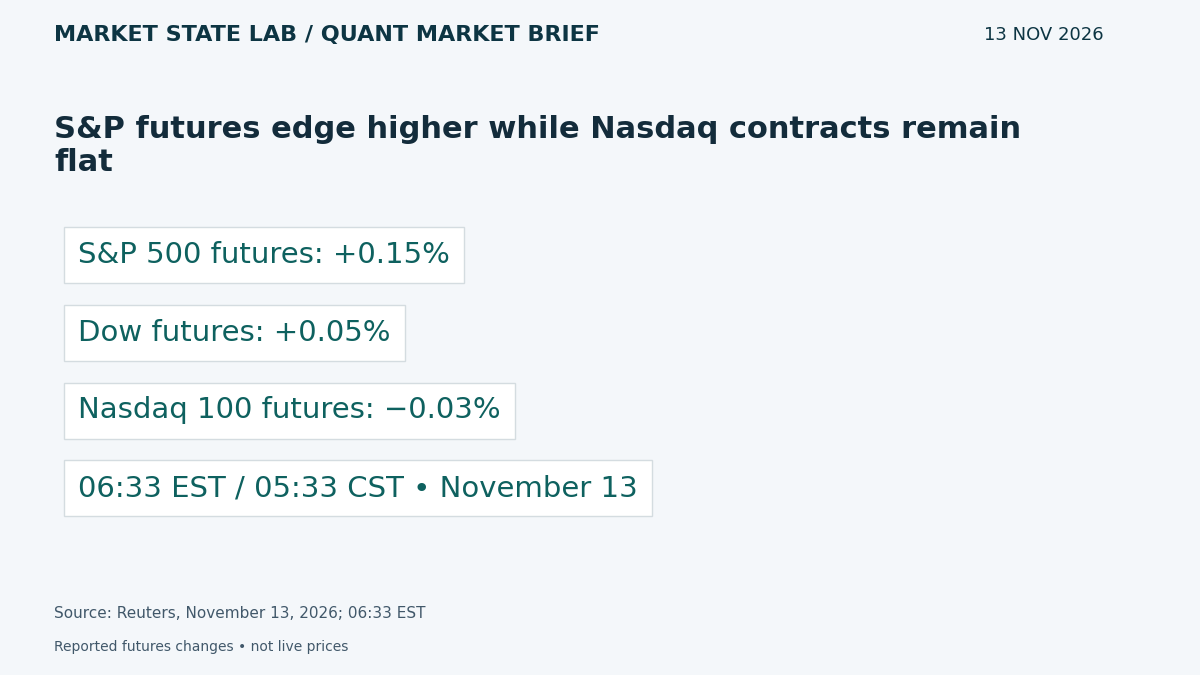
3. S&P futures edge higher while Nasdaq contracts remain flat
Graphic: Market State Lab; Reuters, November 13, 2026; 06:33 EST.
Fact — Reuters November 13; observation 06:33 EST / 05:33 CST: At 5:33 a.m. CST, Reuters reported S&P 500 futures +0.15%, Dow futures +0.05% and Nasdaq 100 futures −0.03%. Direct source
Inference / Why it matters: Monitor ES/NQ relative strength and SPY/QQQ breadth separately; refresh quotes after the inflation release before sizing execution.
Uncertainty: This is an earlier reported snapshot, not a live executable quote or evidence of deep liquidity.
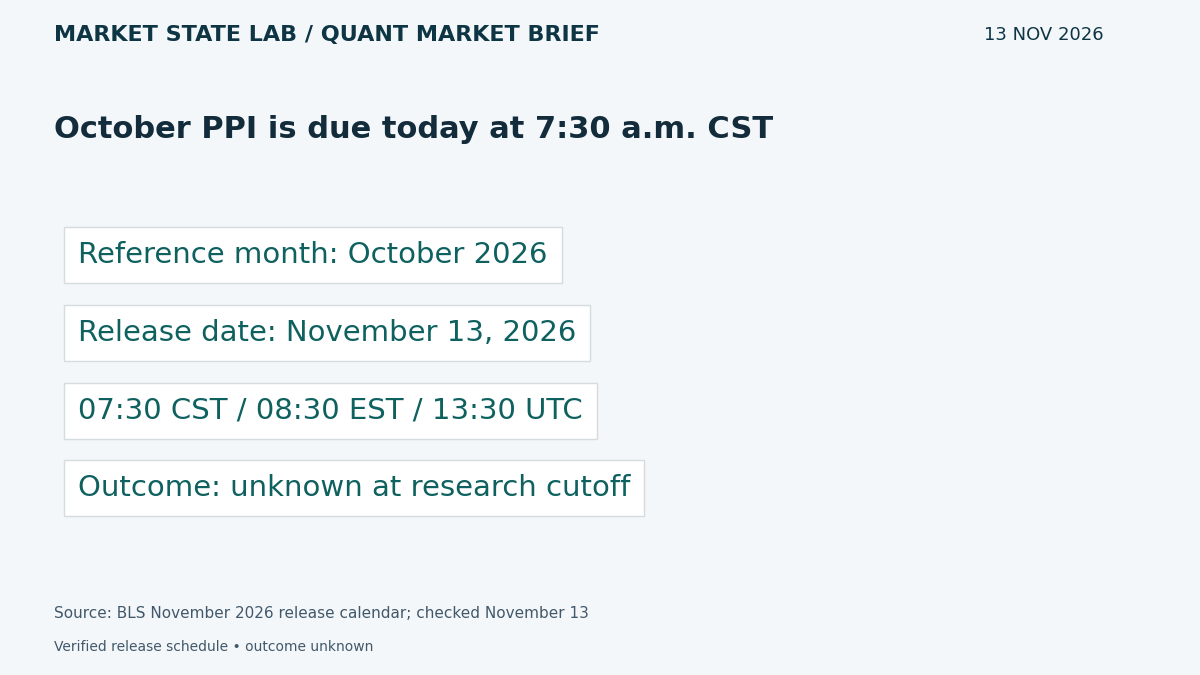
4. October PPI is due today at 7:30 a.m. CST
Graphic: Market State Lab; BLS November 2026 release calendar; checked November 13.
Fact — BLS November 2026 calendar, rechecked November 13 before release: BLS schedules the October Producer Price Index release for November 13 at 8:30 a.m. EST / 7:30 a.m. CST / 13:30 UTC. Results were unavailable at the research cutoff. Direct source
Inference / Why it matters: Separate pre-release and post-release states, stress gaps and spread expansion, and compare component readings with timestamped expectations.
Uncertainty: This confirms timing only. It is neither an inflation forecast nor a Federal Reserve decision; PPI does not map one-for-one into CPI or PCE.
5. Cisco reports 24% revenue growth and raises fiscal-year outlook
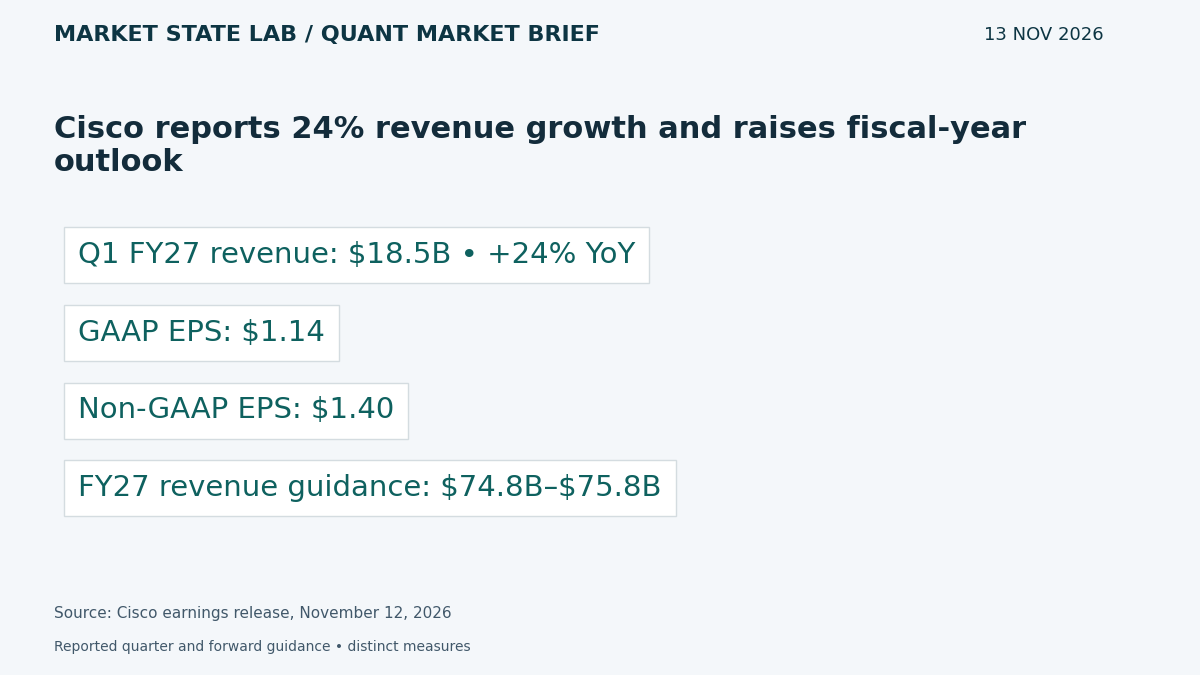
Graphic: Market State Lab; Cisco earnings release, November 12, 2026.
Fact — Cisco fiscal Q1 2027 results published November 12, 2026; quarter ended October 24: Cisco reported quarterly revenue of $18.5 billion, up 24%, GAAP EPS of $1.14 and non-GAAP EPS of $1.40. It raised fiscal 2027 revenue guidance to $74.8–$75.8 billion. Direct source
Inference / Why it matters: Track networking demand alongside margins and cash conversion; separate reported results from forward guidance when evaluating infrastructure exposure.
Uncertainty: Non-GAAP earnings require reconciliation; guidance is forward-looking and does not establish future growth or share-price performance.
Quant & Market Dashboard
Liquidity and volatility
- Overnight: The reported 05:33 CST futures snapshot shows small, mixed moves. Current ES/NQ spreads, displayed depth, overnight volume, executable ETF NBBO and Treasury-market depth remain unverified. Direction is a cautious sentiment proxy, not a liquidity rating; refresh execution feeds before trading.
- Funding: Latest verified SOFR is 3.89% for November 10, updated November 12 at 07:02 CST. Today's update was unavailable at cutoff. This lagged fixing cannot diagnose current funding stress. FRED.
- Regime: Moderate; medium confidence, with concentrated event risk. Delayed VIX was 18.22 at November 13 07:04 EST / 06:04 CST, versus November 12 close 18.70. House bands: below 15 low, 15–25 moderate, 25–35 high, above 35 stressed; descriptive conventions, not calibrated forecasts. Skew, term structure and dealer gamma remain unverified. VIX.
Factor proxies
| Factor | ETF | Nov 11→12 | Oct 9→Nov 12 (~1 month) |
|---|---|---|---|
| Momentum | MTUM | +0.14% | -13.30% |
| Value | VLUE | -1.06% | -4.59% |
| Quality | QUAL | -0.60% | -1.29% |
| Size | IWM | -1.64% | -0.18% |
| Growth | IWF | -0.37% | -9.16% |
| Low volatility | SPLV | -0.23% | +8.15% |
Source-linked split-adjusted Close-column price returns, excluding distributions, through November 12 at 16:00 EST / 15:00 CST. October 9 baselines are archived from earlier editions; latest closes were rechecked today. Corporate actions were not independently validated. These imperfect ETF proxies do not isolate factor premia. Momentum rose slightly Thursday while the other five proxies declined; low volatility remains positive over the longer window.
Execution and microstructure
- PPI: 07:30 CST / 13:30 UTC today; cash opening auction: 08:30 CST / 14:30 UTC. Results remain unknown at cutoff. Separate observations and risk settings across the release; recheck other calendars before staging orders. BLS calendar.
- SPY/QQQ: inspect quote age, NBBO spreads, displayed depth, auction imbalances and ES/NQ basis. Use bounded limits and participation caps; stress slippage, gaps, cancellations, latency and missed fills. Small index moves can conceal thin depth or concentrated constituent risks.
- Options: verify Friday expiries, deliverables, settlement and exercise obligations. Reject stale, crossed or one-sided quotes. Near-expiry gamma and event-volatility repricing can amplify execution risk; dealer positioning, expiry concentrations, pinning and flow magnitude remain unknown. Do not infer gamma direction from open interest alone.
Research watchlist: SPY, QQQ, IWM, RSP, TLT; ES, NQ, ZN, VX; MTUM, VLUE, QUAL, IWF, SPLV; CSCO, NVDA, GOOGL.
DRL Improvements for the MATLAB System
- Enforce drawdown, exposure, participation and stale-data limits outside the policy, with an explicit safe fallback.
- Penalize spread, impact, turnover, latency and missed fills; include forecast instability and tail losses in evaluation.
- Use purged walk-forward evaluation, training-only preprocessing and an untouched final holdout; separate event and quiet regimes.
- Randomize depth, observation delays and fill probabilities; test abstention and hard risk compliance under distribution shift.
Model hygiene
Audit leakage, survivorship bias, look-ahead bias, corporate actions, stale options quotes, multiple testing, calibration and drift. Preserve point-in-time universes, release vintages and actual availability timestamps. Fit preprocessing inside folds. Forecast targets must match feasible actions; daily OHLCV cannot validate order-book fills.
MATLAB optimization patterns
- Use named-zone timetables and causal synchronization; retain quote and release timestamps separately.
- Vectorize rolling features, preallocate logs and profile bottlenecks.
- Parallelize independent folds or Bayesian trials with reproducible random streams and fixed search budgets.
- Use GPUs for sufficiently large batches; keep forecasts, environments, execution simulation and risk controls modular.
High-value quant research question
At matched risk and trading costs, do action-aligned distributional forecasts improve net decisions more than a more accurate but less stable point forecast?
Compare identical policies with and without forecast inputs, matching seeds, search budgets and action opportunities across held-out regimes. This tests decision value and stability rather than predictive accuracy alone; electricity-market simulation evidence does not establish transfer to equities.
Please forward this edition to one colleague who would find it useful.
Research and education only—not individualized financial advice. No trading performance is promised.