Quant Market Brief — November 11, 2026: CPI Results & Impact-Model Risk
Research cutoff: November 11, 2026, 6:38 a.m. CST (12:38 UTC). Wednesday post-CPI edition; market data are explicitly timestamped reported/delayed snapshots or prior-close observations, not live executable quotes.
1. Google releases Gemini 4 Carbon for complex workflows
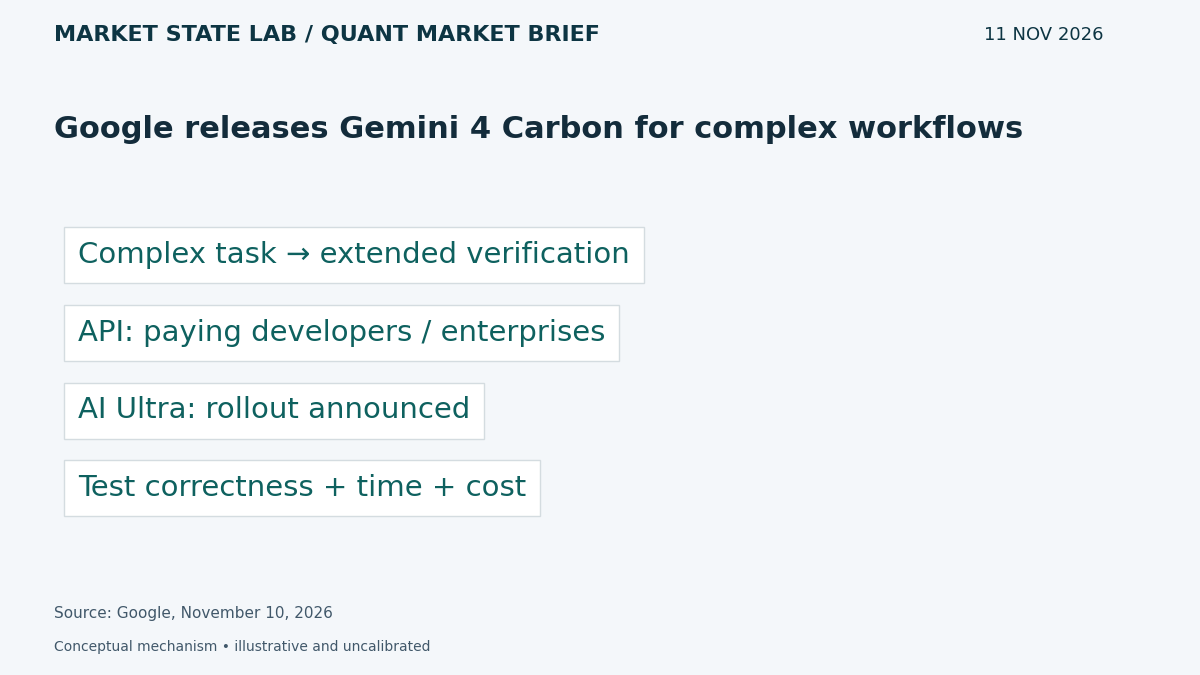
Graphic: Market State Lab; Google, November 10, 2026.
Fact — Google announcement November 10, 2026: Google made Gemini 4 Carbon available through its API for paying developers and enterprises, with rollout to AI Ultra subscribers. It targets complex coding, knowledge work and scientific reasoning with extended verification loops. Direct source
Inference / Why it matters: Test multi-step MATLAB debugging on a frozen task set, recording correctness, verification coverage, latency and cost.
Uncertainty: Capability and economic claims are vendor-reported; longer reasoning does not guarantee correct code or research.
2. Preprint challenges identification of market-impact decay
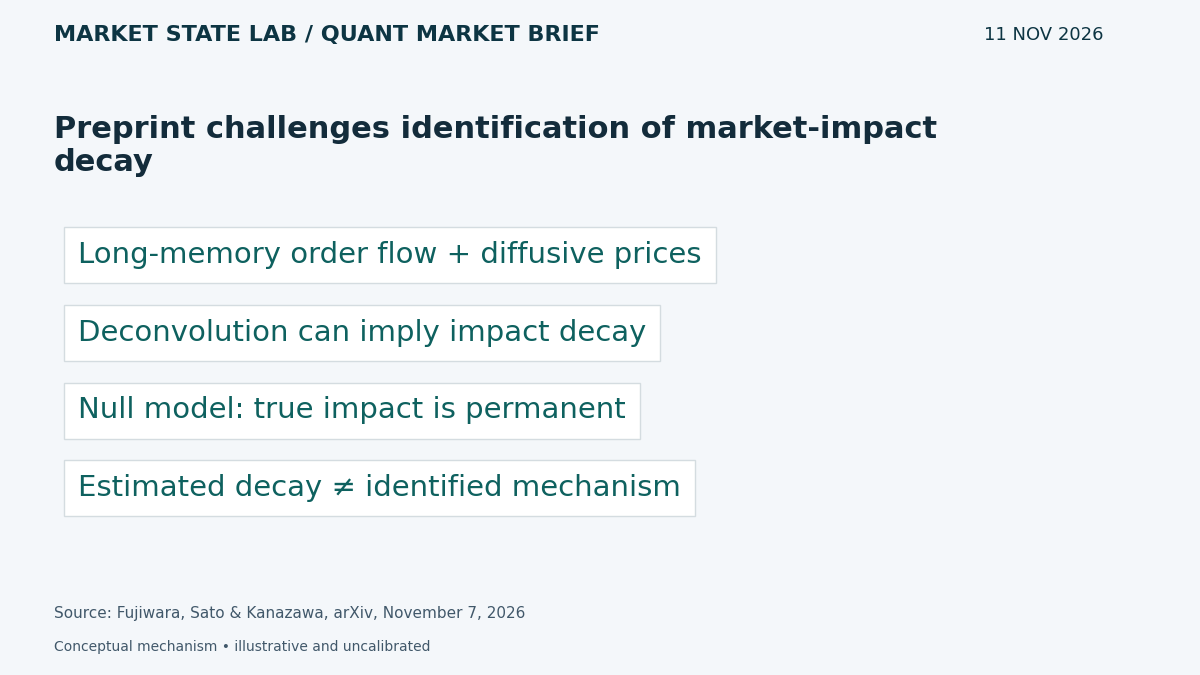
Graphic: Market State Lab; Fujiwara, Sato & Kanazawa, arXiv, November 7, 2026.
Fact — Preprint submitted November 7, 2026: Fujiwara, Sato and Kanazawa show that, under their diffusive-price and long-memory order-flow assumptions, propagator estimation can infer transient impact even when true impact is permanent. Their null model demonstrates this identification failure. Direct source
Inference / Why it matters: Stress execution simulators against permanent-impact nulls before teaching a policy that waiting automatically restores liquidity.
Uncertainty: The result concerns a specified estimation framework, not proof that real-world impact never decays; this is a preprint.
3. Nasdaq futures lead the premarket rebound
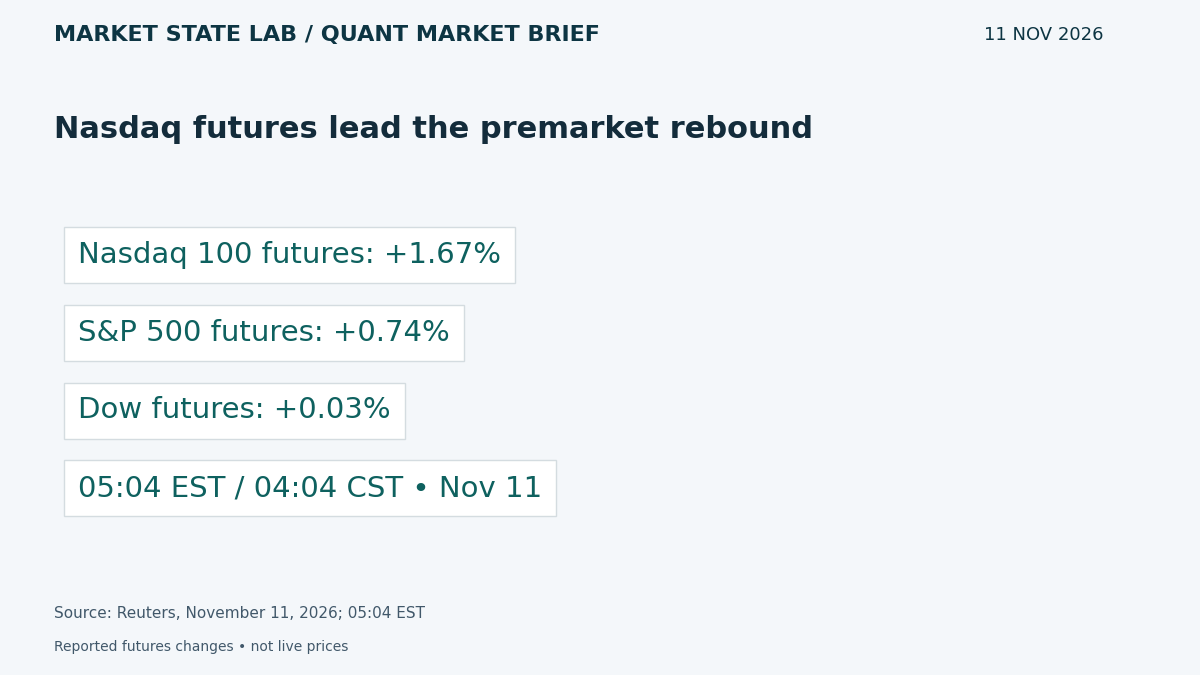
Graphic: Market State Lab; Reuters, November 11, 2026; 05:04 EST.
Fact — Reuters November 11, 2026; 05:04 EST snapshot: At 5:04 a.m. EST, Reuters reported Nasdaq 100 futures up 1.67%, S&P 500 futures up 0.74%, and Dow futures up 0.03%. Direct source
Inference / Why it matters: Monitor QQQ versus SPY and distinguish a concentrated technology bounce from broad participation.
Uncertainty: Earlier reported snapshot, not live executable quotes; price gains do not establish healthy depth.
4. October CPI rises 0.4%; annual comparisons are incomplete
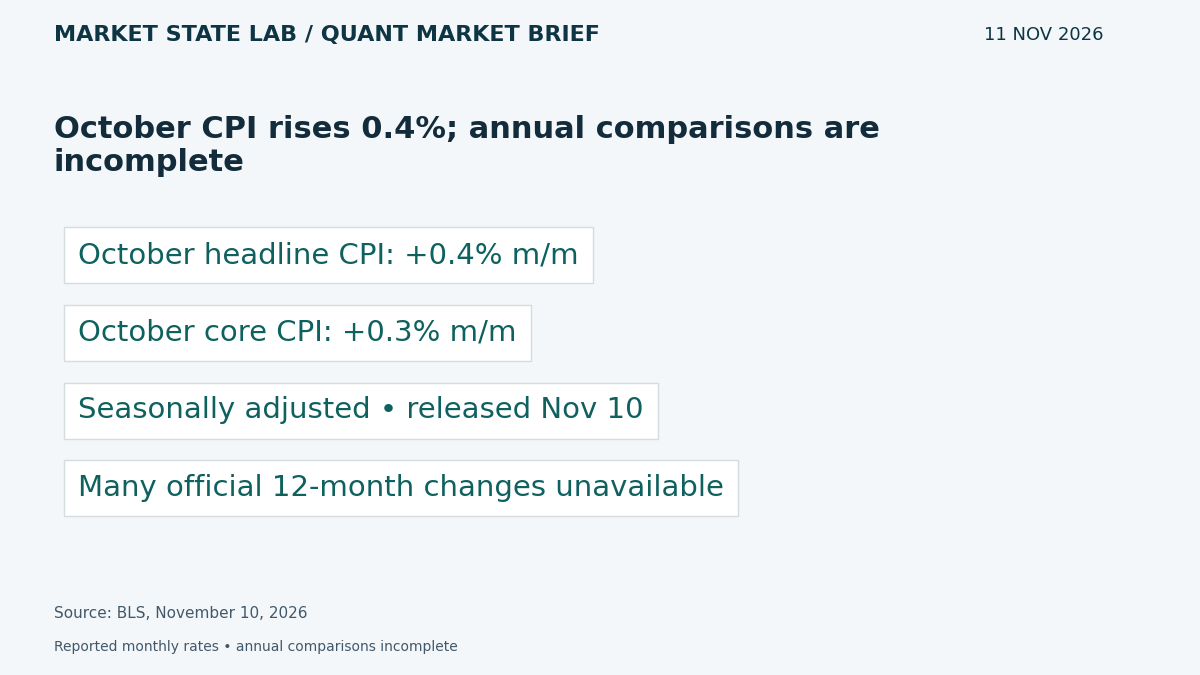
Graphic: Market State Lab; BLS, November 10, 2026.
Fact — BLS release November 10, 2026: BLS reported October CPI up 0.4% month over month, seasonally adjusted, and core CPI up 0.3%. Missing October 2025 survey data prevent publication of many official October 2026 twelve-month changes. Direct source
Inference / Why it matters: Use official monthly readings and data-availability flags; do not silently replace missing annual inflation with an estimate.
Uncertainty: Missing year-ago observations limit comparisons. CPI is not the Fed’s preferred PCE inflation measure.
5. CoreWeave revenue expands while financing costs weigh
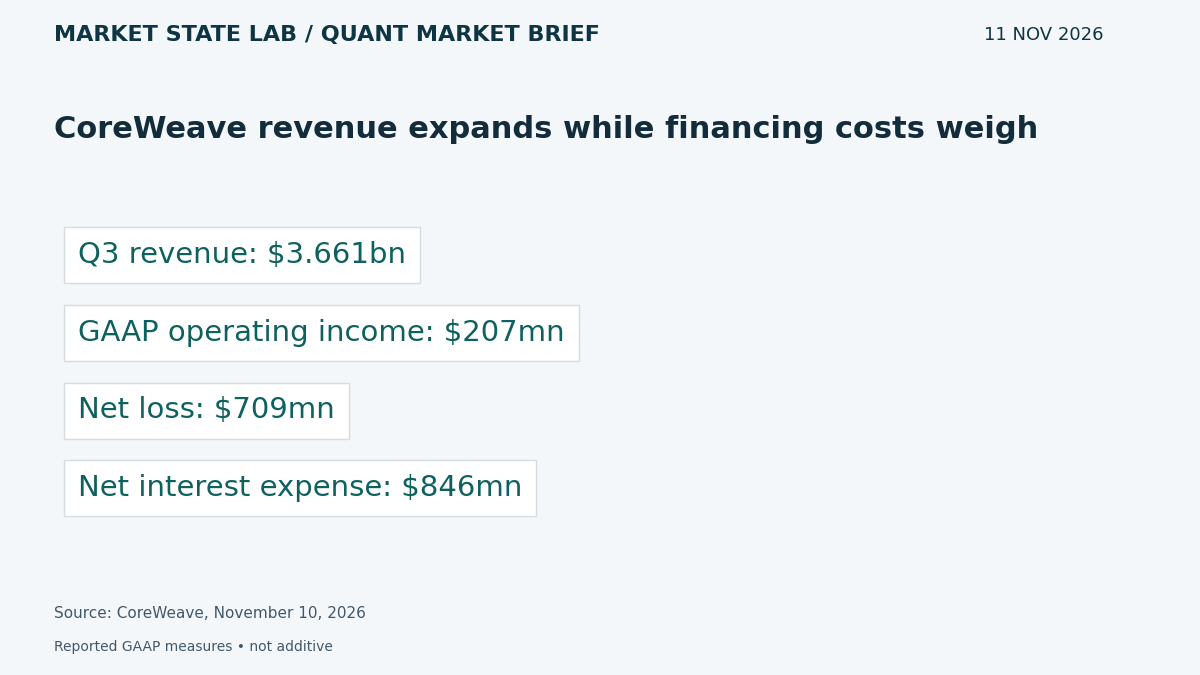
Graphic: Market State Lab; CoreWeave, November 10, 2026.
Fact — Company results November 10, 2026: CoreWeave reported Q3 revenue of $3.661 billion, GAAP operating income of $207 million and net loss of $709 million. Net interest expense was $846 million. Direct source
Inference / Why it matters: Evaluate demand growth alongside financing burden and cash requirements; operating income alone does not establish bottom-line profitability.
Uncertainty: Adjusted metrics differ from GAAP; backlog and forward guidance depend on future delivery and are not cash in hand.
Quant & Market Dashboard
Liquidity and volatility
- Overnight: The futures snapshot indicates technology-led gains, not order-book health. Current ES/NQ spreads, depth, overnight volume, ETF NBBO and Treasury depth are unverified. Refresh the execution feed; no reliable current liquidity rating is assigned.
- Holiday conditions: SIFMA recommends a full fixed-income market close today for Veterans Day; firm decisions can differ. NYSE’s calendar does not list today as an equity holiday. Infer greater cross-asset execution caution, not a measured deterioration in depth. SIFMA · NYSE.
- Funding: Latest verified SOFR is 3.88% for November 9, updated November 10 at 07:02 CST; next FRED update is November 12. This lagged fixing does not diagnose current stress. FRED.
- Regime: Moderate; medium confidence. Delayed VIX was 18.60 at November 11 06:36 EST / 05:36 CST, versus November 10 close 19.46. House bands: below 15 low, 15–25 moderate, 25–35 high, above 35 stressed; descriptive, not calibrated forecasts. Skew, term structure and dealer gamma are unverified. VIX.
Factor proxies
| Factor | ETF | Nov 9→10 | Oct 9→Nov 10 (~1 month) |
|---|---|---|---|
| Momentum | MTUM | -0.21% | -16.59% |
| Value | VLUE | -0.14% | -6.33% |
| Quality | QUAL | -0.34% | -1.64% |
| Size | IWM | -0.68% | +0.59% |
| Growth | IWF | -0.86% | -10.86% |
| Low volatility | SPLV | +0.33% | +8.25% |
Source-linked split-adjusted Close-column price returns, excluding distributions, through November 10 at 16:00 EST / 15:00 CST. October 9 baselines are archived from the prior edition; latest closes were rechecked today. These are imperfect ETF proxies, not isolated factor premia. Corporate actions were not independently validated. Low volatility rose Tuesday while the other five fell; momentum and growth remain negative over the longer window.
Execution and microstructure
- Cash opening auction: 08:30 CST / 14:30 UTC today. Yesterday’s CPI has been released; do not retain a pre-release event flag. Recheck exchange and product-specific holiday trading and settlement calendars.
- SPY/QQQ: inspect quote age, NBBO spreads, depth, auction imbalances and ES/NQ basis. Use bounded limits and participation caps; stress slippage, gaps, cancellations, missed fills and latency. A technology-led rebound on thin depth can trap marketable orders.
- Options: verify same-day expiry availability, deliverables and settlement. Reject stale, crossed or one-sided quotes. Near-expiry gamma can amplify hedging; dealer-gamma sign, expiry concentrations, pinning and flow magnitude remain unknown. Holiday-thinned underlying hedges are a scenario to test, not an observed fact.
Research watchlist: SPY, QQQ, IWM, RSP, TLT; ES, NQ, ZN, VX; MTUM, VLUE, QUAL, IWF, SPLV; CRWV, NVDA, GOOGL.
DRL Improvements for the MATLAB System
- Enforce drawdown, exposure, participation and stale-data limits outside the policy, with an explicit safe fallback.
- Penalize spread, impact, turnover, latency and missed fills; stress permanent as well as transient impact and evaluate tail losses separately.
- Use purged walk-forward evaluation with training-only preprocessing and a one-use final holdout; separate holiday, event and ordinary sessions.
- Randomize depth and observation delays across regimes; test abstention when liquidity estimates or impact models are unreliable.
Model hygiene
Audit leakage, survivorship bias, look-ahead, corporate actions, stale options quotes, multiple testing, calibration and drift. Preserve point-in-time universes, release vintages, missing-data flags and availability timestamps. Fit preprocessing inside training folds. An estimated impact-decay kernel is not itself causal identification.
MATLAB optimization patterns
- Use named-zone timetables with exchange-specific calendars and causal synchronization.
- Vectorize rolling features, preallocate logs and profile bottlenecks.
- Parallelize independent folds or Bayesian trials with reproducible random streams and fixed budgets.
- Use GPUs for sufficiently large batches; keep impact models, risk limits and evaluation modular.
High-value quant research question
Does an execution policy retain its net advantage when a fitted transient-impact model is replaced by a permanent-impact null at matched volatility and order-flow persistence?
Use matched seeds, risk budgets and fill assumptions in walk-forward tests. This tests whether apparent policy skill depends on an unidentified liquidity-recovery mechanism.
Please forward this edition to one colleague who would find it useful.
Research and education only—not individualized financial advice. No trading performance is promised.