Quant Market Brief — November 1, 2026: Queue-Aware Execution & Event Risk
Research cutoff: November 1, 2026, 6:31 a.m. CST (12:31 UTC). Weekend edition: market prices are October 30 prior-close; VIX is delayed at Friday’s close; funding fixings are lagged. No live depth or options-positioning feed verified.
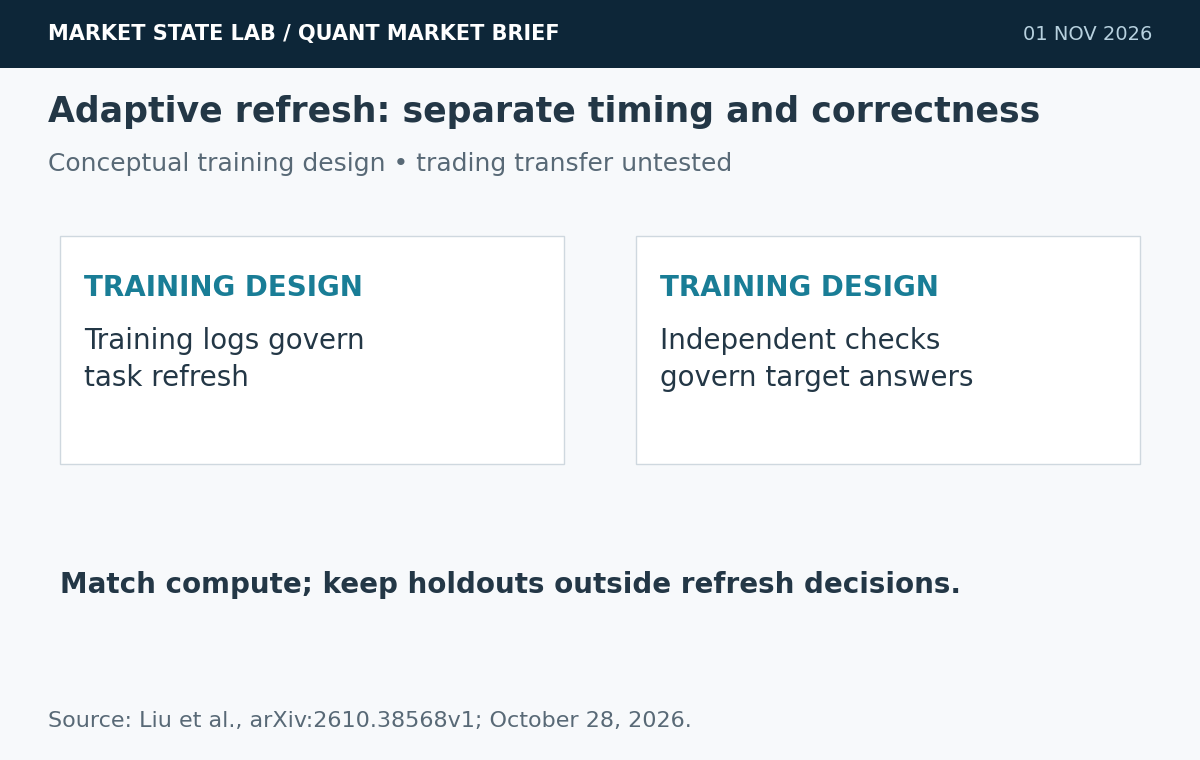
1. A-RSI refreshes training tasks without consulting test scores
Graphic: Market State Lab; Liu et al., arXiv:2610.38568v1; October 28, 2026. Conceptual or quantitative as labeled.
Date: Preprint submitted October 28, 2026.
Fact: A-RSI uses reward variation and training accuracy to refresh a task pool when its learning signal declines. Reference answers come from a static library of model-authored programs and are separately audited; refresh decisions do not consult validation or test scores. Direct source
Inference: Refresh timing and target correctness should be evaluated as separate mechanisms.
Uncertainty: Multimodal benchmark improvements do not establish trading-policy benefits or guarantee correct synthetic labels.
Why it matters: Compare adaptive and fixed refresh schedules at matched compute, with independently checked rewards and untouched holdouts.
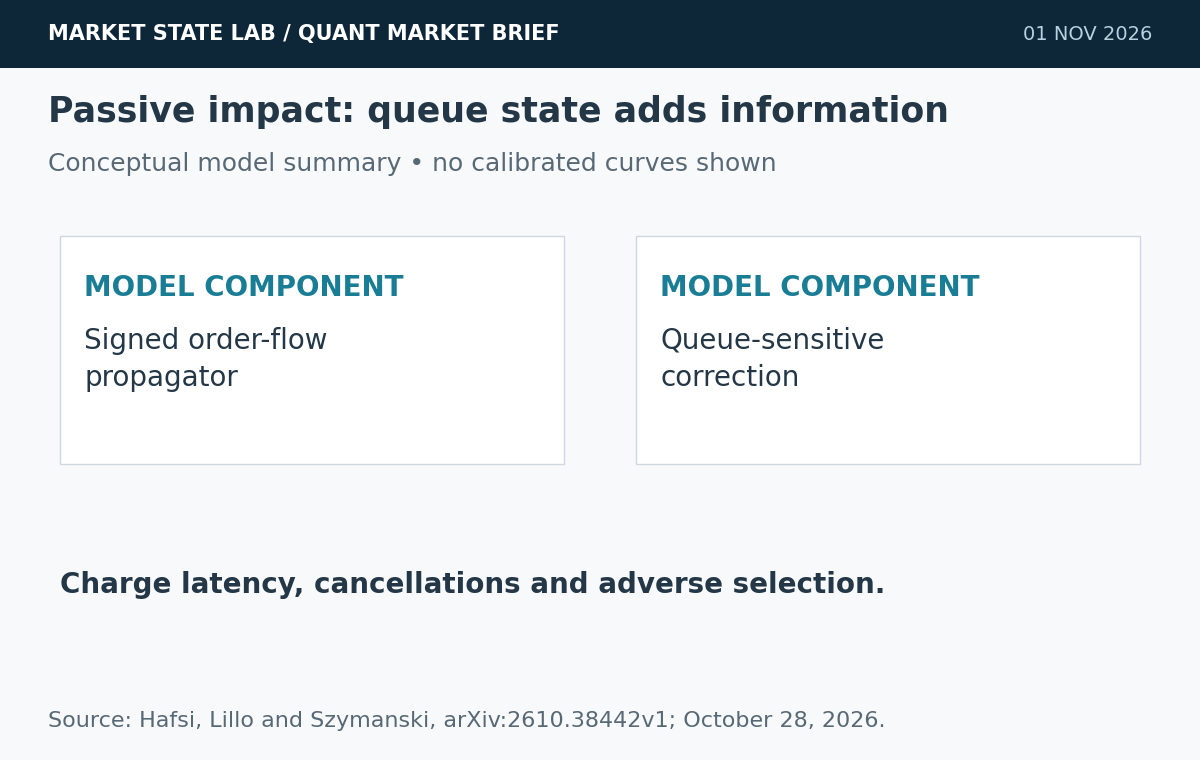
2. Passive-order impact depends on queue state
Graphic: Market State Lab; Hafsi, Lillo and Szymanski, arXiv:2610.38442v1; October 28, 2026. Conceptual or quantitative as labeled.
Date: Preprint submitted October 28, 2026.
Fact: A queue-sensitive propagator model separates signed order-flow impact from a state-dependent correction linked to volume at the best quotes. Calibration on high-frequency order-book data improves model fit and predicted passive-impact curves. Direct source
Inference: Limit-order execution models need queue-state information as well as signed flow.
Uncertainty: In-sample fit and calibrated impact accuracy are not evidence of profitable live execution or transfer to every venue.
Why it matters: Test queue-aware fill and impact models against flow-only baselines after latency, cancellations and adverse selection.
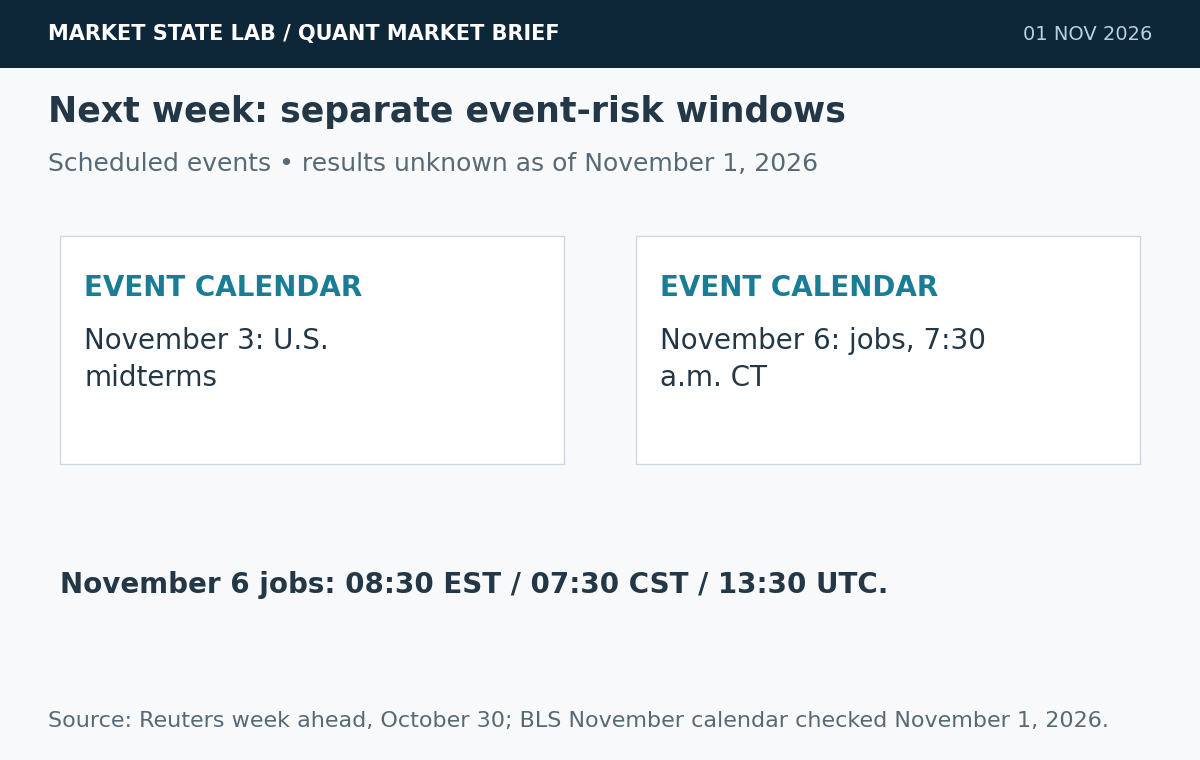
3. Election and jobs week adds distinct repricing windows
Graphic: Market State Lab; Reuters week ahead, October 30; BLS November calendar checked November 1, 2026. Conceptual or quantitative as labeled.
Date: Reuters week-ahead report October 30; events November 3 and 6.
Fact: Reuters highlights the coming U.S. midterms, major earnings and October employment report as tests for an AI-wary market. Election Day is November 3; BLS schedules the jobs report for November 6 at 8:30 a.m. ET / 7:30 a.m. CT. Direct source
Inference: Election-result uncertainty and scheduled economic releases require separate gap-risk scenarios.
Uncertainty: Election outcomes, earnings reactions and payroll results are unknown; a busy calendar supplies no directional trading signal.
Why it matters: Map event exposure by session and contract expiry; refresh quotes and liquidity after each repricing window.
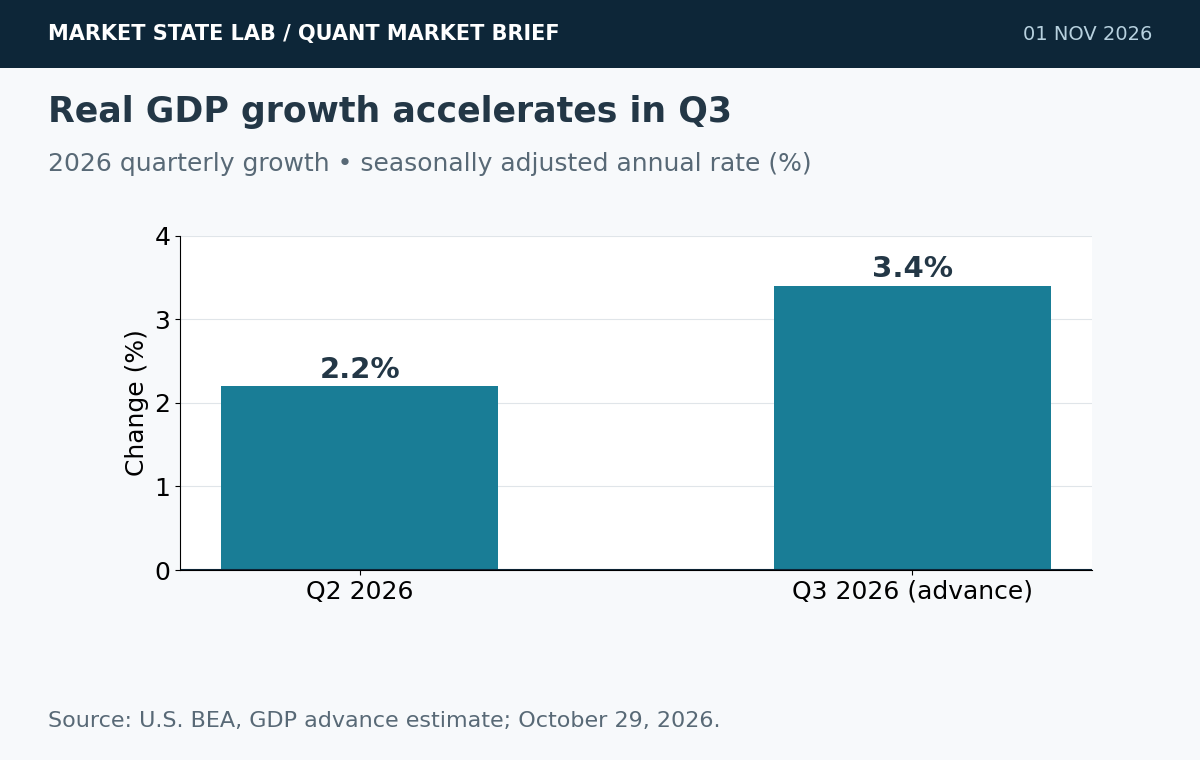
4. Third-quarter GDP accelerates to a 3.4% annualized pace
Graphic: Market State Lab; U.S. BEA, GDP advance estimate; October 29, 2026. Conceptual or quantitative as labeled.
Date: BEA advance estimate October 29; third quarter 2026.
Fact: Real GDP grew at a 3.4% seasonally adjusted annual rate in the third quarter, versus 2.2% in the second. Real final sales to private domestic purchasers increased 4.9% at an annual rate. Direct source
Inference: Headline growth and private domestic demand provide different measures of economic momentum.
Uncertainty: This is an advance estimate subject to revision. Annualized quarterly growth is not year-over-year growth and does not precommit Fed policy.
Why it matters: Preserve the release vintage and separate inventories, underlying demand and inflation in macro features.
5. Google reports its first orbital TPU-generated response
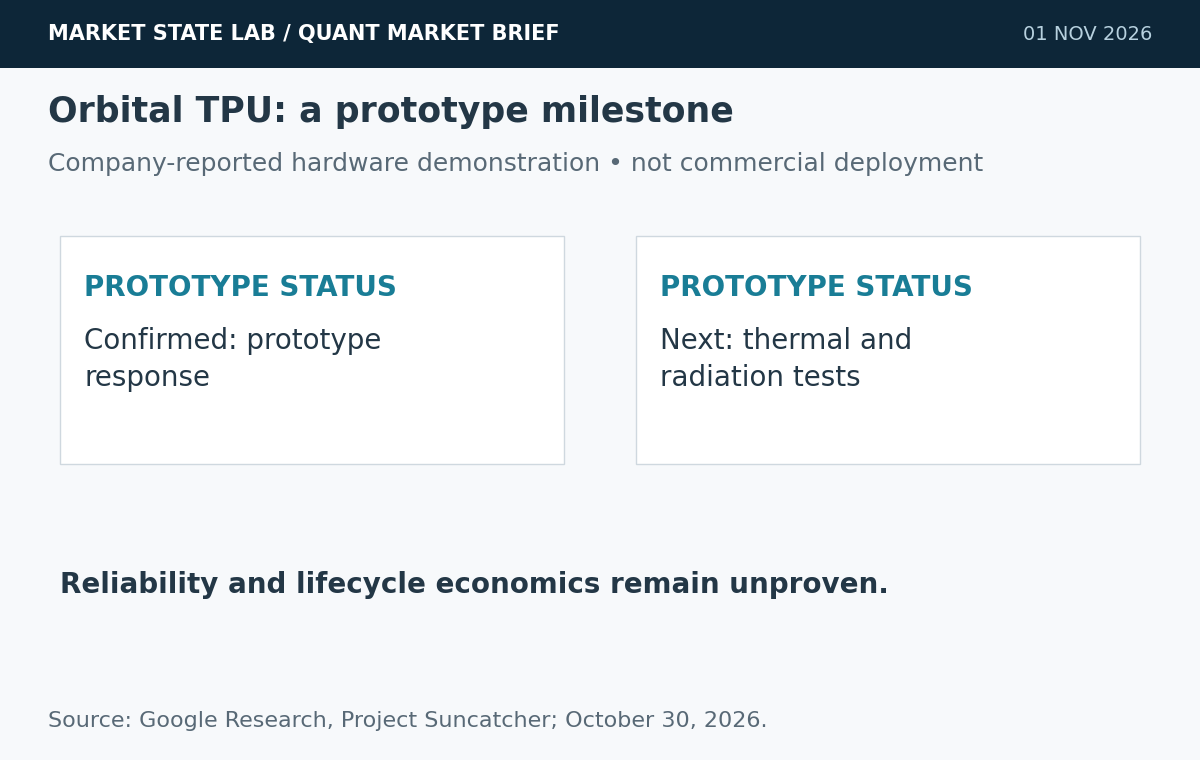
Graphic: Market State Lab; Google Research, Project Suncatcher; October 30, 2026. Conceptual or quantitative as labeled.
Date: Google announcement October 30, 2026.
Fact: Google says its Project Suncatcher prototype produced a response from an onboard Gemma 4 model running on a data-center-class TPU. Thermal-stress and radiation tests are next; twin interconnected satellites are a planned 2027 milestone. Direct source
Inference: The demonstration advances hardware feasibility, while deployment economics remain a separate question.
Uncertainty: A company-reported prototype milestone does not establish commercial reliability, cost advantage or a production orbital data center.
Why it matters: Evaluate power, cooling, communications, radiation resilience and total lifecycle cost before extrapolating infrastructure value.
Quant & Market Dashboard
Liquidity, funding and volatility
- Weekend state: U.S. cash equities are closed. No reliable current overnight futures/ETF spreads, depth, volume or funding transactions verified. Friday data are historical context; do not carry their liquidity assumptions into the next open.
- October 30 completed rows: SPY close 755.72, volume 77.70m, high–low range 11.10 points; QQQ close 690.49, volume 85.24m, range 15.18 points. Quote banners differ from daily rows; all calculations use completed rows. Volume is an activity proxy, not depth or slippage. SPY · QQQ.
- Funding: Latest verified October 29 SOFR 3.94%, EFFR 3.88%, both unchanged. The six-basis-point gap is lagged aggregate context; current executable Treasury spreads/depth unavailable. SOFR · EFFR.
- Volatility: Moderate, near the high boundary; medium confidence. Delayed VIX at 4:00 p.m. ET / 3:00 p.m. CT October 30: 19.42, up 12.907% from 17.20. The sub-20 level supports moderate classification, but the sharp equity decline and weekend gap risk require stricter execution controls. No live weekend reading, term structure, skew or dealer-gamma estimate verified. VIX.
Factor performance proxies
| Factor | ETF | October 30 daily | September 23→October 30 |
|---|---|---|---|
| Momentum | MTUM | -4.77% | -10.36% |
| Value | VLUE | -1.70% | -3.34% |
| Quality | QUAL | -0.99% | +0.16% |
| Size | IWM | -1.65% | -0.92% |
| Growth | IWF | -2.89% | -6.20% |
| Low volatility | SPLV | +0.33% | +7.32% |
Unadjusted close-to-close price returns exclude distributions; these ETF exposures are not isolated factor premia. Fresh October 30 endpoints; September 23 anchors preserved from the dated archive. No future corporate actions applied. Low volatility was the only positive daily proxy; momentum had the largest daily decline.
Execution and microstructure
- Before the next 8:30 a.m. CT cash open, refresh SPY/QQQ NBBO, quote age, displayed depth, ES/NQ basis and opening-auction imbalances. U.S. daylight saving time ended today: Central is now CST (UTC−6), Eastern EST (UTC−5). Use named time zones; the Monday cash open is 14:30 UTC.
- Use bounded limits and capped participation. Stress weekend gaps, spread widening, slippage, queue uncertainty, cancellations and missed fills; stale indicative prices are liquidity traps.
- Review Friday-expired options and exercise/assignment outcomes; check each remaining contract’s expiry, settlement and deliverable. Reject stale, crossed or one-sided quotes. Short-dated gamma and volatility repricing matter; dealer-gamma sign and pinning are unknown.
- Watch November 3 election-result risk and the November 6 jobs release at 7:30 a.m. CST (13:30 UTC). Treat each as a separate liquidity reset. BLS calendar. Outcomes remain unknown.
Research watchlist: SPY, QQQ, IWM, RSP, TLT; ES, NQ, ZN, VX; MTUM, VLUE, QUAL, IWF, SPLV; SOXX, GOOGL, AMD, AAPL.
DRL Improvements for the MATLAB System
- Enforce drawdown, exposure, participation and liquidity limits outside the learned policy, with a safe fallback for stale inputs.
- Charge spread, impact, turnover, latency and missed fills in rewards; report tail loss and coverage separately.
- Separate task-refresh timing from target validation; keep untouched holdouts outside the refresh loop and condition execution costs on queue state.
- Use purged, embargoed walk-forward folds, paired seeds and unseen regimes; stress weekend gaps and variable execution costs.
Model hygiene
Preserve availability timestamps and point-in-time universes. Check leakage, survivorship and look-ahead bias, causal corporate actions, stale options, multiple testing, calibration and drift. Archive economic vintages and retrieval versions; synthetic data must not contaminate the final holdout.
MATLAB optimization patterns
- Use named-zone timetables and causal synchronize/retime alignment; test daylight-saving boundaries.
- Vectorize features, preallocate logs and profile before parallelizing.
- Parallelize independent folds or Bayesian trials with reproducible random streams and immutable holdouts.
- Use GPUs only for suitable large batches; keep environment, risk and execution modules modular.
High-value quant research question
Does adding queue state improve out-of-sample passive-execution shortfall after latency and adverse selection?
Compare queue-aware and flow-only baselines with identical order intent, participation caps and cancellation rules. This separates useful state information from optimistic fill assumptions.
Please forward this edition to one colleague who would find it useful.
Research and education only—not individualized financial advice. No trading performance is promised.